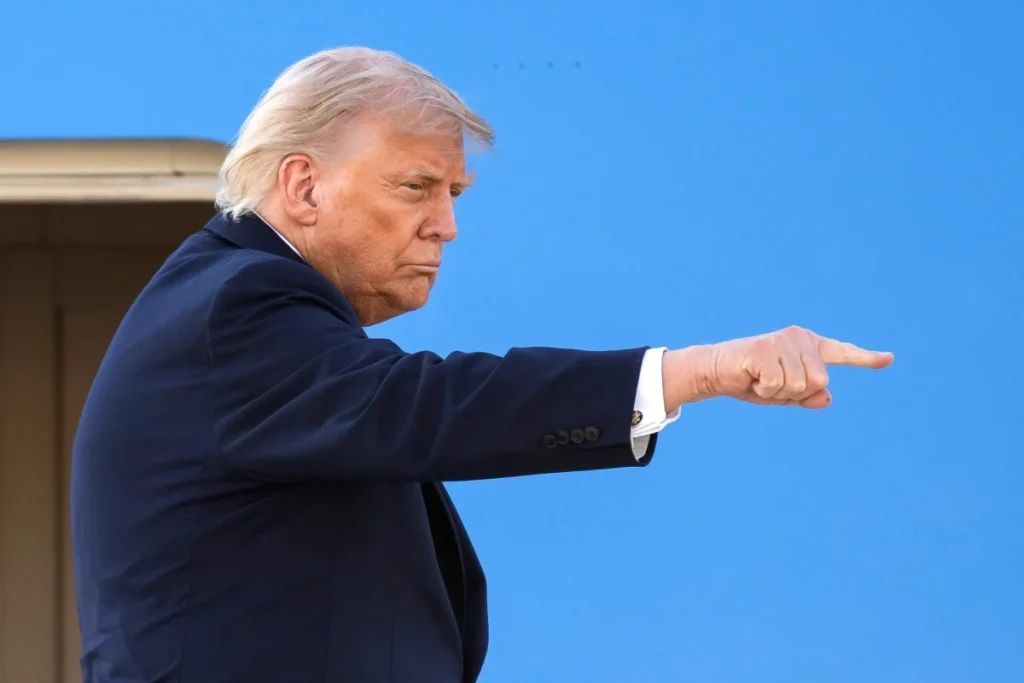
United States President, Donald Trump, announced early Saturday that American forces had launched what he described as “major combat operations” against Iran, accusing Tehran of refusing repeated U.S. demands to halt its nuclear weapons program.
According to Trump, Iranian leaders rejected diplomatic efforts and instead “attempted to rebuild their nuclear program and continue developing long range missiles that can now threaten our very good friends and allies in Europe, our troops stationed overseas and could soon reach our American homeland.”
In an eight-minute video posted to his Truth Social account, the president characterized the strikes as part of a “massive and ongoing operation” targeting the government in Tehran.
However, he did not specify the full scale of the military action.
Shortly after the announcement, Israeli Prime Minister Benjamin Netanyahu released his own video statement confirming Israel’s involvement in what he called a coordinated effort “to remove the existential threat posed by the terrorist regime in Iran.”
“This murderous terrorist regime must not be allowed to arm itself with nuclear weapons that would enable it to threaten all of humanity,” Netanyahu said.
As tensions escalated, the Israeli military reported on X that it had “identified missiles launched from Iran toward Israel,” adding that its defense systems were working to intercept them.
In his address, Trump vowed sweeping military action against Iran’s strategic assets.
“We are going to destroy their missiles and raze their missile industry to the ground,” he declared. “We are going to annihilate their navy, we are going to ensure that the region’s terrorist proxies can no longer destabilize the region and the world.”
The president also issued a direct message to Iranian citizens, urging them to remain indoors during the bombardment and prepare for political change afterward.
“To the great, proud people of Iran, I say tonight: The hour of your freedom is at hand,” Trump said. “Stay sheltered. Don’t leave your home. It’s very dangerous outside. Bombs will be dropping everywhere. When we are finished, take over your government. It will be yours to take. This will probably be your only chance for generations.”
Addressing Iran’s leadership, he warned them to “lay down your weapons and have complete immunity, or, in the alternative, face certain death”, a phrase he repeated for emphasis.
Trump acknowledged the dangers involved, cautioning that U.S. troops could face casualties. “The lives of courageous American heroes may be lost and we may have casualties,” he said.
“That often happens in war, but we’re doing this for the future.” He confirmed that missile installations and naval assets were among the primary targets, though casualty figures were not immediately available.
The military escalation follows months of rising tensions. The president had significantly increased American troop presence in the region, marking the largest buildup since the 2003 invasion of Iraq. Just a day earlier, he told reporters he was “not thrilled” with the status of negotiations.
“We sought repeatedly to make a deal,” Trump said in Saturday’s video message. “We tried. They wanted to do it. They didn’t want to do it… they didn’t know what was happening. They just wanted to practice evil.”
Reaction in Washington was swift and divided. Representative Thomas Massie, a Republican critic of foreign military interventions, condemned the move, writing on social media: “Acts of war unauthorized by Congress.”
Democratic Senator Ruben Gallego also voiced concern, posting on X: “We can support the democracy movement and the Iranian people without sending our troops to die.”
The latest strikes come less than a year after Trump authorized air operations targeting major Iranian nuclear facilities, including the Fordow, Natanz and Isfahan enrichment sites, under a broader military campaign previously referred to as Operation Midnight Hammer.
At the time, the administration described the operation as a decisive success, claiming the sites had been “obliterated.”
With the prospect of retaliation, regional instability, or a prolonged conflict looming, the new offensive introduces significant uncertainty, both for the Middle East and for U.S. forces deployed abroad.