Workers in Nevada, United States, are facing competing opportunities and threats from artificial intelligence as a surge in data centre construction creates jobs while automation increasingly puts employment in the hospitality and transportation sectors at risk.
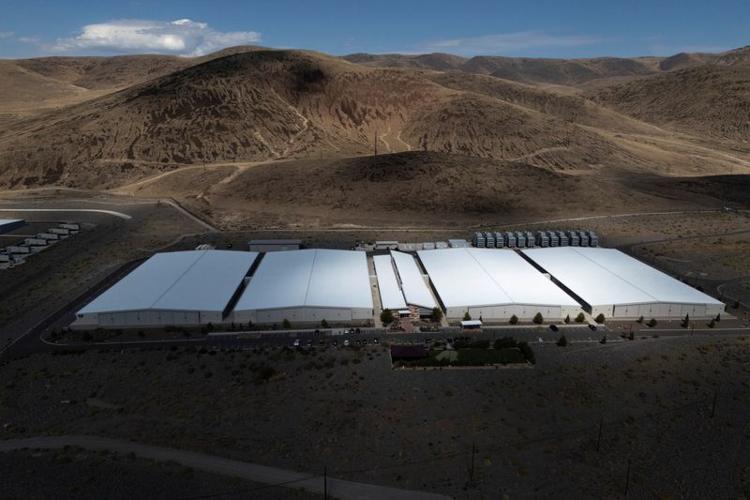
In the desert east of Reno, thousands of electricians, pipefitters and other skilled workers are benefiting from the construction of major data centres.
However, about 400 miles southeast in Las Vegas, self-driving vehicles, robotic bartenders and AI-powered customer service systems are raising concerns about the future of traditional jobs.
The development has divided the Nevada Teamsters, a powerful labour network representing 30,000 workers across the construction, transportation and hospitality industries.
With voters heading to the polls on November 3, the union is working to reconcile the interests of members benefiting from data centre projects with those worried about automation replacing their jobs.
“My job is to represent all of our unions,” said Ross Kinson, the Nevada Teamsters’ political director, explaining that the organisation began working towards a unified position on the issue in April.
“This is a very, very important issue to the building trades, and it’s providing a lot of jobs and creating good opportunities for a lot of people.” But, he said, he has been encouraging members to consider the flip side: “What is it doing to our jobs?”
The disagreement reflects a wider debate across the United States over whether governments should restrict AI development to protect employment or allow the technology to expand in anticipation of economic growth and new job opportunities.
The union interviewed more than 180 political candidates from both major parties ahead of the November election.
According to Kinson, candidates who failed to support strong worker protections or advocated an outright ban on new data centre construction were unlikely to secure the union’s endorsement.
“It’s a political minefield for politicians to tiptoe through,” Kinson said.
The issue could also influence Nevada’s role in the 2028 presidential election, when the state is scheduled to hold the second Democratic primary contest after South Carolina.
AI raises fears over Las Vegas hospitality jobs
Larry Goldfinger, 63, who has worked as a valet at some of Las Vegas’s best-known casinos for nearly three decades, is among those concerned about the impact of automation.
Together with fellow Teamsters members, Goldfinger has been visiting residents to campaign for candidates he believes will protect workers from AI-related job losses.
Having spent another decade in hospitality jobs in Las Vegas, he fears that opportunities for younger workers could diminish as hotels and casinos increasingly adopt automated services.
“I raised my family, and I have had a good life doing it, and I feel like these guys that are 30ish aren’t going to be able to do that,” he said, wearing a Teamsters baseball cap against the desert sun.
An analysis by RCG Economics estimates that AI and automation could put as many as 92,000 hospitality jobs in Southern Nevada at risk by 2035, representing roughly one-third of the sector’s workforce.
The changes are already affecting casino operations, with workers represented by Teamsters Local 986 losing call-centre positions to automation.
Meanwhile, autonomous vehicles operated by Waymo and Zoox are competing with human-driven taxis, while robotic bartenders and touchscreen hotel check-in systems are becoming increasingly common.
MGM Resorts laid off about 200 call-centre employees last year, Kinson said. On a recent investor call, MGM International Chief Financial Officer Jonathan Halkyard disclosed that approximately 80 per cent of guest interactions “now take place via AI/digital platforms.”
MGM declined to comment on the report but referred Reuters to a 2023 labour agreement with culinary union members.
The agreement provides for advance notice of AI-related job losses, as well as healthcare and severance benefits for affected employees.
John Restrepo, principal of RCG Economics, said Las Vegas had experienced numerous economic booms, downturns and technological changes, but the way it handles AI could have far-reaching consequences.
“If they use those tools to just do massive job displacement, that’s not going to be good,” he said.
Goldfinger also warned that excessive automation could undermine the hospitality experience that attracts tourists to the city, particularly those who value personal interactions with trained hotel and casino staff.
“We are not against the changes,” he said. “We just want to make sure we are involved in how it’s changing.”
Data centres offer new opportunities
While hospitality workers worry about losing their jobs, data centre construction is providing new opportunities for workers in northern Nevada.
Christopher Williams, 20, moved from northern California to Reno last year after struggling to secure enough working hours as a line cook earning $18.50 an hour.
He now earns more than $22 an hour and works between 45 and 60 hours weekly at a data centre development in the Tahoe Reno Industrial Center, where companies including Google, Switch and Tract are expanding their operations.
“I might not fully agree with data centers being built everywhere, but they are helping a lot of people,” he said.
“If I don’t take the job, somebody else will, and it’s a lot of money left on the table.”
The area, historically associated with Nevada’s 19th-century gold rush, has become a major destination for data centre investment and construction.
Storey County Commissioner Clay Mitchell said the projects were helping the local economy recover from a prolonged downturn and reduce its dependence on gaming and tourism.
“We’re finding that our economy is more stable than it used to be as a primarily gaming and tourism economy, and it’s providing opportunities, especially for young people that want to stay,” he said.
According to the International Brotherhood of Electrical Workers, the Tahoe Reno Industrial Center generated 850,000 work hours monthly in 2026, compared with approximately the same number across the whole of 2022.
The figures highlight the scale of the construction boom and the economic benefits it is bringing to skilled tradespeople and local communities.
Candidates seek balance on AI regulation
The Nevada Teamsters’ deliberations have resulted in an endorsement of Democratic Attorney General Aaron Ford for governor, Kinson said.
Ford is challenging Republican incumbent Governor Joe Lombardo and has proposed ending new tax abatements for data centres while requiring developers to protect residents from rising energy costs.
He has also advocated strong regulations to safeguard jobs from AI-related disruption.
Kinson said the proposals offered a compromise that could appeal to different groups within the union.
Ford consulted the Teamsters before unveiling his data centre policy platform during the summer and held his first town hall on the issue at Teamsters Local 14.
Lombardo, meanwhile, has promoted data centres as a major source of economic growth, describing the industry as a “new gold rush”.
However, Kinson said the governor had been slower to embrace measures to regulate the sector.
In September, Lombardo introduced new restrictions on some of the generous tax incentives that had attracted data centre developers to Nevada. He did not respond to requests for comment.
The debate is not limited to Nevada. In Kansas, Republican gubernatorial candidate Ty Masterson secured endorsements from the state’s largest transit and railroad union and a local chapter of the electrical workers’ union after Democratic rival Cindy Holscher called for a halt to data centre development.
The endorsement marked the first time in more than 50 years that the Kansas transit union had backed a Republican candidate for governor.
Sean McGarvey, president of North America’s Building Trades Unions, said the expansion of AI and data centres had created divisions within the wider labour movement, similar to those in Nevada.
However, he rejected calls to stop new data centre projects altogether.
“We don’t throw the baby out with the bathwater,” he said.
“This is one of those once-in-a-lifetime opportunities to reindustrialize the country.”
Union influence could prove significant in Nevada, where labour organisations represent a larger share of the workforce than in the United States overall.
In 2025, union members accounted for approximately 13 per cent of the state’s wage and salary workers, compared with 10 per cent nationally, according to the Bureau of Labour Statistics.
As Nevada approaches its November election, the challenge for politicians and unions will be finding a balance between the economic benefits of AI investment and the need to protect workers whose livelihoods could be threatened by the same technology.