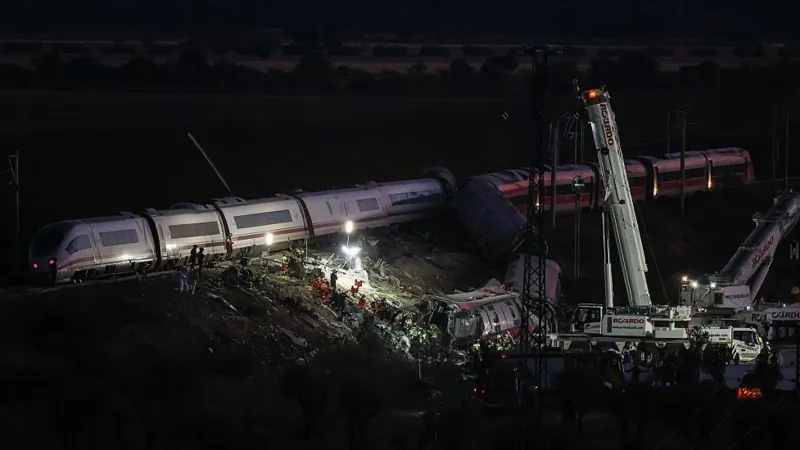
Spain has declared three days of national mourning following a deadly train collision that killed at least 68 people and injured dozens of others in one of Europe’s worst rail disasters in recent history.
Emergency responders worked through the night under powerful floodlights on Wednesday, cutting through damaged train carriages to search for victims.
Authorities are still working to identify many of the dead as investigations into the cause of the crash continue.
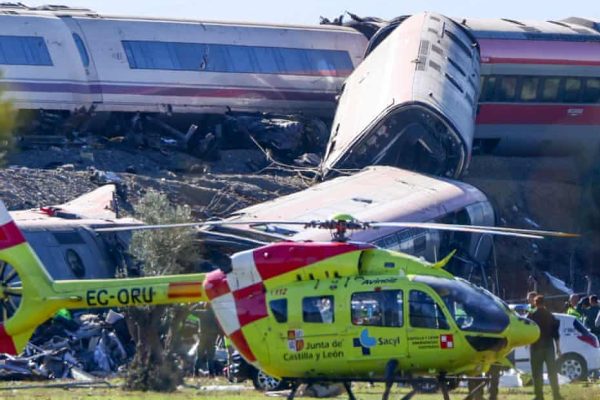
The accident occurred on Wednesday morning when a high-speed train travelling from Madrid to Seville crashed into another train that had stopped on the tracks.
The collision sent several carriages down an embankment, leaving passengers trapped in the wreckage.
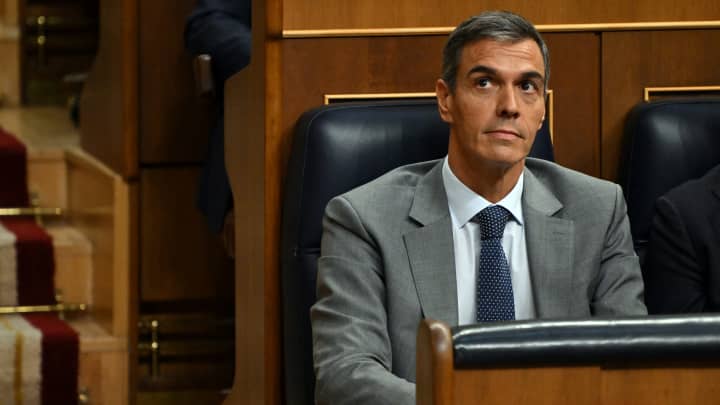
Spanish Prime Minister Pedro Sánchez expressed condolences to the victims and their families, saying the “whole of Spain is grieving”.
He added that “lives have been shattered, families have been torn apart, the pain is immense”.
Spain’s Transport Minister, Óscar Puente, said the stationary train, operated by private rail company Iryo, had 147 passengers on board and stopped because of a computer failure.
He explained that a control centre in Madrid, which operates around the clock, assumed responsibility following the system failure but made an “inexplicable” decision to allow the trains to move again without speed restrictions.
Audio recordings between train controllers and drivers reportedly suggest that one high-speed train was cleared to proceed despite another train having stalled ahead.
Iryo said its train was “struck from behind” by a train operated by state-owned railway company Renfe, which was carrying 397 passengers.
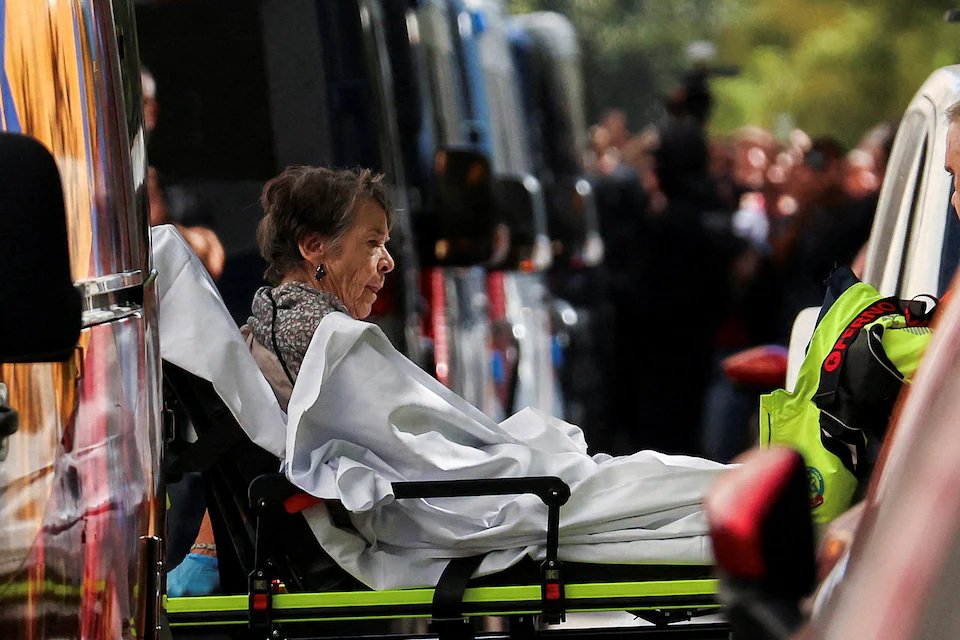
Witnesses described scenes of panic, with passengers crying, bleeding and trapped in their seats as smoke filled the carriages.
One of the carriages reportedly caught fire as emergency workers rushed to rescue survivors and recover bodies.
Hundreds of personnel have been deployed to the site, while drones and helicopters are being used to locate victims and clear debris.
The crash has renewed concerns about railway safety in Spain, which suffered another deadly high-speed train accident near Córdoba in January that killed 46 people.
Sánchez described the recurrence of serious rail disasters within the same year as “unacceptable”.
Wednesday’s collision occurred on the same railway line as the January accident, although much farther south.
Political parties suspended campaigning ahead of upcoming elections following the disaster, with the far-right Vox party being an exception.
Its leader, Santiago Abascal, rejected what he described as attempts to “use mourning to silence criticism” of Spain’s railway infrastructure.
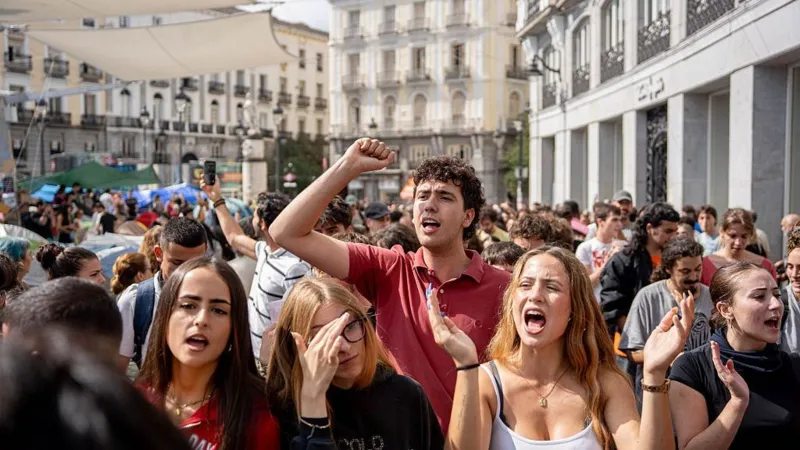
Meanwhile, around 1,500 people gathered outside the Transport Ministry in Madrid on Wednesday night, according to Spanish broadcaster TVE.
Demonstrators reportedly called for the resignations of Sánchez and Puente, while police used tear gas to disperse the crowd after bottles and flares were thrown. No injuries or arrests were reported.
Railway drivers are also expected to proceed with a planned strike on Thursday.
The Spanish Union of Railway Drivers, Semaf, said the action would take place “in defence of railway safety”.
Opposition leader Alberto Núñez Feijóo of the People’s Party also demanded answers, saying, “Spain has the right to know what is happening with its infrastructure.”
As families continued searching for information about missing relatives, Spain’s Civil Guard established offices in Madrid, Toledo, Seville and Córdoba to investigate missing-person reports.
The agency said its immediate priority was identifying the missing and collecting DNA samples to help locate their relatives.
In Toledo, near the crash site, residents observed a minute’s silence during a vigil for the victims.
European Union flags were also flown at half-mast in Brussels as the European Commission expressed solidarity with Spain during the mourning period.
The disaster is Spain’s deadliest train crash since 2013, when 80 people died in a derailment near Santiago de Compostela in the country’s north-west.