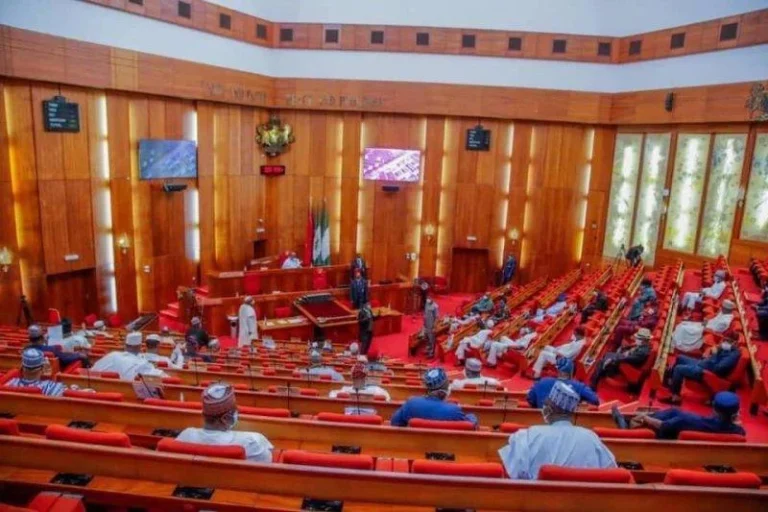
The Senate has denied claims that the Leader of the Senate, Senator Opeyemi Bamidele, and the Chairman of the Senate Committee on Media and Publicity, Senator Yemi Adaramodu, sponsored or introduced the controversial proposal seeking penalties for preaching, hawking and trading inside commercial vehicles.
The clarification comes amid widespread criticism of the Federal Road Safety Corps (Amendment) Bill, 2026, which has generated outrage from religious bodies, civil society groups, opposition parties and many Nigerians over a provision prescribing a N50,000 fine for anyone convicted of preaching, hawking or trading inside commercial vehicles.
Speaking with The Punch, Adaramodu dismissed reports linking him and Bamidele to the proposal, explaining that the amendment bill originated from the House of Representatives and was not sponsored by the Senate Leader.
He also urged Nigerians to distinguish between legislative debates and laws, stressing that discussions on the floor of the National Assembly do not automatically result in legislation.
He said, “No, look, when things are brought into the floor of the Assembly, and it is debated, after debate, it does not translate to law automatically.
“There are times some people often mistake motions for law. Even when motions are brought and then debated, some will just say it has been passed.
“If any proposed legislation comes in as a bill, either as a public or personal bill to any of the two chambers, it goes to the other chamber for another debate, which we call concurrence.
“This is because you don’t just concur without debating. The only thing is that it’s only one arm or one chamber that will do public hearing.
“So if there is any bill that goes to a committee, it will ensure that it’s subjected to public hearing. After that, it will be brought back to the chamber in question, whether it is the green or red chamber.
“Subsequently, it will be sent back to the Committee of the Whole, which will commence another line of debate again.”
Adaramodu explained that after consideration by the Committee of the Whole, a bill may either be adopted or rejected. If adopted, it is transmitted to the other chamber for concurrence, where lawmakers conduct another round of debate before any differences are resolved through a joint conference committee.
According to him, once both chambers approve the same version, the proposed legislation is forwarded to the executive for scrutiny by the Federal Ministry of Justice and other relevant agencies before being presented to the President for assent.
He maintained that only after completing these constitutional and legislative procedures can a bill become law.
The senator cautioned Nigerians against concluding that every issue debated by lawmakers has become law, noting that debates and motions should not be mistaken for enacted legislation.
He said, “So it is until then that we can now say that a law is made or not.
“Therefore, it’s not that whenever a senator or House of Representatives member raises his or her hand in the chamber to discuss something, people will just go to town and say that the Senate or Reps have passed a law.”
Addressing claims circulating on social media, Adaramodu insisted neither he nor Bamidele proposed the contentious provision.
He said, “Even erroneously, some people are saying, because I saw it on social media, that it is the Senate Leader, Senator Opeyemi Bamidele and Senator Yemi Adaramodu who proposed it. How?
“I find that baffling because I did not raise my hand, nor did the Senate Leader. The two of us didn’t propose any motion.
“Notwithstanding, we are in the Senate together and take responsibility for anything that comes up. So what I’m saying basically is that a motion or debate in the House of Representatives or Senate does not translate to a law.
“Even when resolutions are taken during a motion, it is advisory. It is only the bill that can go into law. And before that can be done, it will go through so many tests, platforms and stages before it can become law.”
The Senate had earlier clarified that the disputed provision is not a new proposal targeting religious activities but an existing section of the FRSC Act that has been in force since 2007.
Lawmakers said the amendment bill is part of broader efforts to strengthen road safety enforcement and reduce road crashes, while reiterating that the legislation originated in the House of Representatives.