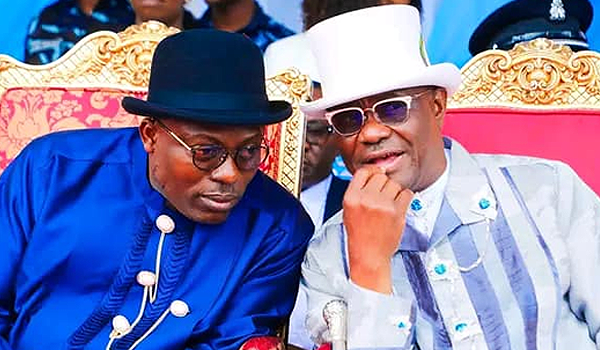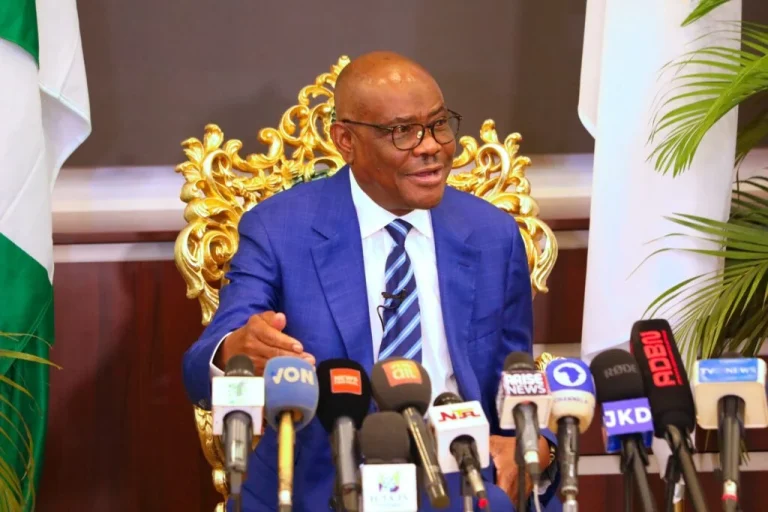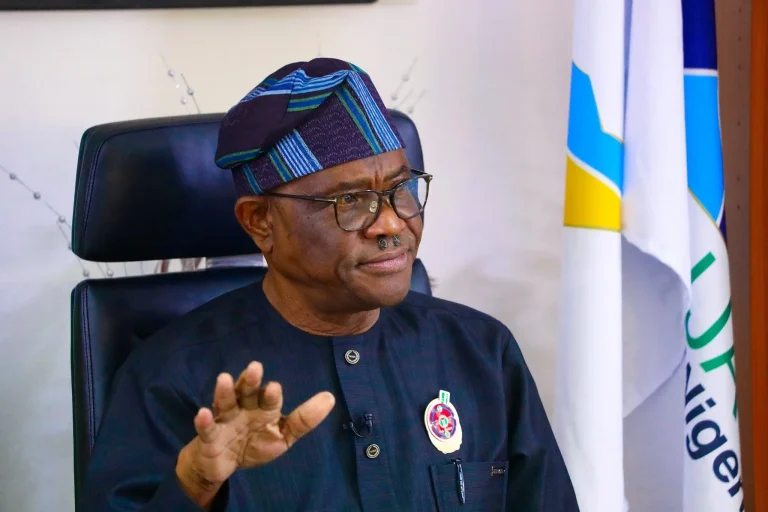
The Minister of the Federal Capital Territory, Nyesom Wike, has said the political crisis in Rivers State denied Governor Siminalayi Fubara the opportunity to pursue a second term, attributing the development to what he described as poor political advice and the influence of external interests.
Wike made the remarks during the August edition of his monthly media chat aired on Channels Television on Tuesday, where he reflected on his relationship with his former political ally.
According to the former Rivers State governor, he repeatedly cautioned Fubara against abandoning the political structure that facilitated his emergence as governor.
“I told him not to derail. When I became governor, I also faced challenges, but I stayed focused despite the difficulties,” Wike said.
He recalled inheriting an administration with limited resources, noting that he had to borrow ceremonial vehicles at the time before rebuilding government infrastructure during his tenure.
“When I assumed office, there was virtually nothing. I even had to borrow parade vehicles. Before leaving office, I had renovated Government House and provided official vehicles for the governor, deputy governor and the governor’s wife,” he said.
Wike maintained that he expected his successor to consolidate on the foundation already laid rather than dismantle it.
“Someone had already established a foundation. The idea was to continue building so Rivers could compete with states like Lagos. There was nothing wrong with that vision,” he added.
The FCT minister also alleged that individuals who initially opposed Fubara’s emergence later became close associates and encouraged him to confront those who supported his rise to power.
“Those who never wanted him to become governor later became his friends. They misled him into fighting those who worked for his emergence. In the end, I lost nothing, but he lost the opportunity to seek another term,” Wike said.
Responding to a question on whether he still had affection for the Rivers governor, Wike said his support for Fubara’s emergence demonstrated that he still cared about him.
“If I didn’t care about him, why would we have supported him in the first place?” he asked.
He disclosed that efforts were made to reconcile both camps but said political considerations ultimately stalled the process.
“There was a point when everyone agreed to let bygones be bygones, but political interests intervened. Some people believed reconciliation would weaken their political relevance,” he said.
Wike further alleged that some external actors sought to gain influence over Rivers State for financial reasons.
“There are external forces that see Rivers State as a cash cow. We decided that situation had to end because some people were exploiting the system for their own interests,” he said.
He also accused some legal practitioners of giving Fubara advice that worsened the crisis.
“Some people kept telling him the law was on his side. They encouraged him to resist instead of seeking a political solution,” Wike stated.
The disagreement between Wike and Fubara began shortly after the latter assumed office in 2023, following allegations that the governor was attempting to distance himself from the political structure that produced him.
The dispute later escalated into a prolonged political crisis involving the Rivers State House of Assembly, impeachment threats and the declaration of a state of emergency in the state.
Fubara was subsequently reinstated and later joined the All Progressives Congress, citing President Bola Tinubu’s intervention in resolving the crisis.
Although he obtained nomination forms to contest the APC governorship primary, he later withdrew from the race and subsequently endorsed the governorship candidate backed by the Wike-led Rainbow Coalition.