A powerful magnitude-7.5 earthquake struck off Japan’s northeastern coast on Monday, injuring over two dozen people and prompting authorities to issue evacuation orders for more than 100,000 residents.
The quake occurred at 11:15 p.m. local time, roughly 44 miles off the northeast coast, at a depth of approximately 33 miles, according to the United States Geological Survey.
Even in Tokyo, more than 400 miles from the epicenter, a CNN team reported feeling strong tremors that lasted over 30 seconds.
The Japan Meteorological Agency warned that a “large-scale earthquake of magnitude 8 or greater” could strike Japan this week, though the probability remains low at 1%. “While it remains deeply uncertain whether a major earthquake will actually occur, we believe it’s essential to take disaster preparedness measures based on the principle that we must protect our own lives,” the agency said.
Following the earthquake, the JMA issued a tsunami warning for the Pacific coast of Hokkaido, Aomori, and Iwate prefectures. However, the resulting waves were smaller than expected, with a 2.3-foot tsunami recorded at Kuji port in Iwate and 1.3-foot waves in Aomori and Hokkaido. The warning was later downgraded to an advisory, which was lifted by Tuesday morning.
Japan’s Fire and Disaster Management Agency reported that over 114,000 people had been ordered to evacuate.
Prime Minister Sanae Takaichi told reporters Tuesday that at least 30 people were injured, warning that similar or even stronger tremors could follow.
Chief Cabinet Secretary Minoru Kihara said there were multiple reports of injuries and fires in Aomori prefecture. Power outages affected Aomori and Iwate, and high-speed train services were suspended between Fukushima and Aomori, with some expressway sections also closed.
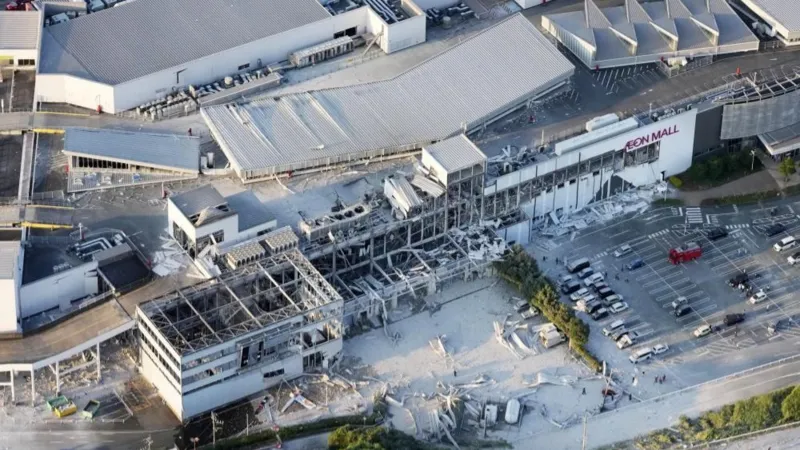
Footage from Reuters showed damaged buildings and a hotel in Mutsu, Aomori prefecture, as well as a car trapped on a compromised highway.
As tsunami waves swept the Pacific, some observers in Asia even noted eerie similarities to a manga prophecy.
Kihara urged residents in affected regions to seek higher ground or move to secure buildings, including evacuation shelters.
There have been no reports of “abnormalities at this time” at the Higashidōri and Onagawa nuclear power plants, Kihara said, adding that “we have received reports that other nuclear facilities are currently being checked.”
Takaichi, elected in October, assured that her government would collaborate closely with local officials to assess damage and implement emergency response measures, emphasizing that the government would act “as one under the principle of putting human life first.”
Japan, situated on the seismically active Ring of Fire, is no stranger to devastating earthquakes.
The country’s most catastrophic recent quake was the 9.1-magnitude Tohoku earthquake in 2011, which triggered a massive tsunami and a nuclear crisis at the Fukushima Daiichi plant.
That disaster claimed over 22,000 lives or left them missing and caused reactor meltdowns, releasing radioactive contamination into surrounding areas.