Japan is grappling with the aftermath of a powerful earthquake that struck Kyushu island, killing at least 13 people, according to Prime Minister Sanae Takaichi.
Takaichi said emergency teams are working urgently to locate survivors believed to be trapped beneath collapsed buildings and debris.
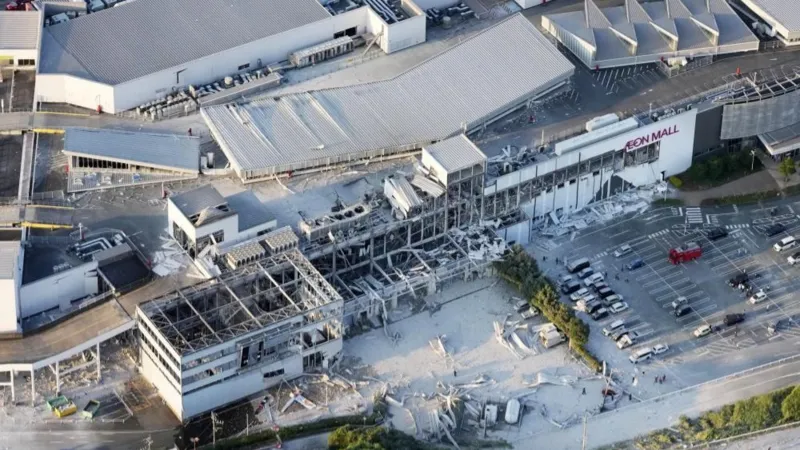
Authorities had earlier reported that 19 people were missing following the collapse of an Aeon shopping mall and damage at a paper factory after the earthquake, which measured 6.8 in magnitude.
The disaster also triggered widespread destruction, including power outages, damaged roads, the collapse of a castle wall and a footbridge, while local officials said 9,872 residents have been evacuated.
As rescue efforts continue, more information is still emerging from Japan.
The earthquake struck Kumamoto Prefecture on Kyushu island at 16:27 local time (07:27 GMT) on Tuesday, prompting authorities to order hundreds of thousands of residents to seek safety at evacuation centres.
Japan’s Meteorological Agency initially measured the earthquake at magnitude 7.1, while the US Geological Survey later revised it to 6.8. Magnitude readings are often adjusted as experts analyse additional seismic data.
Kumamoto, home to the collapsed Aeon Mall, is located on Kyushu, Japan’s third-largest and second-most populous main island.
The region has a history of major seismic activity. In 2016, devastating earthquakes in Kumamoto and neighbouring Oita Prefecture claimed 278 lives, according to Japan’s public broadcaster NHK.
An official from Kumamoto Prefecture’s Disaster Management Division confirmed that three people died at the Aeon Mall after the earthquake.
Rescue workers have pulled at least eight people from the damaged shopping complex, although authorities have yet to determine how many remain trapped.
A witness reported seeing an explosion and smoke at the shopping mall after the quake.
The mall’s operator told AFP that an explosion occurred after staff and customers had evacuated.
The witness also said the building’s second floor collapsed, with several shoppers taken to hospital for treatment.
Elsewhere in Kumamoto Prefecture, police quoted by NHK said a chimney collapsed at Nippon Paper’s Yatsushiro Plant.
An aerial image obtained by Reuters appeared to show the chimney broken and lying in ruins.
The disaster management official told the BBC that two people at the plant had been found in a state of “cardiac arrest” and nine people are still missing.
The earthquake also damaged the historic 17th-century Kumamoto Castle, causing parts of its centuries-old walls to crumble.
The landmark has suffered similar damage before. A magnitude 7.3 earthquake that struck the region in 2016 caused sections of the 400-year-old castle, including its turrets and curved walls, to collapse.
Authorities have not confirmed whether anyone was injured in the collapse of a nearby footbridge or exactly when it gave way. Traffic has continued to move on a parallel bridge.
Local officials said 36,700 households remain without electricity, while several roads have sustained damage.
Japan Railways suspended train services across Kyushu following the quake.
Earlier, NHK reported that seven passengers aboard the Kyushu Shinkansen were injured. It also said some travellers were forced to spend the night on stranded bullet trains after damaged tracks prevented services from continuing.
The Japan Meteorological Agency recorded more than 60 aftershocks ranging between magnitudes 1 and 4.
Although a tsunami warning was issued immediately after the earthquake, authorities lifted it within two hours.