Colombia’s newly inaugurated President Abelardo de la Espriella has vowed to launch an aggressive campaign against armed criminal groups, declaring that his government will no longer pursue dialogue with narco-terrorists.
De la Espriella made the declaration on Friday during his first major address as president, delivered to hundreds of soldiers at a military garrison in Cali, southwestern Colombia.
The 48-year-old leader, who has pledged closer ties with the United States and a tougher approach to Colombia’s armed groups, arrived at the military facility by helicopter shortly after his inauguration.
“There will be no room for maneuvers that undermine the stability of the nation,” the president told the troops.
He also promised to “relentlessly defeat narco-terrorism,” while declaring that “the option of dialogue is completely exhausted” in an apparent rejection of the previous administration’s attempts to negotiate with guerrilla groups.
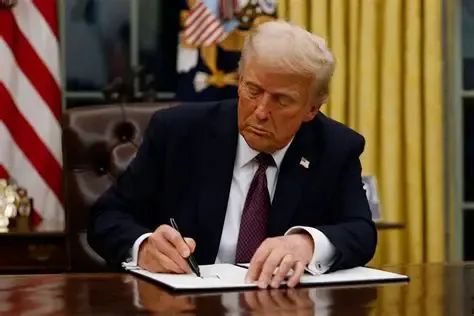
De la Espriella said one of his administration’s immediate priorities would be joining US President Donald Trump’s regional anti-cartel initiative, known as Shield of the Americas.
His election has given Washington a new ally in Bogota, with the US State Department announcing on Friday that the Trump administration plans to work with Congress on “$1 billion in assistance as part of a security package to support” Colombia’s new government.
The Colombian leader, who holds both Colombian and US citizenship, has expressed willingness to allow American troops to operate in Colombia.
He has also proposed bombing cocaine laboratories in jungle areas, constructing “mega-prisons” and reducing the size of government.
Unusual inauguration
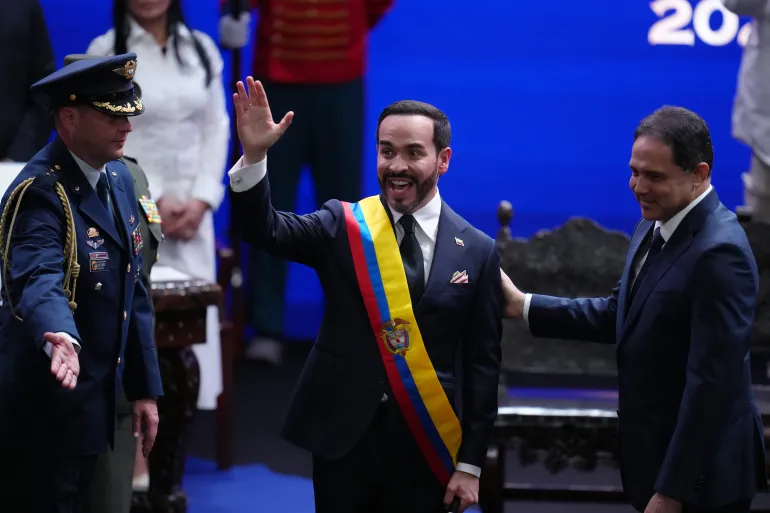
De la Espriella’s inauguration broke with Colombia’s traditional presidential ceremonies, taking place in Cali rather than at Congress in the capital, Bogota.
Among those present was FIFA president Gianni Infantino, while other high-profile right-wing figures included Argentine President Javier Milei and Todd Blanche, who represented Trump’s administration.
Former President Gustavo Petro, whose four-year left-wing administration ended with De la Espriella’s victory, did not attend the ceremony.
Security was significantly tightened in Cali because of the city’s history of guerrilla attacks.
About 11,000 troops were deployed alongside an anti-drone system during the inauguration.
De la Espriella secured victory by less than one percentage point, bringing an end to Colombia’s first left-wing government.
However, his administration faces the challenge of governing with a divided Congress where it does not hold a majority.
His supporters expect the new government to take a much harder line against crime and dissident armed groups.
“This government has a lot to prove. A lot was said during the campaign,” 46-year-old Marisol Peira, a resident of Cali, told AFP.
Petro’s attempts to negotiate peace with Colombia’s numerous armed groups failed to produce lasting results.
Analysts have argued that some of the groups, which were once driven largely by ideology, have increasingly focused on cocaine trafficking and other illegal businesses, using government ceasefires to strengthen their operations.
Petro, who has alleged electoral fraud without presenting evidence, called for mass demonstrations in major cities on Friday.
Hundreds of people subsequently protested peacefully in Bogota and Barranquilla.
Plan Colombia II
De la Espriella’s election is part of a broader shift towards the political right in Latin America, following similar electoral victories in countries including Chile and Costa Rica, where security concerns played a major role.
Nicknamed “The Tiger”, the new president has promised to eradicate coca plantations used in cocaine production “by all means”.
He also supports fracking, plans tax reductions for wealthy Colombians and wants to establish closer military cooperation with the United States and Israel.
His proposed “Plan Colombia II” draws inspiration from the earlier US-backed initiative launched in the 2000s to combat drug cartels and left-wing armed groups.
“We have to support him so there won’t be so much crime,” said German Angulo, a 63-year-old contractor. “We need a complete change.”
The original Plan Colombia helped weaken major armed groups, although it was also accompanied by allegations of serious human rights abuses.