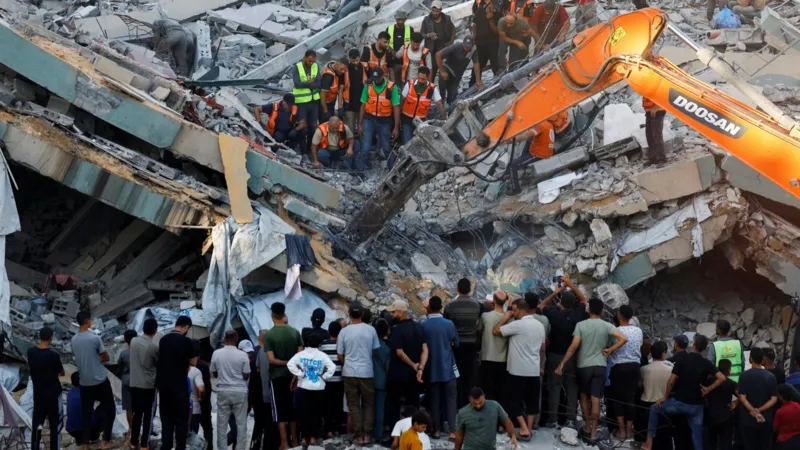
A dire humanitarian crisis has gripped northern Gaza, particularly Gaza City, where scenes of lawlessness and desperation are unfolding daily.
The situation has deteriorated into widespread chaos, with civilians scrambling for food amid a collapsing security structure, while aid remains largely inaccessible.
According to the Hamas-run interior ministry, seven police officers were killed by an Israeli air strike on Thursday as they attempted to bring order to a marketplace near the central al-Saraya junction in Gaza City.
The ministry claimed the officers were trying to stop looting when they were targeted.
“Israeli occupation aircraft targeted a number of police officers… while they were performing their duty in confronting a group of looters earlier today, leading to the martyrdom of several officers and civilians in yet another massacre,” the ministry stated.
The Israeli military has not confirmed the strike but said it carried out air raids on “dozens of terror targets” across Gaza over the previous 24 hours.
Medical sources and emergency teams reported at least 44 deaths across the region on Thursday, with 23 fatalities occurring in the central Bureij refugee camp alone.
This surge in violence came a day after the UN’s World Food Programme (WFP) revealed that two people were fatally shot when crowds stormed its warehouse in Deir al-Balah.
The WFP described the desperate crowd as “hordes of hungry people,” though the source of the gunfire remains unknown.
Earlier in the week, chaos erupted at a new aid facility in Rafah, operated by the US and Israeli-supported Gaza Humanitarian Foundation.
A UN official in Gaza reported that nearly 50 people were shot and wounded as thousands surged through the gates in pursuit of aid. The Israeli military stated that only warning shots were fired into the air, not at civilians.
Thursday’s airstrike on police officers underscores a broader collapse of law enforcement in Gaza, which has been exacerbated by Israel’s continued targeting of the interior ministry’s personnel.
Israel has accused the ministry’s police of facilitating Hamas operations and repressing dissent, especially following the assassination of Gaza’s police chief and his deputy in January. However, the ministry insists its role is centered on “civilian protection.”
Graphic footage shared on social media following Thursday’s strike showed bloodied bodies and debris strewn across the marketplace. Witnesses reported that the targeted area, a cluster of stalls selling vegetables and canned goods, had been crowded with people trying to find food.
Elsewhere in the enclave, desperate civilians flooded another GHF aid distribution site. One individual recounted to the BBC how the scene near Rafah quickly turned chaotic after Israeli drones instructed people to approach the aid centre.
“For exactly 10 minutes, things were organised but then the crowd broke through the gate and rushed into the courtyard,” the witness said.
Thousands, some on foot, others using carts and bicycles, pushed forward, carrying off whatever food supplies they could find.
An AFP interview with 60-year-old Abu Fawzi Faroukh highlighted how elderly Gazans were being left behind in the crush for resources.
“The young men are the ones who have received aid first, yesterday and today, because they are young and can carry loads. But the old people and women cannot enter due to the crowding,” he said.
“We have been humiliated, the Palestinian people are humiliated.”
Many others walked away empty-handed. Umm Mohammed Abu Hajar arrived with her ID in hand, hoping for assistance.
“I found all the people hungry,” she told the BBC. “So, I couldn’t get anything. I left like this… empty-handed.”
She urged for better systems to ensure fair distribution. “Some people eat and some people don’t,” she lamented.
Hani Abed, another hopeful recipient, echoed the frustration. “I came empty-handed and I left empty-handed. I will take dirt for my children to eat.”
According to the GHF, approximately 17,280 food boxes—equal to nearly a million meals—were distributed on Thursday at its three active locations. The group plans to expand its operations further into central and northern Gaza.
The GHF denied any shootings took place at its distribution points, stating, “No shots have ever been fired.” The organization, operating outside UN frameworks, uses US security contractors to safeguard food parcels in Israeli-controlled areas.
The UN has refused to support the effort, calling it unethical and unsustainable.
Head of the UN’s humanitarian office in Gaza, Jonathan Whittall, criticized the GHF model, claiming it “essentially [engineers] scarcity” and cannot serve the 2.1 million people in need.
The US and Israeli governments maintain that the GHF setup prevents aid theft by Hamas, a charge the militant group denies.
Israel enforced a full blockade on Gaza’s humanitarian and commercial supplies on 2 March and resumed its offensive two weeks later after a brief truce ended.
The Israeli government has linked this pressure campaign to efforts to secure the release of 58 hostages still held in Gaza, of whom at least 20 are believed to be alive.
The military campaign intensified on 19 May, with Prime Minister Benjamin Netanyahu declaring intentions to “take control of all areas” in Gaza. A day later, he announced a minimal easing of the blockade to allow some basic supplies in.
Families of the remaining hostages continue to push for a ceasefire deal. On Thursday, White House press secretary Karoline Leavitt confirmed that Israel had backed a new ceasefire proposal delivered to Hamas by US special envoy Steve Witkoff.
“Israel signed off on this proposal before it was sent to Hamas,” Leavitt said.
However, a senior Hamas official told the BBC the group rejected the plan, arguing that it diverged from earlier talks with Witkoff. The official cited the lack of guarantees for a permanent ceasefire or a full Israeli military withdrawal as reasons for the refusal.
Reports from Israeli and US media suggest that the proposal included the release of 10 living hostages and the remains of deceased ones in exchange for a 60-day ceasefire and the freeing of Palestinian prisoners.
The current war began on 7 October 2023, when Hamas launched a deadly incursion into Israel, killing around 1,200 people and abducting 251.
In response, Israel began its military operation in Gaza, which has since led to the deaths of at least 54,249 Palestinians, according to Gaza’s health ministry, including nearly 4,000 since the latest offensive resumed.