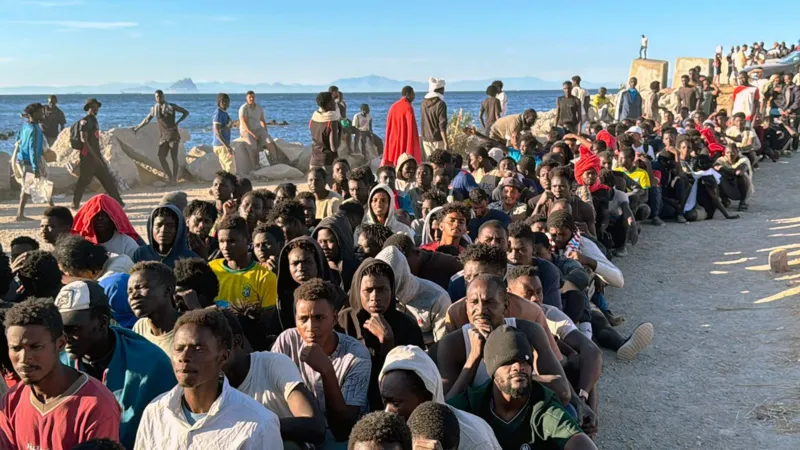
An estimated 49,000 migrants crossed from Morocco into Spain’s North African enclave of Ceuta by land and sea within the past 24 hours, according to Spanish officials, in what is being described as one of the largest migration surges ever recorded at the border.
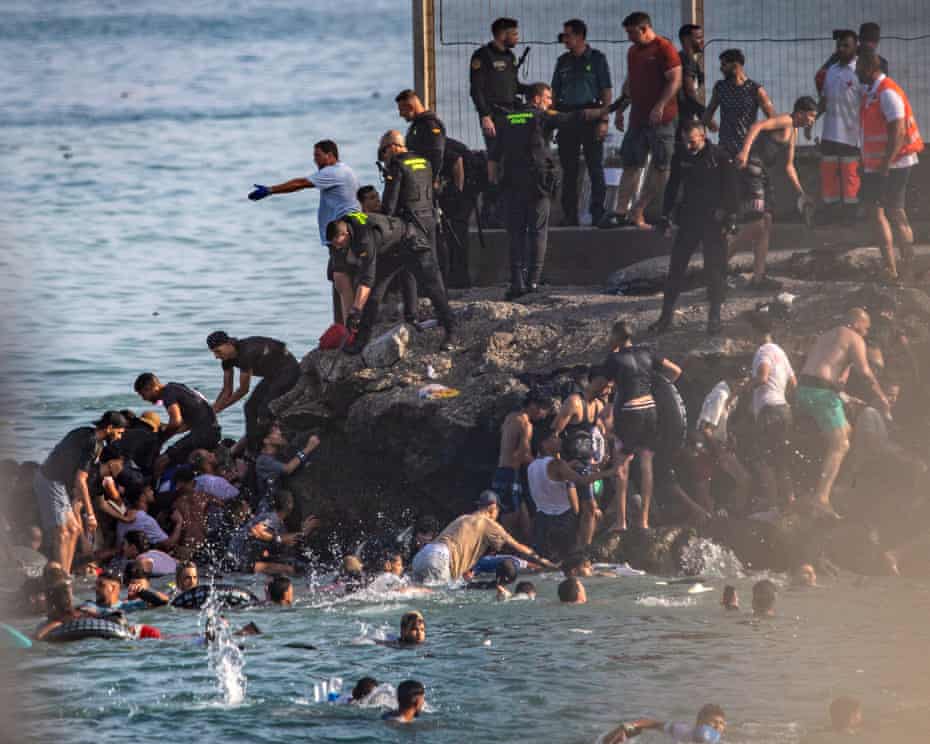
Videos and photographs circulating online showed thousands of people swimming into the enclave on Thursday, while local media reported that crossings continued throughout the night.
Authorities said at least 18 people have died in recent days while attempting the dangerous journey.
The latest wave of arrivals follows a ruling by Spain’s Supreme Court earlier this month that migrants intercepted at sea while trying to reach Ceuta or Melilla cannot be immediately returned to Morocco.
Ceuta, located on Morocco’s northern coast across the Strait of Gibraltar from mainland Spain, has long served as a key entry point for migrants hoping to reach Europe.
Although local authorities had requested additional support from Madrid after a recent rise in attempted crossings, border controls appeared overwhelmed on Thursday as thousands entered the territory.
The estimated 49,000 arrivals represent more than half of Ceuta’s population, which stands at approximately 83,600 residents.
In response, Spain deployed military personnel to reinforce security in Ceuta and the neighbouring Spanish enclave of Melilla, where officials also recorded between 300 and 400 illegal crossings overnight.
Ceuta and Melilla remain at the centre of longstanding diplomatic tensions between Spain and Morocco, which continues to claim sovereignty over both territories.
Spain, however, maintains that the enclaves are an integral part of the country and enjoy the same autonomous status as its mainland autonomous communities.
Both territories have been under Spanish rule since the 15th century and have held Autonomous Community status since 1995. They also represent the European Union’s only land borders with Africa.
Officials said the majority of those arriving were young men, although women, children and even babies were also among the crowds.
Around 7,000 of those who entered Ceuta over the past day are believed to be minors.
Migrants attempting to enter Ceuta typically swim several kilometres from the Moroccan coast.
This time, however, many reportedly reached the border fence with little difficulty. Some walked around the jetty before entering the water, while others swam around the barrier to nearby beaches.
The whereabouts and response of Moroccan border guards during the crossings remain unclear.
One migrant told Reuters news agency that he was returning to Morocco, adding, “It’s not good at all, and it’s not fun either.
“I mean, people are dying here. I beg you, please, if you haven’t come yet, don’t come. Don’t do it.”
Residents of Ceuta described scenes of fear and disorder as thousands arrived.
“Nobody is going out on the street. They’re afraid.
“This is stronger and more aggressive than what we’ve experienced before,” a hospital security guard told the Spanish site.
Another resident said those entering the enclave were not “poor or needy”.
“They are coming to Spain to abuse the system,” he said.
A 24-year-old migrant identified as Yassine said returning to Morocco was not an option for him.
“I have nothing there, Morocco is death,” he added.
The unprecedented influx came after several days of rising arrivals by sea, with reports suggesting news of successful crossings spread rapidly among migrants.
The previous major surge occurred in 2021 when about 8,000 people crossed into Ceuta after Morocco relaxed border controls during a diplomatic dispute with Spain over Western Sahara.
Tensions between the two countries have resurfaced following Spanish Prime Minister Pedro Sánchez’s recent visit to Algeria, which supports Western Sahara’s independence movement.
Spain’s Interior Ministry said it was coordinating with Moroccan authorities to ensure the return of migrants who entered illegally “as soon as possible.”
Sánchez is expected to visit Ceuta on Friday.
Italian Prime Minister Giorgia Meloni reacted swiftly, describing the scenes in Ceuta as “shocking” and warning on social media that such “uncontrolled immigration” posed a security risk to Europe.
She said Italy would consider suspending the Schengen agreement with Spain on free movement, although questions remain over how such a move could be implemented given that the two countries do not share a land border.
Italy’s Foreign Ministry later clarified that its proposal referred to suspending Schengen arrangements at the Italy-Spain border rather than removing Spain from the agreement altogether.
For now, migrants who have entered Ceuta remain confined to the enclave and have not reached mainland Spain.
Meloni’s remarks echoed comments made by Italian Foreign Minister Antonio Tajani, prompting criticism from his Spanish counterpart, José Manuel Albares, who accused him of politicising migration.
The Spanish foreign minister said such remarks were “improper” for “a partner and friendly country from which we expect European solidarity and not partisan demagoguery”.
Spain has since summoned the Italian ambassador to Madrid.
Finnish Interior Minister Mari Rantanen also backed Meloni’s position, arguing that Spain had failed to adequately protect its external border.
The Schengen Area allows passport-free travel across 29 European countries that have abolished routine border checks between participating states.