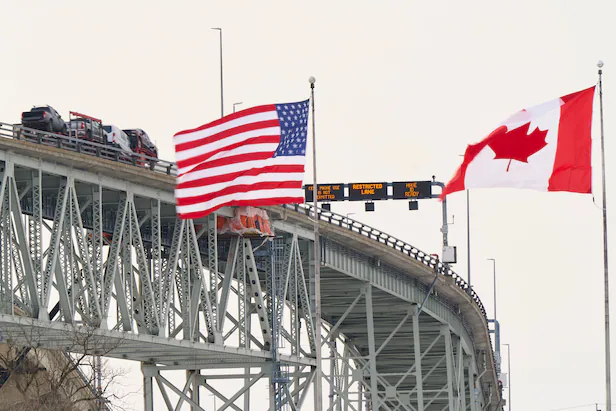
Trade tensions between the United States and Canada have escalated again after last-minute negotiations between the two countries failed to produce an agreement, prompting Ottawa to suspend talks and promise retaliatory tariffs.
CNN reported that Canadian Prime Minister Mark Carney announced late Friday that Canada’s negotiating team would return home after the two sides failed to reach an agreement before a midnight deadline.
“As a result, this evening, I have decided to suspend trade negotiations with the US and have directed Canada’s negotiators to return to Ottawa,” Carney said in a statement.
The breakdown means 50% US tariffs on about $20 billion worth of Canadian goods have now taken effect. Canada has vowed to respond with equivalent measures.
“Canada will match those tariffs dollar for dollar to protect our workers and businesses,” Carney added.
The latest development followed several days of intensive discussions involving US President Donald Trump, Carney and senior trade officials from both countries.
Trump had earlier extended the tariff deadline by three days in an effort to give negotiators more time to reach a deal.
Earlier this week, Trump had suggested that an agreement was close, saying, “We’ve come to a deal with Canada.”
However, he noted that the arrangement was “still subject to finalization of documents.”
US Trade Representative Jamieson Greer blamed Canada for the collapse, saying Ottawa had introduced new demands and reversed some commitments.
“Despite the U.S. offer to Canada to receive the best treatment of any major exporter to our market, new demands and walk backs of other commitments by Canada have upended the careful balance reached in the past days,” Greer said.
According to Greer, the US proposal included substantial tariff reductions on Canadian steel, aluminum, automobiles and lumber, alongside what he described as “a historic economic and national security partnership.”
Carney, however, said changes introduced by Washington at the last minute made the proposed agreement unacceptable.
The dispute comes after months of worsening relations between the two North American neighbours.
Trump has imposed tariffs on several major Canadian industries, including automobiles, steel and aluminum, while Ottawa has responded with retaliatory measures.
The latest tariffs affect a relatively small portion of bilateral trade, covering goods worth around $20 billion, or approximately 5% of the value of Canadian goods imported into the US last year.
Although the immediate effect on American consumers is expected to be limited, the broader concern is that the renewed tariff confrontation could deepen the trade dispute between the two countries.
Carney said Canada would provide further assistance to workers and businesses affected by the tariffs, building on nearly $25 billion in support already announced over the past 18 months.
He also insisted that Canada’s economy was gaining momentum and pledged that Ottawa would defend the country’s economic interests.
“Canada’s economic growth is accelerating” and Ottawa would “not allow any nation to determine our future,” Carney said.
What the Failed Deal Contained
The negotiations had reportedly included discussions about reducing US tariffs on Canadian steel, aluminum and vehicles.
Steel and aluminum currently face 50% duties, with US officials considering cutting those rates by half.
Canadian vehicles, meanwhile, are subject to 25% tariffs on their non-US content, with negotiators discussing a possible reduction to 15%.
Trump has also repeatedly criticised Canada’s restrictions on US dairy products.
While American dairy goods are allowed into Canada, quotas limit the amount that can enter without facing much higher tariffs.
Trump had argued that a new agreement would benefit American farmers.
“Our farmers will no longer be held up because they were being hurt very badly by Canada,” he said earlier this week.
New Tariff Authority
The Trump administration is relying on a rarely used 1930s law known as Section 338 to impose the new tariffs.
The law has never previously been used in this manner and is expected to face legal challenges.
If the tariffs survive court scrutiny, the provision could allow the administration to impose duties of up to 50% when it determines that a trading partner is discriminating against American commerce.
Unlike some other tariff authorities used by Trump, Section 338 does not appear to impose a specific time limit on the duties, potentially allowing them to remain in place indefinitely.
The first round of tariffs targets nearly 500 categories of Canadian goods, although key products such as energy, critical minerals and fish have so far been excluded.
Canada’s decision to match the tariffs dollar for dollar now raises the prospect of a broader confrontation between two of the world’s most closely integrated economies.