Ukraine is pressing ahead with the development and deployment of artificial intelligence-powered combat robots despite the recent dismissal of former defence minister Mykhailo Fedorov, whose reforms were instrumental in advancing the country’s military technology sector.
Across Ukraine, engineers and military units continue to expand the use of autonomous systems, insisting that innovation driven by the battlefield has gained enough momentum to continue regardless of political changes.
Among those leading the effort is engineer Eduard Trotsenko, who has transformed his workshop into a hub for developing robotic systems designed to reduce risks to soldiers. Surrounded by drones, robotic vehicles and computer equipment, he said his long-term vision includes self-recharging robotic birds and combat-ready robotic dogs.
“In order to save human lives, to save soldiers, there must be robots,” Trotsenko told AFP.
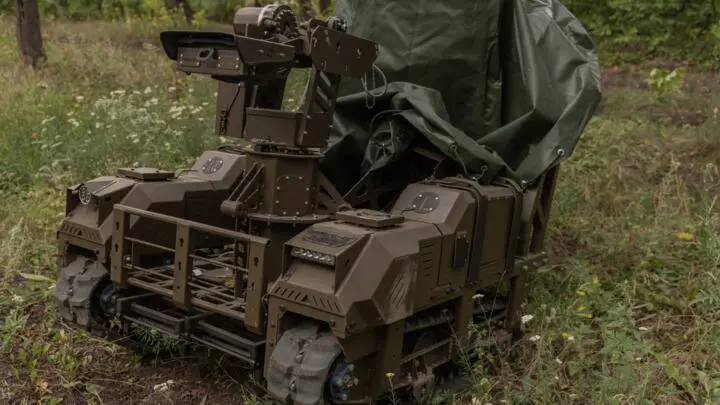
The war with Russia has accelerated Ukraine’s reliance on autonomous technologies. While aerial drones have become indispensable for surveillance and strike missions, unmanned ground vehicles are increasingly being used to transport supplies and evacuate wounded troops from dangerous combat zones.
Ukraine’s rapidly growing drone industry, which President Volodymyr Zelensky has described as among the world’s best, experienced a major boost under Fedorov’s leadership.
His removal from office last month, however, raised concerns among some observers about the future direction of the sector.
Trotsenko questioned the decision.
“I don’t understand why they sacked Fedorov,” Trotsenko, the founder and CEO of robot manufacturer Temerland, said.
Despite the leadership shake-up, he believes technological progress within the military has become irreversible.
“The young people there won’t let it go. There’ll definitely be drones,” Trotsenko said.
Before Russia’s full-scale invasion, the 55-year-old engineer, originally from Kazakhstan, manufactured electric vehicle charging stations. Since the outbreak of war, he has shifted his focus to designing military robots, particularly unmanned ground vehicles capable of operating in the highly dangerous front-line areas constantly monitored by enemy drones.
Currently, many of the vehicles are used for casualty evacuation and logistics, helping minimise troop exposure.
Trotsenko is now developing armed versions equipped with rocket-propelled grenade launchers and heavy machine guns, guided by onboard artificial intelligence.
“They’re currently being tested in some brigades,” said Trotsenko, who is awaiting a green light for further rollout by the General Staff.
During his tenure, Fedorov established the Defence AI Center A1 to accelerate the military’s adoption of artificial intelligence by integrating frontline feedback into the development process.
He also encouraged private companies to compete for defence contracts, allowing innovations to be developed and deployed more rapidly.
“In a private company, you can take risks more quickly,” said Trotsenko, explaining how small companies were incentivised to modify and adapt at speed to win contracts.
On the battlefield, military units have embraced the technology as a way to reduce casualties.
A commander identified only by the call sign “Jason”, who leads a unit operating ground drones, said the systems have become invaluable.
“You can afford to lose a drone, but not a person. The probability of human losses there is reduced,” he told AFP.
Following Fedorov’s dismissal, public protests also contributed to the removal of commander-in-chief Oleksandr Syrsky, who had faced criticism for resisting greater integration of drone technology and for what critics described as excessive risks to soldiers.
However, Jason dismissed suggestions that Fedorov’s exit could derail Ukraine’s technological progress.
“It’s not that simple … the technological initiative was not flowing from the top down. It wasn’t a government order,” he said.
According to him, the invasion triggered widespread grassroots innovation, with engineers and technology specialists independently developing equipment before collaborating with military units to refine and deploy it.
After Russia invaded, “there was an explosion of bottom-up initiative”.
Young engineers began to create new products, showed them to the military, who took what they wanted and then started their own development, he said.
Jason added that specialists in software, telecommunications and engineering are now fully integrated into military operations, although finding enough qualified personnel remains a major challenge.
“The shortage of professionally trained people” is the biggest challenge he faces.
Back in his workshop, Trotsenko said his team is already looking beyond current battlefield technologies, envisioning future conflicts dominated by remotely operated humanoid robots controlled from distant locations, even by wounded soldiers recovering in hospital.
“Things have really taken off,” he said confidently.