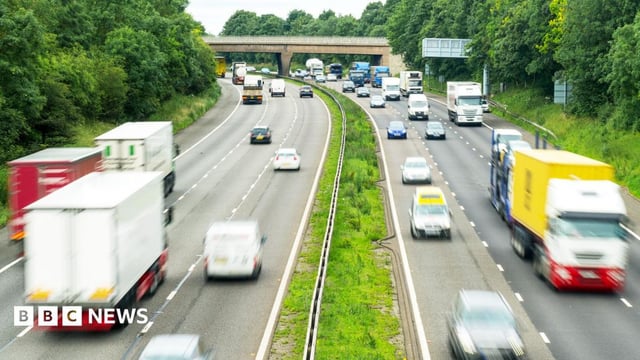
Thousands of illegal vehicle registration plates designed to evade automatic number plate recognition cameras have been detected by a new system being tested on motorways in the United Kingdom, the BBC Panorama investigation has revealed.
The plates, known as ghost plates, are designed with special reflective materials that make some or all of their registration details difficult or impossible for most automatic number plate recognition cameras to read.
ANPR cameras are widely used across the UK to enforce speed limits and low-emission zones, while police also rely on the technology to identify vehicles linked to criminal activity.
The UK has about 14,000 ANPR camera sites, capturing an estimated 100 million number plates daily.
However, experts have raised concerns that some motorists are increasingly using methods to avoid detection.
A new camera system being tested by ANPR technology provider MAV Systems has detected more than 1,000 ghost plates daily over several months at a site near the Dartford Crossing, outside London.
At another location near the M25, daily detections increased from about 1,000 to almost 2,000, while a separate site near Folkestone and the Eurotunnel has been recording more than 400 detections per day.
The investigation also found that cloned registration plates, where criminals use the details belonging to another legitimate vehicle, remain a major concern.
Tony Porter, a former senior counter-terrorism officer who has advised the UK Government on surveillance cameras, said both cloned and ghost plates were undermining police efforts to track criminals.
“The police need an effective ANPR system that doesn’t have weaknesses [and] doesn’t put the public at risk,” he said.
Porter added, “we tolerate a £10 number plate with no security mechanism on it”.
The investigation highlighted cases in which illegal plates were linked to fatal road crashes.
Sharon Gannon’s son, Jason Wallis, was killed in Buckinghamshire in 2023 after he and his brother-in-law, Lewis Baker, crashed into a car while riding motorcycles at high speed.
Baker, who admitted using a device to conceal his number plate, was later jailed for 15 months for dangerous driving.
“It has broken us all,” Gannon said about the impact of the crash on her family.
In another case, 81-year-old Graham Slinn was killed in 2025 after a car with cloned plates struck him at high speed on a pedestrian crossing.
The driver, 20-year-old Cain Byrne, was driving without a licence or insurance and had inhaled nitrous oxide shortly before the crash.
He was eventually identified through hours of CCTV footage and jailed for 11 years and six months for causing death by dangerous driving, driving while disqualified and driving without insurance.
Slinn’s daughter, Nicola Timmis, described cloned plates as a “gateway drug” that could encourage motorists to take increasingly dangerous risks.
“It seems like it’s harmless, but then one thing leads to another, leads to another, and before you know it, it’s somebody dead,” she said. “It is not a victimless crime.”
The BBC investigation also found that obtaining illegal plates could be relatively easy. Of three businesses approached undercover at a market in Essex, two offered ghost plates and claimed they could help motorists avoid cameras enforcing London’s Ultra-Low Emission Zone.
One supplier sold a plate without requesting identification or proof that the buyer was authorised to use the registration, despite both being legal requirements.
The plate was purchased for £40 and produced within eight minutes.
Although buying a ghost plate is not itself illegal, using one on a vehicle on public roads is against the law.
More than 34,000 businesses are registered with the Driver and Vehicle Licensing Agency to supply number plates, while only six DVLA officers are responsible for inspecting and auditing the registered suppliers.
A Freedom of Information request by Panorama found that only two number plate suppliers had been prosecuted and removed from the DVLA register since 2020.
The DVLA said it was “cleaning up the register, strengthening compliance and enforcement” and continued working with police and Trading Standards to deal with suppliers who violated the rules.
During a roadside operation involving police and DVLA officials in the West Midlands, officers stopped a van whose ghost plate was detected using specialist infrared goggles.
The driver was issued a £100 fine and said he was unaware the plate was illegal.
Police later inspected the supplier of the plate and found ghost plates and separate letters and numbers among its stock. Officers said this suggested “some level of intent”.
The supplier received a warning letter, although police said prosecution was still being considered.
Chief Constable Tim Forber, the UK’s policing lead on ANPR, said police forces wanted tighter licensing and regulation of number-plate suppliers.
“Not a week goes by where we don’t see an example of someone on cloned plates involved in serious and organised crime,” he said.
Meanwhile, Justin Madders, the UK minister responsible for vehicle registration, said the government was establishing a national centre to tackle illegal number plates.
The centre will bring together police forces to share intelligence and test new technology aimed at improving road safety, tackling organised crime and dealing with motorists attempting to avoid fines.
“I don’t think we can rule anything in or out at this stage,” Madders said.