The Lagos State Government says it is intensifying efforts to reduce environmental pollution by promoting the recycling and conversion of abattoir waste into useful products, including biogas and organic fertiliser.
The state government disclosed this on Friday in a statement signed by the spokesperson for the Lagos State Ministry of Environment, Kunle Adeshina.
According to the statement, the Permanent Secretary, Office of Environmental Services, Lagos State Ministry of Environment and Water Resources, Dr Gaji Tajudeen, made the disclosure during a one-day workshop for abattoir operators at ABIS Farmers Market, Ajah, Lagos.
The workshop, themed, “Red to Green: From Waste Disposal to Resource Recovery,” centred on sustainable waste management, public health protection and ways of generating economic value from waste produced during animal slaughtering and meat processing.
Tajudeen, who was represented by the Director, Public Sanitation Utility, Rahman Fagbolade, said abattoirs and slaughterhouses remained important to Lagos’ food supply chain while providing livelihoods and supporting economic activities.
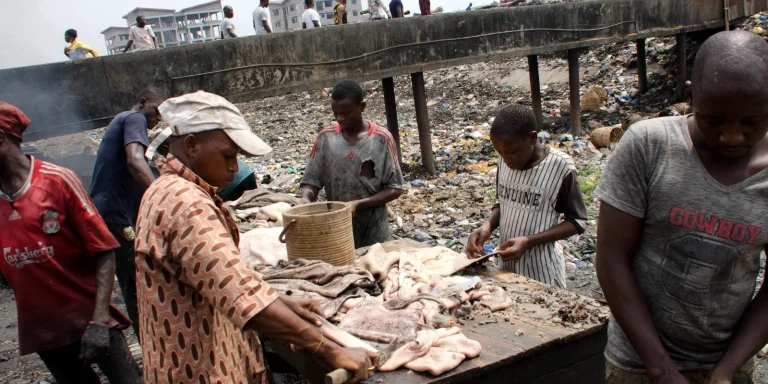
He, however, warned that slaughtering operations produced significant quantities of waste, including blood, paunch and rumen contents, bones, horns, hooves, faecal matter and wastewater.
He said poor handling of such waste could lead to environmental pollution, blocked drainage channels, unpleasant odours, poor sanitation and public health risks.
Tajudeen said the government would continue to enforce environmental and sanitation standards across abattoirs and slaughterhouses, adding that achieving sustainable compliance required regular engagement, education and capacity building for operators.
He explained that the workshop was aimed at moving operators away from the traditional approach of simply disposing of waste towards recovering and converting it into valuable resources.
According to him, blood, paunch and rumen contents, wastewater and faecal matter could be processed into biogas and organic fertiliser, while bones, horns and hooves could also be processed for other commercial uses.
“When properly segregated, processed and managed, materials traditionally regarded as waste can become valuable resources that support enterprise development, job creation, additional income generation and the growth of a circular economy,” he said.
The permanent secretary identified regulation, education, innovation and collaboration as essential to achieving sustainable waste management in Lagos’ abattoir sector.
He also urged operators to see environmental compliance beyond a statutory requirement, describing it as an investment in public health, consumer confidence and the long-term sustainability of their businesses.
Tajudeen encouraged young people, farmers and other stakeholders to take advantage of emerging opportunities in waste recovery and waste-to-wealth initiatives, saying such ventures could create businesses, provide jobs and improve agricultural productivity.
He stressed that achieving a cleaner and healthier Lagos would require joint efforts from government agencies, businesses, communities and individuals.
Describing the “Red to Green” transition as a major shift in how waste is viewed and managed, Tajudeen said the initiative was designed to turn waste from an environmental challenge into an economic opportunity.
He urged participants to exchange practical experiences, identify workable solutions and implement the recommendations from the workshop.
“The true measure of success for this initiative will not be today’s discussions alone, but the actions we take afterwards—in our abattoirs, slaughterhouses, farms, businesses and communities,” he said.
He commended the ABIS Group for hosting and supporting the workshop, expressing optimism that the initiative would improve sanitation and environmental sustainability while advancing the circular economy in Lagos.
Speaking on “From By-products to Business: Unlocking the Economic Value of Bones, Horns, Hooves and Other Abattoir By-products,” the guest lecturer, Muyiwa Semowo, urged abattoir operators and other stakeholders to adopt innovative methods of converting waste into commercially valuable products.
Semowo said abattoir by-products could be processed for use in sectors such as agriculture, manufacturing, pharmaceuticals, cosmetics and animal feed.
He advised operators to improve their segregation, handling and processing practices to enhance the quality and commercial value of the materials.
He added that embracing a circular economy approach would not only reduce pollution and improve sanitation around abattoirs but also create new businesses, generate employment and increase operators’ income.
The workshop was attended by operators of abattoirs and slaughterhouses from across Lagos State.