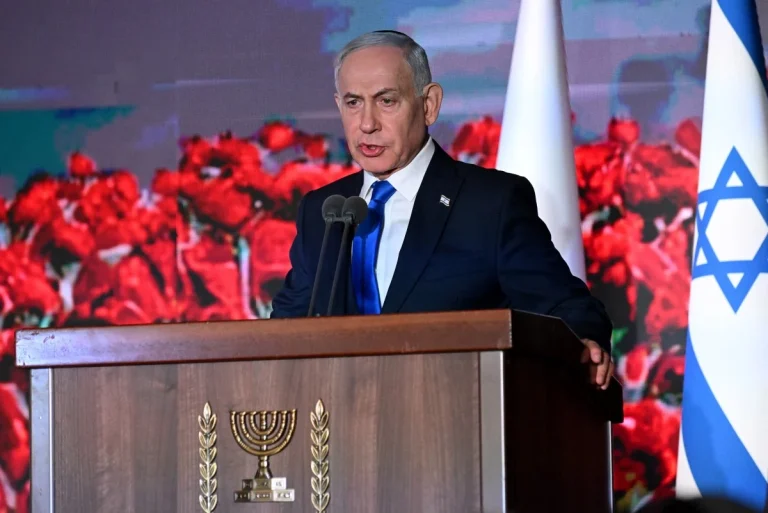
Israeli Prime Minister Benjamin Netanyahu is exploring ways to remain in power after a closely contested election left his political bloc without a clear parliamentary majority.
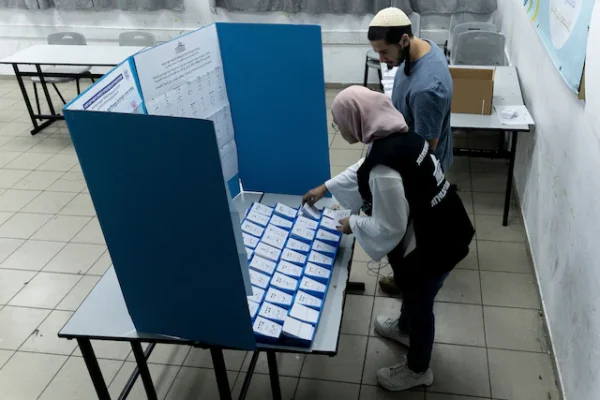
Voters turned out in record numbers on Tuesday for an election widely viewed as a referendum on Netanyahu, who has led Israel for more than 19 years across several periods in office.
With almost all ballots counted, Netanyahu’s right-wing bloc appeared to have a narrow lead over the opposition camp led by former military chief Gadi Eisenkot.
However, neither side secured enough seats to command a majority, leaving both scrambling to assemble a governing coalition.
The result could trigger weeks of political negotiations, while the deadlock may temporarily favour Netanyahu, who would remain caretaker prime minister.
Arab parties, which recorded unprecedented gains, could prove decisive in helping the opposition remove him from office if it agrees to cooperate with them.
Netanyahu, who repeatedly criticised Arab parties during his campaign, has accused them of stealing the election and called for an investigation into allegations of foreign funding, which have not been substantiated.
President Isaac Herzog, who is responsible for selecting a candidate to form the next government, has urged political leaders to avoid another election.
His position has raised the prospect of a national unity government involving rival political factions.
During the final hours of voting, Netanyahu made an intense appeal to his supporters to increase turnout in favour of his Likud party.
“We cannot leave this battle here in the hands of the left and the Arab parties,” he told a crowd in a Likud stronghold.
“So no barbecues, don’t go to the beach — go to the polling station and vote Likud.”
Netanyahu’s longstanding reputation as a security-focused leader suffered a major blow following Hamas’s October 7, 2023, attack on Israel.
Eisenkot capitalised on public anger over the security failures preceding the assault as he challenged the prime minister at the polls.
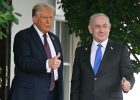
Nevertheless, Netanyahu campaigned aggressively, highlighting an endorsement from United States President Donald Trump and Israel’s military operations against Hamas in Gaza, Hezbollah in Lebanon and Iran, which supports the two groups.
The 77-year-old Israeli leader also faces an international arrest warrant over alleged war crimes in Gaza, a longstanding corruption trial and a widening regional conflict that has continued for more than three years.
Born in Tel Aviv on October 21, 1949, Netanyahu inherited his political ideology from his father, Benzion, who served as an aide to Zeev Jabotinsky, the founder of the Revisionist Zionist movement associated with the idea of a Greater Israel.
Netanyahu opposed the Israeli-Palestinian peace process of the 1990s, which sought to establish a two-state solution, and eventually helped undermine the initiative.
He now advocates a vision of Israel with expanded borders, including support for annexing parts of the occupied West Bank and policies encouraging the expansion of Israeli settlements, which are considered illegal under international law.
Before entering politics, Netanyahu served in an Israeli commando unit and fought in the 1973 Arab-Israeli war.
His elder brother, Yonatan, was killed while leading the Israeli hostage-rescue operation at Entebbe, Uganda.
Recalling the loss, Netanyahu later wrote, “When the news reached me that Yoni had died, I felt as if my life had ended.”
Having spent part of his childhood in the United States, Netanyahu graduated from the Massachusetts Institute of Technology and developed a strong public profile as an Israeli spokesman, particularly on American television.
He entered parliament in 1988 and became leader of the Likud party in 1993.
Three years later, he narrowly defeated his opponents following the assassination of former prime minister Yitzhak Rabin, becoming Israel’s youngest prime minister at the age of 46.
Netanyahu held the office from 1996 to 1999 and returned in 2009, serving until 2021.
He regained power in late 2022 through a coalition that included far-right figures who had previously been politically marginalised.
For much of his political career, Netanyahu maintained that Israel’s security depended primarily on military strength, although he was also regarded as a cautious leader.
He strongly opposed Palestinian statehood and viewed Hamas’s control of Gaza, supported financially by Qatar, as a means of dividing Palestinian leadership and weakening the Palestinian Authority, which governs parts of the occupied West Bank and enjoys strong European support.
However, Hamas’s October 2023 attack exposed the weaknesses of that approach.
As the conflict spread, Netanyahu increasingly portrayed the war as a generational struggle aimed at reshaping the Middle East and reducing the influence of Iran’s clerical leadership.
In recent months, he has repeatedly claimed that he “changed the face of the Middle East”.
His supporters argue that he responded decisively to Israel’s worst security crisis and directly confronted Iran in a way previous Israeli leaders had not. His critics, however, accuse him of prolonging regional conflicts and damaging Israel’s international standing.
The possibility of renewed hostilities with Iran has added urgency to discussions about forming a unity government with Eisenkot, who has previously declared that Netanyahu “is unfit to remain in office”.