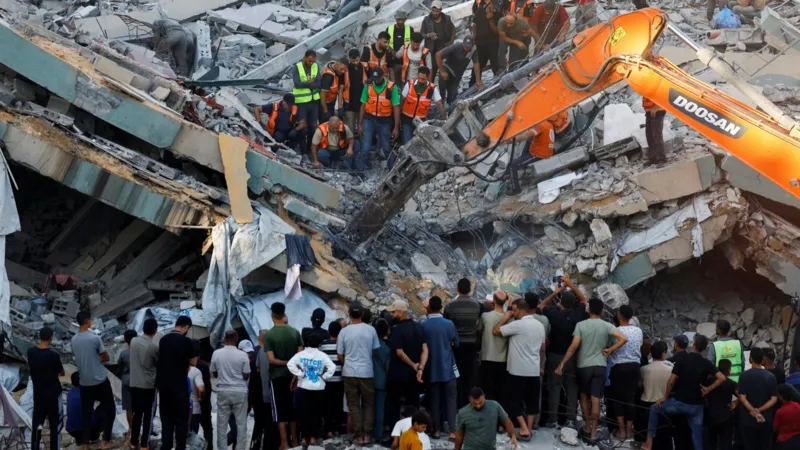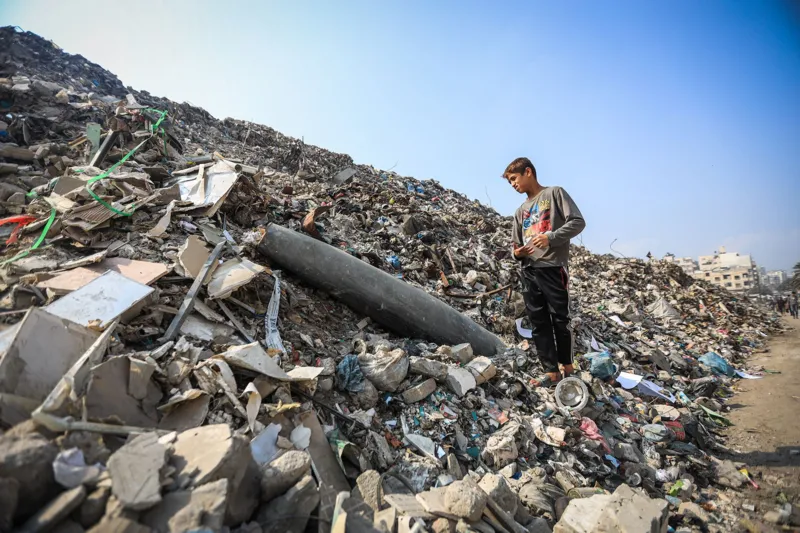
Israeli military attacks have turned the Gaza Strip into a “toxic wasteland”, with more than 99 per cent of the Palestinian territory showing signs of potential environmental contamination, a new report by international charity Oxfam has revealed.
The report, published in collaboration with the UK-based Conflict and Environment Observatory, warned that heavy metals, explosive residues, asbestos from destroyed buildings, dioxins and biological contaminants pose serious threats to the health and survival of Palestinians, with the consequences potentially lasting for decades.
Oxfam International’s Executive Director, Amitabh Behar, said the scale of environmental destruction had severely undermined the conditions necessary for human survival in the territory.
He accused Israel of committing “environmental war crimes” as part of what he described as an “ongoing genocide in Gaza”.
Behar said the impact on Gaza “will have fundamentally degraded the environmental conditions necessary for human safety and survival”.
The report drew on satellite imagery, remote sensing, spatial analysis and other publicly available information to assess the environmental consequences of nearly three years of intense warfare.
It examined the effects of military explosives, destroyed buildings and damaged infrastructure on Gaza’s soil, water and air quality.
According to the report, more than 200,000 tonnes of explosives were dropped on Gaza in almost two years, based on an estimate cited by a United Nations special rapporteur in February.
The amount was described as “the equivalent of the total energy of approximately 13 Hiroshima-type nuclear bombs”.
The United Nations Environment Programme had also estimated that Israeli military operations generated more than 61 million tonnes of debris across Gaza, with approximately 15 per cent potentially containing hazardous materials that pose significant contamination risks.
Lama Abdul Samad, an author of the Oxfam report, warned that the pollutants could cause serious health complications long after the fighting ends.
“There are going to be chronic health impacts that are long term because a lot of these contaminants are persistent in the environment,” she told the BBC.
She said Palestinians could experience increased respiratory diseases, cancers, organ damage, birth defects and stillbirths as a result of prolonged exposure to environmental contaminants.
The situation has been worsened by the collapse of Gaza’s sanitation infrastructure, with all six wastewater treatment plants no longer operational.
Untreated sewage is consequently entering groundwater and the Mediterranean Sea, increasing the risk of waterborne diseases and environmental damage.
Recent heavy winter storms have further aggravated the situation, causing rainwater to mix with wastewater and flow through streets and displacement camps where thousands of Palestinians are living in tents.
The report also highlighted the difficulty of determining the exact levels of contamination because laboratories in Gaza have been destroyed, while Israeli restrictions have limited the entry of specialised testing equipment and scientists.
Doctors in Gaza have reported rising cases of acute respiratory infections linked to dust from destroyed buildings and the burning of plastic, cardboard and other materials by displaced families trying to cook food and keep warm.
Palestinian dermatologist, Dr Alaa Abu Hajar, told the BBC that he had recorded a five-fold increase in chronic skin diseases since the beginning of the war, attributing the development to pollution and overcrowded, unhygienic living conditions in displacement camps.
“There are rodents, rubbish and sewage that’s spread through the streets,” he said. “Unfortunately, the age group most affected is children.”
The environmental crisis has also affected agriculture and fishing, with farmers and fishermen warning that contaminated soil and seawater have made it increasingly difficult to produce safe food.
Fisherman Abu al-Abed Sultan said untreated sewage and debris from destroyed buildings were damaging marine life and affecting the livelihoods of fishing communities.
“Sewage and wastewater are discharged into the sea without treatment and this is a great disaster,” he said.
“There is also rubble from destroyed houses that’s dumped into the sea. When we lower our nets, we catch rubble and garbage.
This harms the marine environment; the fish are affected and so are the fishermen.”
Oxfam called for a comprehensive and independent environmental assessment of Gaza to identify contamination hotspots and determine the risks before reconstruction and clean-up operations begin.
It also stressed the need to protect workers who would be involved in removing hazardous materials.
However, the Israeli embassy in the United Kingdom rejected the report, describing it as falling short of professional standards.
It argued that the findings relied on satellite imagery and unverified assumptions, adding that the methodology lacked sufficient academic rigour.
The embassy also accused the report of failing to consider the environmental impact of tunnels allegedly excavated by Hamas across Gaza, arguing that the omission undermined its conclusions about soil and groundwater contamination.
Israel has consistently rejected allegations of genocide in the ongoing case before the International Court of Justice, describing the accusations as baseless and distorted.
It maintains that its military campaign was launched in self-defence following Hamas’s October 7, 2023, attack and that it takes measures to minimise civilian casualties.
Meanwhile, the humanitarian situation in Gaza remains critical, with at least 74,746 Palestinians killed since the beginning of the war, according to figures from the Hamas-run health ministry, which the United Nations considers reliable.
Israel has made large-scale reconstruction conditional on the complete disarmament of Hamas and other Palestinian armed groups.
Although Hamas accepted a United States-backed proposal in July to surrender its weapons in exchange for an Israeli troop withdrawal, the Israeli government said the offer was insufficient.