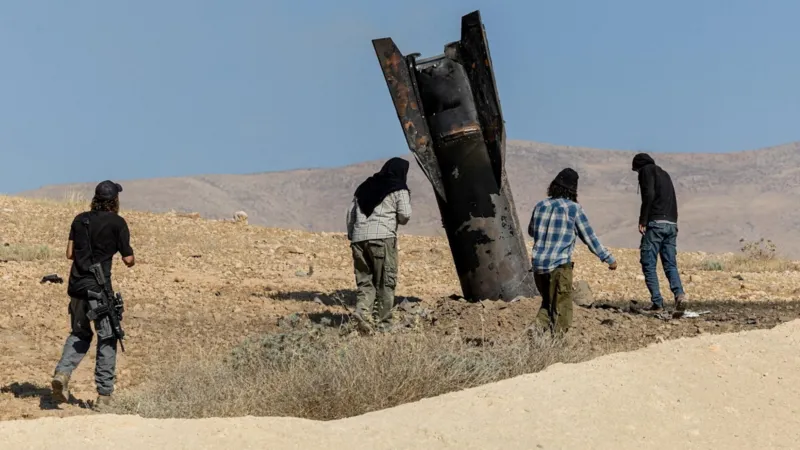
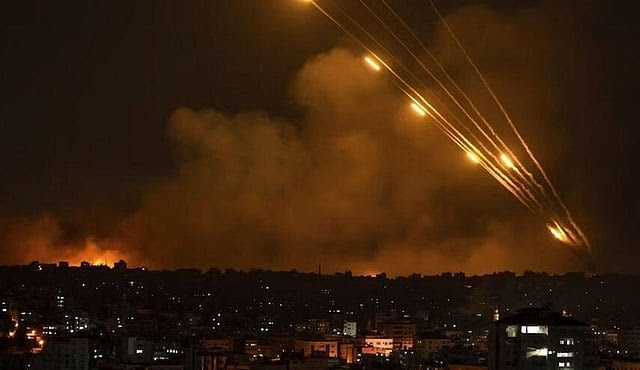
The Yemen-based Houthi militant group has claimed responsibility for a missile attack on Israel, signaling its entry into the expanding Middle East conflict and raising fresh concerns about disruptions to key global shipping routes.
In a statement released via Telegram on Saturday, the group’s armed wing said the strike involved ballistic missiles aimed at Israeli military sites.
The Houthis said they acted in response to escalating military actions across the region.
The group stated that it “have carried out their first military operation with a batch of ballistic missiles, which targeted sensitive military targets” of Israel, citing “continued military escalation” against Iran, Lebanon, Iraq and the Palestinian territories.
“This operation coincided with the heroic operations carried out by the brothers, the fighters in Iran and Hezbollah in Lebanon, and the operation successfully achieved its goals,” the Iran-backed group added.
The Israel Defense Forces confirmed that a missile was launched from Yemen toward Israeli territory, noting that its air defense systems were activated to intercept the threat. Authorities later issued an all-clear, allowing civilians to leave shelters.
Although the direct military impact of such attacks may be limited, analysts warn the Houthis’ involvement could deepen instability, particularly along the Red Sea, a crucial route for global trade.
The development comes amid severe disruptions in global shipping and oil markets following Iran’s response to a joint U.S.-Israeli strike, which effectively shut down the Strait of Hormuz.
The International Energy Agency has described the situation as the most significant disruption ever recorded in the oil market.
The Red Sea remains another strategic artery for global commerce, especially trade between Europe and Asia. Roughly 10 percent of the world’s seaborne oil passes through the Bab el-Mandeb Strait, a narrow passage linking the Arabian Peninsula and the Horn of Africa. With Hormuz affected, Saudi Arabia has increasingly relied on the Red Sea corridor for oil exports.
The Houthis, part of Iran’s “Axis of Resistance,” had previously stayed out of the conflict triggered by U.S.-Israeli strikes on Iran. However, their recent actions suggest a shift.
The group began attacking vessels in the Red Sea in October 2023 in response to Israel’s offensive in Gaza, significantly reducing maritime traffic.
By mid-2024, traffic through the Suez Canal had dropped by 70 percent, according to the United Nations Conference on Trade and Development, while oil flows through the Bab el-Mandeb Strait were halved, based on U.S. Energy Information Administration data.
According to Fawaz Gerges, a professor of international relations at the London School of Economics, the Houthis have already demonstrated their capacity to disrupt the waterway.
“The American-Israeli war in Iran is really no longer a limited war. It’s all-out regional conflict,” he said. “What I worry about is that it’s no longer just a military conflict, it’s now an economic war that involves the supply chains, the global energy system, its waterways.”
He added that through the latest strike, “the Houthis have given the Americans and the Israelis a taste of what’s to come.”
Last year, U.S. President Donald Trump authorized a prolonged bombing campaign against the Houthis, costing about $1 billion before a ceasefire was announced. Despite this, the group later sank two additional vessels.
By December, maritime intelligence firm Lloyd’s List reported that shipping activity in the Red Sea had only begun to recover gradually.
Iran has also hinted at expanding the conflict to the Red Sea, warning that the presence of the U.S. aircraft carrier USS Gerald R. Ford could make the area a target.
Its military said any infrastructure supporting the carrier group “will be regarded as potential targets by Iran’s armed forces,” according to the semiofficial Fars News Agency.
Elsewhere, remain high. U.S. officials confirmed that several American service members were injured after an Iranian missile struck Prince Sultan Air Base in Saudi Arabia on Friday. While none of the injuries were life-threatening, at least one aircraft was damaged.
Since the conflict with Iran began, at least 3,191 people have been killed across the Middle East. Among them are 15 U.S. service members, including two whose deaths were not combat-related, while at least 303 Americans have been injured, with 10 in serious condition.