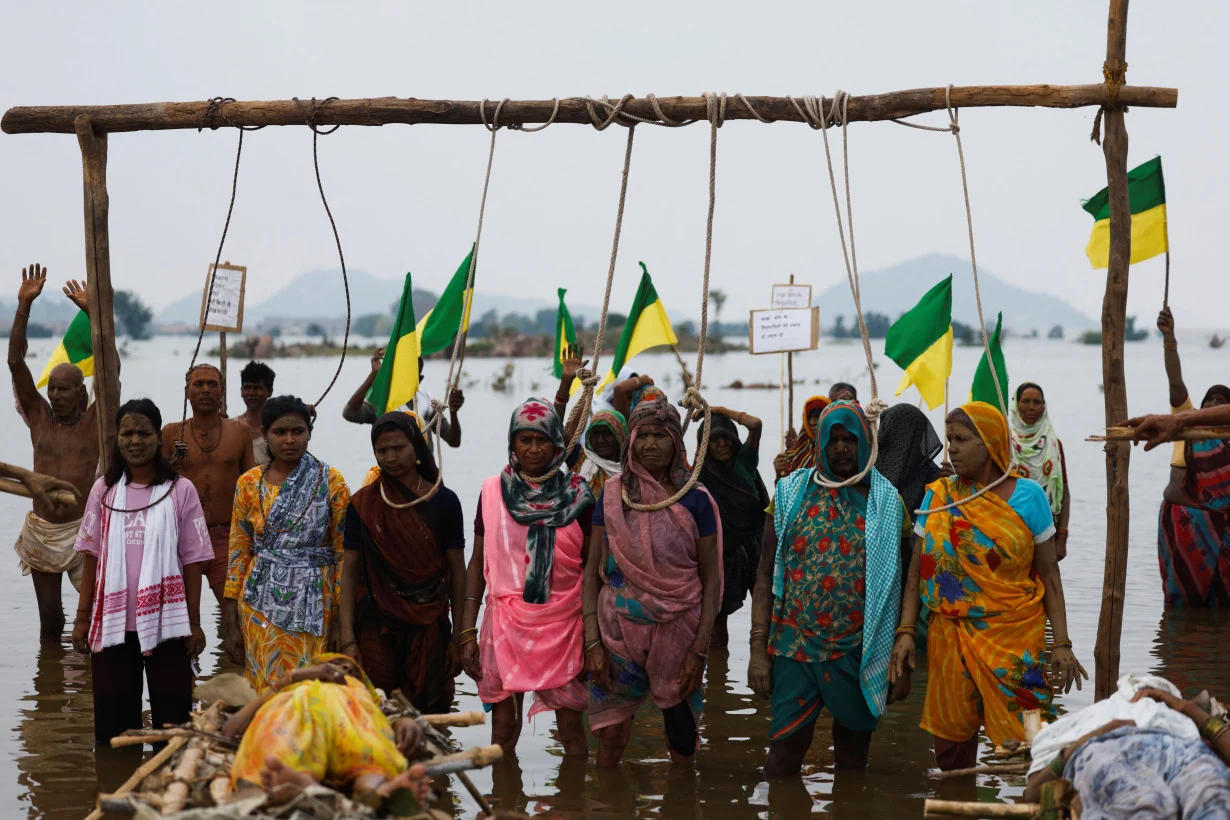
Villagers in India have protested an $87bn government project to link the country’s rivers, saying rising water levels have flooded their homes and temples, while the compensation offered for their displacement is inadequate.
The protesters, including members of tribal communities in Madhya Pradesh, are demanding better compensation and proper rehabilitation as construction progresses on the Ken-Betwa River Linking Project.
One of the protesters, Bitti Bai Kondar, was seen standing knee-deep in the Ken River with mud smeared on her face to symbolise her connection to land her family has cultivated for more than a century.
Her four adult sons have also joined the demonstrations.
Kondar said her village had been affected by rising water linked to the project, adding that residents were unwilling to abandon their ancestral homes without adequate compensation.
“The government is taking our land and water without giving us another place to live,” she said.
“They’re digging up our soil to build their dam, but they’re not giving us enough compensation to rebuild our lives.”
The project is part of India’s long-standing plan to connect about 30 rivers to redistribute water from areas considered to have a surplus to regions facing shortages.
The initiative, championed by Prime Minister Narendra Modi, is intended to improve agricultural production and strengthen food security by providing water to millions of farmers.
The Ken-Betwa link, which will connect the Ken River in Madhya Pradesh to the Betwa River in Uttar Pradesh, is the first phase of the initiative and is estimated to cost about $4.6bn.
The government has offered residents in the affected areas of Panna district at least 1.25 million Indian rupees, equivalent to about $13,000, per hectare of land. The amount is more than twice the initial offer of 500,000 rupees.
However, some residents maintain that the payments do not adequately cover their losses.
District administrator, Usha Parmar said compensation had already been paid to more than 90 per cent of those affected.
Dhaniram Bhatnagar, a local priest, said the project had submerged the temple where he worked, leaving him without his source of income.
“The temple was my only source of income and now it is gone,” he said.
“The compensation offered by the government is only for my home, and that is not enough.”
Meanwhile, environmentalists have raised concerns about the project’s potential impact on forests and wildlife.
They warn that the proposed 2km-long Daudhan Dam on the Ken River could inundate about 9,000 hectares of land, including a significant portion of the Panna Tiger Reserve, which is known for its tiger conservation efforts.
The Indian government has acknowledged that the environmental consequences are “unavoidable”, but said they could be reduced through tree planting, wildlife conservation and other interventions.
Critics have also questioned whether the project is based on sufficiently established scientific evidence, particularly the assumption that the Ken basin has excess water while the Betwa basin faces a deficit.
Himanshu Thakkar, coordinator of the South Asia Network on Dams, Rivers and People, said the project’s underlying assumptions had not been conclusively established.
“There is a big question mark over this project’s feasibility because it rests on a hydrological presumption: a surplus in the Ken basin and a deficit in the Betwa basin,” he said.
“That presumption has never been conclusively established.”
A government spokeswoman declined to comment immediately on the scientific assumptions behind the project, referring instead to an August 21 statement which said the initiative would help tackle chronic water shortages in the Bundelkhand region by providing irrigation, drinking water and hydropower.