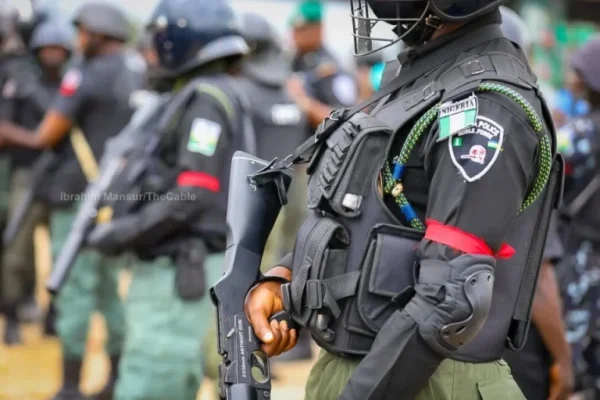
A new report released by the European Union Agency for Asylum has raised concern over Nigeria’s policing priorities, revealing that more than 100,000 police officers are currently attached to politicians and other influential individuals, rather than serving the general public.
The report, published in November 2025, noted that the Nigeria Police Force has an estimated workforce of about 371,800 officers, serving a population of roughly 236.7 million people.
According to the agency, diverting a significant portion of personnel to escort and protection duties worsens the country’s already limited police coverage.
“More than 100,000 police officers were assigned to the protection of politicians and VIPs, rather than to tasks serving the general population,” the report stated.
The document further linked slow response times, inadequate community patrols, and increased vulnerability to crime to manpower shortages and a lack of resources within the police system.
It also cited corruption and weak disciplinary structures as factors enabling professional misconduct among some officers.
“The shortage in manpower, as well as corruption and insufficient resources, has resulted in delayed responses to crimes and numerous communities being left without protection,” the report added.
Attempts to obtain comment from the Force Public Relations Officer, Benjamin Hundeyin, were unsuccessful as calls and messages were not answered.
Concerns over the use of police officers as private security are not new. In 2023 and again in April 2025, the Inspector-General of Police, Kayode Egbetokun, issued directives to withdraw Police Mobile Force operatives from VIP protection, arguing that the elite tactical team should focus on national security operations. However, the new findings suggest the practice has persisted.
Also reacting earlier in August, the Special Adviser to the President on Policy and Coordination, Hadiza Bala-Usman, criticised the culture of assigning heavily armed officers to private individuals.
“One of the most disturbing things for me is when VIPs arrive somewhere with so many policemen trailing them, while the areas that actually need security are left unattended,” Bala-Usman said.
“Whoever feels too important and wants machine gun-wielding personnel protecting him should go and hire a private security company.”
She emphasised the need for reforms that would allow private security firms to handle certain categories of protection, freeing police officers for core national duties.