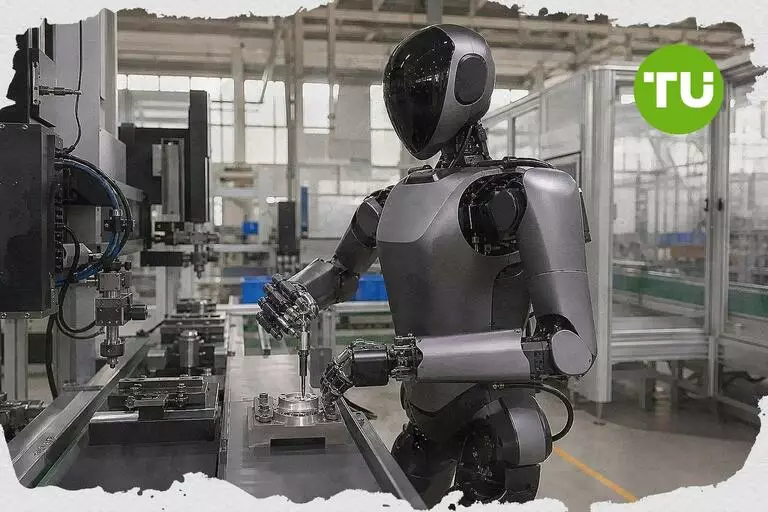
A Chinese technology startup, DexForce, is turning to virtual simulations to train humanoid robots, hoping to reduce development costs and accelerate the machines’ ability to perform practical tasks in real-world environments.
Based in Shenzhen, southern China, the company uses simulated environments to teach robots how to handle objects and carry out different activities. Its technology allows virtual robots to practise tasks under varying conditions, including changes in object colours, table positions and arm movements.
DexForce believes this approach could help address a major challenge facing the humanoid robotics industry: developing machines capable of independently performing a broad range of tasks in factories, offices and homes.
Although Chinese manufacturers have developed humanoid robots capable of impressive physical feats, such as running and jumping, ensuring that the machines can reliably perform useful work remains a significant commercial hurdle.
While many robotics companies collect extensive real-world data by recording human workers performing repetitive tasks, DexForce is relying on synthetic data generated through computer simulations to improve training efficiency and reduce expenses.
The company’s Chief Executive, Jia Kui, believes the strategy could accelerate progress in robotics in much the same way that ChatGPT transformed the development and adoption of generative artificial intelligence following its release in 2022.
“Trying to achieve ‘physical artificial general intelligence’ purely through real-world data collection would require 10 trillion samples … manual (data) collection for infinite human tasks is fundamentally inefficient,” Jia told Reuters.
He was referring to the prospect of humanoid robots eventually learning to perform unfamiliar tasks in new environments simply by receiving instructions.
Achieving that capability would require artificial intelligence systems that can understand their surroundings, navigate physical spaces and adjust to changing conditions.
FROM SIMULATION TO REAL-WORLD APPLICATIONS
DexForce develops artificial intelligence software that recreates physical environments and models how objects move and interact.
Through this technology, the company creates digital representations of workplaces and tasks, trains robots within those virtual settings and subsequently transfers the acquired skills to physical machines.
According to the company, simulated training offers a faster and less expensive alternative to gathering data from human trainers, who may have to repeat the same movements more than 100 times to produce sufficiently precise training examples.
The approach comes as China invests heavily in humanoid robotics, with dozens of training centres being developed across the country to generate data for teaching machines to perform real-world activities.
Many of these facilities require substantial funding and rely significantly on government subsidies.
However, most Chinese robotics manufacturers combine simulated training with real-world data collection, while access to high-quality training data remains a major obstacle for the industry.
STARTUP ATTRACTS MAJOR INVESTORS
Jia, a machine-learning professor at the Chinese University of Hong Kong, Shenzhen, founded DexForce in 2021.
The company employs approximately 500 people and has attracted investment from Lenovo Capital, the investment arm of Lenovo, and Lens Technology, alongside several state-owned investment funds.
DexForce recently raised one billion yuan, equivalent to approximately $147 million, in a Series B funding round that valued the company at more than 10 billion yuan.
Bloomberg previously reported that the startup was considering an initial public offering in Hong Kong, although Jia declined to comment on the report.
The company’s software is already being used in industrial operations by Chinese and international manufacturers, including Toyota, Samsung, Panasonic, Foxconn, Haier and Hisense.
Beyond industrial applications, DexForce also produces humanoid robots designed to interact with customers.
The machines have been deployed at shopping malls and tourist attractions in more than 15 Chinese cities, where they perform activities such as making coffee and serving customers.
As competition intensifies in the humanoid robotics sector, DexForce is betting that virtual training can provide a more efficient route towards machines capable of carrying out increasingly complex tasks without constant human intervention.