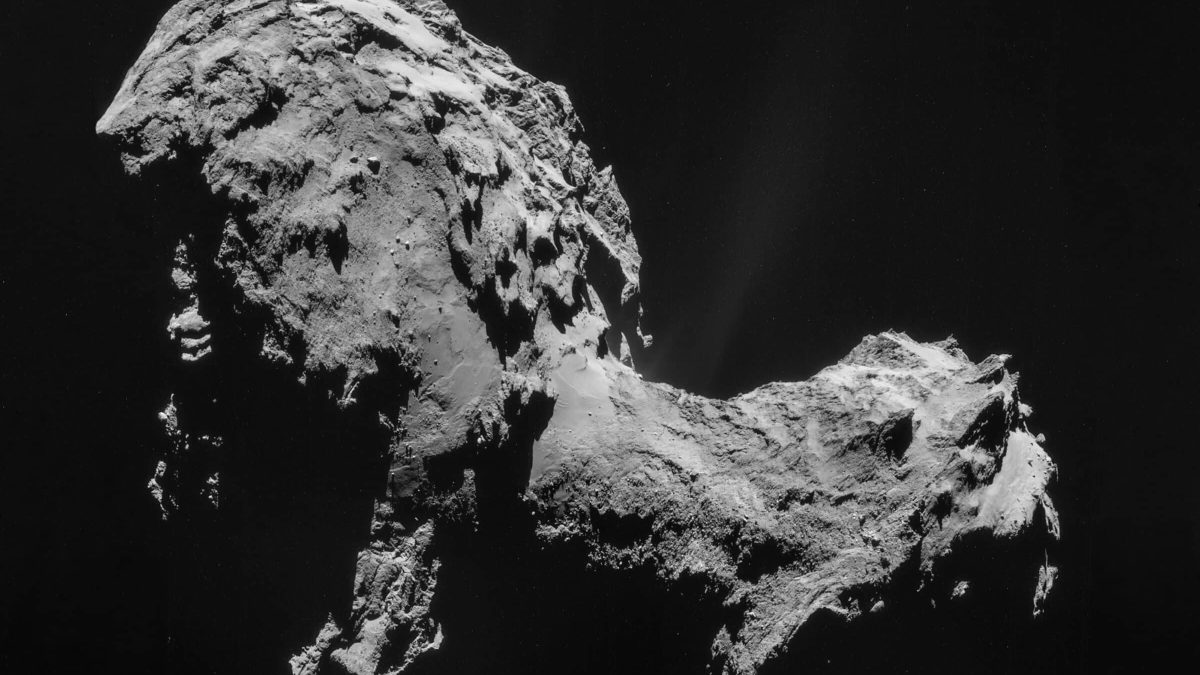
Scientists have questioned a decades-old theory that comets helped bring the building blocks of life to Earth, following new research suggesting that the extreme conditions created by their impacts could have destroyed essential organic molecules.
The theory, which dates back to at least 1961, proposes that comets delivered water and organic materials to early Earth, providing some of the ingredients necessary for life to emerge.
However, new computer simulations suggest that the icy space objects may have been travelling too fast to deposit these fragile substances without destroying them.
The study, published on Wednesday in the journal Scientific Reports, examined the possibility of comet impacts during Earth’s early history, more than four billion years ago.
Tesearchers estimated that the planet may have experienced bombardment from over 100,000 comets measuring more than 100 metres in diameter.
Using advanced models of comet formation and evolution, the research team conducted 100,000 simulations to assess whether organic molecules could survive such collisions.
The results showed that 54 per cent of the simulations recorded no impacts, while the remaining 46 per cent had at least one collision. Only a tiny minority produced as many as three impacts.
Lead author of the study, Richard Anslow, who conducted the research during his doctorate at the Institute of Astronomy, University of Cambridge, said the simulations found no successful impacts on average.
“Given what we know about surface environments on the early Earth, on average, our simulations found that there were no successful impacts,” he said.
The researchers particularly examined hydrogen cyanide, a chemical compound containing hydrogen, carbon and nitrogen that plays an important role in prebiotic chemistry.
The substance, which has been detected in several comets, can contribute to the formation of amino acids, the building blocks of proteins, when combined with water.
Anslow explained that the speed at which comets struck Earth could have exposed the chemical compounds to extreme temperatures and pressure, destroying many of the materials needed for the emergence of life.
“The typical velocities of these comets when they impact the Earth meant that actually very few, if any, would have been able to deliver intact organic molecules, so comets actually don’t seem to be as useful for prebiotic chemistry as was previously thought,” he said.
The study also noted that even when organic molecules survived an impact, they might not have reached Earth in sufficient concentrations to support prebiotic chemical reactions.
Those landing in oceans could also have dissolved quickly, while other essential elements, including phosphorus and sulfur compounds, were not routinely found in comets.
However, the researchers cautioned against completely dismissing the possibility that comets contributed to the emergence of life.
Anslow said rare successful impacts could have occurred under favourable conditions, although such events would have required a combination of specific environmental factors.
Scientists are now considering other possible explanations, including the possibility that early Earth produced the necessary organic molecules through chemical reactions in its primordial environment.
Asteroids have also emerged as potential contributors because they generally struck Earth at lower speeds and in greater numbers.
Samples collected from asteroids Bennu and Ryugu have revealed several amino acids used in building proteins, strengthening interest in the possibility that asteroids delivered important organic materials to Earth.
The findings have also raised questions about whether ancient Mars offered better conditions for preserving organic compounds delivered by comets.
According to Anslow, the planet’s smaller size and greater distance from the Sun meant that comets would typically have struck it at lower speeds than on Earth.
“Because Mars is much smaller than Earth and further away from the sun, the typical impact velocity of comets is much lower, so while these impacts on Earth were destroying most of the HCN, this wasn’t the case so much for Mars,” he said.
Despite the findings, some scientists believe comets may still have played a role in supplying the chemical ingredients necessary for life.
Queenie Chan, an associate professor of Earth sciences at Royal Holloway University of London, who was not involved in the research, said chemical reactions occurring before comets entered Earth’s atmosphere could have produced more stable organic compounds capable of surviving impacts.
“Therefore, the inefficiency of delivering intact HCN does not completely rule out a potential role for comets in supplying other important organic compounds that may have contributed to Earth’s prebiotic organic inventory before the emergence of life,” Chan wrote in an email.
Similarly, Nicolle Zellner, a professor of physics at Albion College in Michigan, said the findings provided useful evidence about the limitations of comet impacts but did not completely eliminate their possible contribution to the origin of life.