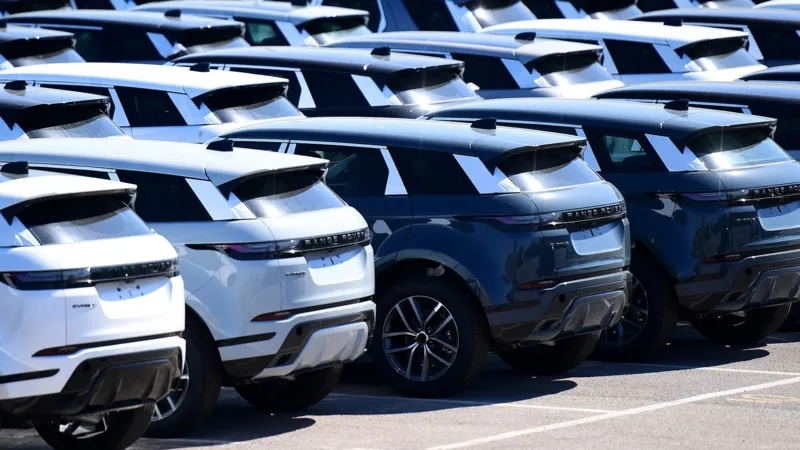
Jaguar Land Rover is set to cut about 4,000 jobs over the next two years as the British carmaker battles rising competition from Chinese manufacturers, US tariffs and the costly shift towards electric vehicles.
The planned redundancies will largely affect employees at the company’s UK-based head office.
JLR employs around 43,000 people globally.
The latest job cuts come after a cyber-attack last year forced the company to halt production for more than a month, worsening existing financial and operational pressures.
JLR chief executive PB Balaji said the company would support affected employees throughout the redundancy process.
“The automotive industry faces significant challenges, with technological change amidst intense competition and ongoing geo-political uncertainty,” he said.
He added that JLR was “committed to supporting everyone with care, fairness and respect” through the redundancy process.
The company is initially seeking to reduce its workforce through voluntary redundancies, with employees given until 4 October to apply.
However, JLR warned that compulsory redundancies could follow if the targeted reduction is not achieved, with less generous terms likely to apply.
The restructuring is expected to help the company save about £1.7bn over the next two years.
JLR’s difficulties have been compounded by declining sales in China, where the company had previously identified significant growth opportunities.
Chinese carmakers have increasingly emerged as major competitors in both domestic and international markets.
The company has also been affected by tariffs imposed by US President Donald Trump.
Unlike several major competitors, JLR does not operate a manufacturing plant in the United States, leaving it more exposed to the impact of the tariffs.
JLR reported that its revenue fell to £22.9bn in the year to the end of March, compared with £29bn over the previous two years.
It identified the US tariffs and the cyber-attack as major factors behind the decline.
David Bailey, a business and economics professor at Birmingham University, described JLR as “as strategically important as it gets for the UK economy”.
He said the company’s importance extended beyond its direct workforce because thousands of jobs depend on its supply chain, while the wider economy was affected when production was suspended following the cyber-attack.
“It’s the centre of our automotive industry,” he added.
Ian Robertson, a former director at BMW, said JLR should have followed competitors such as BMW and Mercedes-Benz by establishing production facilities in the US.
“The biggest operation for BMW in the world is in Spartanburg, South Carolina. Mercedes have their plant further south in Tuscaloosa. JLR didn’t take that decision early enough in my view,” he told the BBC’s Today programme.
Robertson also criticised JLR’s pace in adopting electric vehicles, saying it had been “somewhat late to the party”.
Jaguar introduced its fully electric I-PACE SUV in 2018, but the electric Range Rover announced recently will be the company’s first new electric vehicle launch since then.
Robertson also argued that Brexit had negatively affected the company, although JLR’s manufacturing facility in Slovakia provides some flexibility.
The UK government said it was aware of the uncertainty facing employees and communities affected by the announcement.
The prime minister’s official spokesman said, “We understand that this will be an uncertain and concerning time for affected workers, their families and the wider communities.”
The spokesman also confirmed that Business Secretary Jonathan Reynolds “is in close contact with JLR and he will be meeting them early this week”, while ruling out “any form of bailout”.
Business and trade committee chair Liam Byrne described the announcement as a “body blow for workers, families and communities across the West Midlands”.
“Whether or not these redundancies are voluntary, we now need urgent assurances that maximum support will be deployed to help everyone affected find new work,” he said.
Unite general secretary Sharon Graham said the union would seek urgent details about the planned reductions and called for JLR and the government to consider every possible measure to limit job losses.
“Unite will be demanding all necessary levers are pulled to support JLR workers,” she said.
“It cannot be acceptable that workers again are made to pay the price for failings not of their making.”
The announcement has also reignited debate over the UK’s zero-emission vehicle mandate, which was introduced under the previous Conservative government and retained by Labour.
The policy requires manufacturers to ensure that all new cars and vans sold in the UK are zero-emission vehicles by 2035.
However, the requirement does not apply to vehicles sold overseas, where JLR generates much of its revenue.
Shadow transport secretary Richard Holden blamed the mandate and high energy costs for some of the difficulties facing Britain’s car industry, describing them as “crippling the British automotive industry” and promising to scrap the policy.
The UK Sustainable Investment and Finance Association, however, has defended the mandate, previously describing it as “crucial for attracting finance into this infrastructure as it sets out a clear, predictable pathway for the growth of the electric vehicle market”.