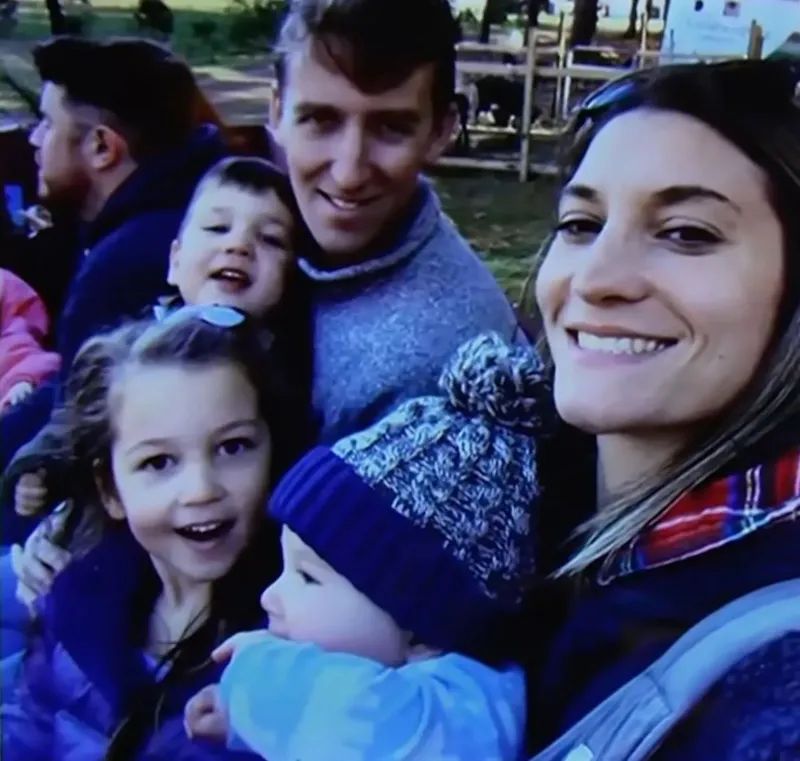
A Massachusetts judge in the United States has declared a mistrial in the murder case involving Lindsay Clancy, a 36-year-old former nurse accused of killing her three young children, after jurors failed to reach a unanimous verdict following more than 40 hours of deliberations.
The decision came on Friday after the jury, which had spent seven days considering the case, indicated that it remained deadlocked over whether Clancy should be held criminally responsible for the deaths.
Clancy faces three first-degree murder charges over the 2023 deaths of her children, Cora, 5, Dawson, 3, and Callan, who was eight months old.
She has not denied killing the children but pleaded not guilty, with her defence arguing that she was experiencing postpartum psychosis at the time and therefore should not be considered criminally responsible.
Judge Sullivan told the jury: “At this point, I’m going to declare that the jury is deadlocked, and I’m going to declare a mistrial.”
A mistrial does not amount to either a conviction or an acquittal.
It means the jury was unable to reach the unanimous decision required for a verdict.
The development followed a tense start to proceedings on Friday, when Clancy’s lawyer, Kevin Reddington, asked for one juror to be removed from the panel.
The request came after jurors had indicated in a note the previous day that a member of the panel was allegedly not applying the legal standard of reasonable doubt correctly.
Under US law, jurors must be convinced beyond a reasonable doubt that a defendant is guilty before returning a conviction.
Judge Sullivan rejected Reddington’s request and sent the jury back to continue deliberations.
About an hour later, the jurors returned and said they still could not reach an agreement.
Reddington then made an emergency appeal to the Massachusetts Supreme Judicial Court, asking it to require the jury to continue deliberating and allow the judge to question the panel about the alleged holdout juror.
The state’s highest court rejected the request, clearing the way for the mistrial to be formally declared.
Clancy appeared subdued as the judge announced the decision, while Reddington visibly expressed his frustration.
He argued that the alleged holdout juror was not acting in good faith and maintained that the judge had authority to remove the juror.
Reddington said he planned to file another motion seeking to have the mistrial reconsidered, an issue that could be addressed at a hearing scheduled for 29 September.
Plymouth County District Attorney Timothy Cruz said prosecutors had not yet decided how they would proceed.
“There will be no decisions made today,” Cruz said, adding that he would consult with his legal team before determining whether to seek another trial.
He also maintained that prosecutors believed Clancy was responsible for the killings.
“The facts are Lindsay Clancy killed her three children and the evidence suggested to us that she was in control of her actions when she committed those homicides,” he said.
Outside court, Reddington claimed that 11 of the 12 jurors would have reached a verdict favourable to Clancy if not for the alleged holdout.
However, the actual positions of individual jurors and the details of their deliberations remain unknown.
The case has attracted widespread attention across the United States, with extensive coverage of the trial and intense public debate about postpartum psychosis and criminal responsibility.
After killing the children, Clancy cut herself with a knife and jumped from a second-storey window in what prosecutors said was an attempt to take her own life. The injuries left her paralysed, and she remains in a mental health facility.
US President Donald Trump also commented on the case on Friday, describing it as a “horrible tragedy”.
“She did a horrible, horrible thing. Can’t be worse,” he said at the White House. “I assume there’s going to be another trial.”
“But you’ll find out what the price to pay is,” Trump added. “There’ll be a price.”
For now, Clancy remains in custody on the same murder charges while prosecutors consider whether to retry the case, negotiate a plea agreement or pursue another legal option.