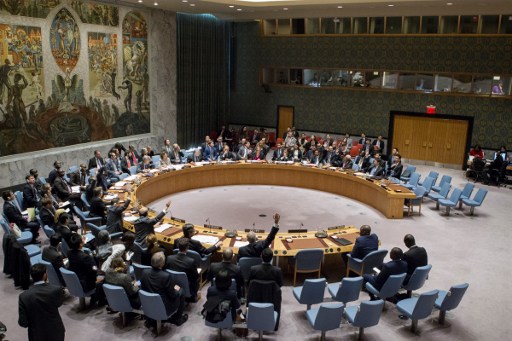
The United Nations Security Council is set to conduct a second informal straw poll to assess support for candidates seeking to become the organisation’s next Secretary-General.
The 15-member council, including the five permanent members with veto powers, will vote anonymously on Friday as the selection process gathers momentum ahead of the end of António Guterres’ tenure on December 31, 2026.
Costa Rica’s Rebeca Grynspan emerged as the leading candidate in the first poll held in July.
Other contenders include Argentina’s Rafael Grossi, who heads the UN nuclear watchdog; former Chilean President Michelle Bachelet; Ecuador’s Maria Fernanda Espinosa; Guyana’s Carolyn Rodrigues-Birkett; Uganda’s Olara Otunnu; and former Senegalese President Macky Sall.
Ecuadorian candidate Ivonne A-Baki joined the race after the first round of voting.
Analysts say Friday’s poll may provide a clearer picture of the direction of the contest, although no candidate is expected to secure a decisive advantage at this stage.
Daniel Forti of the International Crisis Group said, “Diplomats expect fluctuations in the vote distribution compared to the July poll,” adding that attention would focus on whether the early frontrunners strengthen or lose support.
He also noted that the five permanent members — Britain, China, France, Russia and the United States — could delay revealing their preferences until later in the process.
Russia’s UN ambassador, Vassily Nebenzia, similarly suggested that more candidates could enter the race if the current contenders fail to break a deadlock.
He said, “If there is a deadlock on any of the candidates we are seeing today… then I think that we may see other candidates as well.”
A candidate needs at least nine votes from the 15-member council and must avoid a veto from any of the five permanent members before being referred to the UN General Assembly for final confirmation.
During the early stages, council members classify each candidate as “encourage,” “discourage,” or “no opinion.” The process is designed to allow candidates with little support to withdraw voluntarily.
The informal voting system was introduced in the 1980s to help resolve disagreements over the selection of a Secretary-General and has remained part of the process despite criticism over its lack of transparency.
Forti said some candidates could decide to end their campaigns following Friday’s vote.
Traditionally, the UN’s top position is rotated among different regions. With Guterres, a European, completing his second term, there is growing expectation that the next Secretary-General could come from Latin America, where several of the current candidates are from.
The final decision will be made by the General Assembly after the Security Council recommends a candidate.