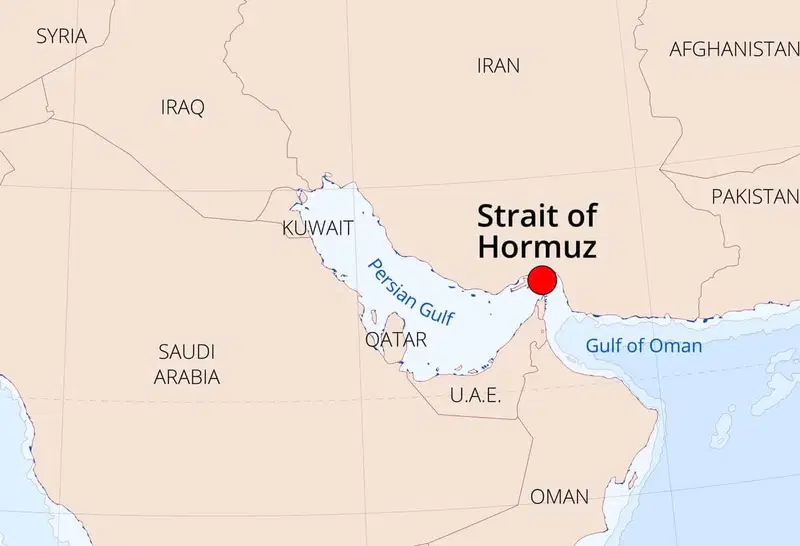
Iran has announced it is again closing the strategic Strait of Hormuz shipping route on Saturday, citing Israel’s military actions in Lebanon as a violation of its agreement with the United States aimed at ending the wider Middle East conflict.
The development comes as Israeli forces continued ground clashes with Hezbollah fighters while its air force carried out deadly strikes in southern Lebanon on Saturday.
The fighting escalated just hours after the United States announced a renewed ceasefire arrangement in the country.
The fragile agreement, signed this week between the United States and Iran, had been intended by US President Donald Trump and Iranian President Masoud Pezeshkian to de-escalate regional tensions across multiple fronts, including Lebanon.
However, it has already come under severe strain amid renewed violence.
Iran’s central military command accused Washington of breaching the deal and condemned what it called ongoing Israeli violations. It stated on Saturday “that the Strait of Hormuz will be closed to vessel traffic”.
The Strait of Hormuz, a critical passage for global oil and gas shipments, had previously seen disruptions during the conflict, sending shockwaves through international energy markets.
Under the preliminary US-Iran understanding, Iran had agreed to reopen the route, with shipping activity gradually resuming in recent days.
Separately, follow-up negotiations on the US-Iran framework, scheduled to take place in Switzerland, were postponed indefinitely after Israel launched a wave of airstrikes in Lebanon following the deaths of four Israeli soldiers in combat.
On Friday, a US official had announced a fresh ceasefire between Israel and Hezbollah, brokered by American and Qatari mediators. Israel’s ambassador to Washington said the truce would be respected if Hezbollah also complied.
However, Israeli military officials later confirmed continued operations, accusing Hezbollah of firing “more than 50 projectiles at Israeli forces in southern Lebanon” overnight.
Hezbollah rejected the accusations, stating that Israel had attempted a ground incursion during the ceasefire window. The group said its fighters responded accordingly.
Lebanese state media reported Israeli air raids across roughly 20 locations, while the country’s civil defence agency said 16 people were killed in the Nabatieh area.
An AFP photographer described smoke rising over the city following the strikes. Additional strikes near Sidon reportedly killed seven more people and wounded 13, according to Lebanon’s health ministry.
On the Israeli side of the border, another AFP journalist reported smoke rising near the historic Beaufort Castle, a strategic position close to Nabatieh that Israel captured last month.
Hezbollah lawmaker Hassan Fadlallah said Saturday that the group “has the full right to confront this enemy when it attacks us”.
An Israeli military official, cited by public broadcaster Kan, said Israel’s operations are being conducted “on the basis of fire being answered with fire”.
Israel’s ambassador to the United States, Yechiel Leiter, insisted Hezbollah was responsible for breaking the truce, stating, “Israel is honouring the ceasefire while defending itself against terrorist attacks, as any self-respecting country would.”
Fadi Zayat, a displaced resident from southern Lebanon, described the growing fear among civilians, saying: “Fear dominates over everyone”.
“We returned to the village a few days ago, but our bags are ready to flee again,” the 53-year-old said. “We’re waiting for a serious decision to end the war… in order to return to our lives.”
Hezbollah entered the broader regional conflict earlier this year after exchanging fire with Israel following strikes linked to Iran and allied groups. A previous ceasefire effort in Lebanon in April also collapsed.
Lebanese President Joseph Aoun urged the United States to pressure Israel to halt strikes during a call with US Secretary of State Marco Rubio, according to his office.
Rubio, however, stressed the need for Lebanon to disarm Hezbollah and reassert full state control over its territory.
Diplomatic efforts continue in parallel. Israel and Lebanon, which have no formal diplomatic relations, have held US-mediated talks in Washington, with another round expected next week.
Meanwhile, planned US-Iran negotiations in Switzerland aimed at building on the initial agreement were postponed, with no new date confirmed.
US Vice President JD Vance had been expected to participate but delayed his trip. US envoy Steve Witkoff was instead dispatched to try to revive discussions, alongside reports that adviser Jared Kushner was also involved.
Pakistan’s interior minister Mohsin Naqvi also arrived in Iran for consultations, according to Iranian media.
The Swiss foreign ministry confirmed that diplomatic representatives remain engaged, saying envoys “from various countries currently present are continuing their efforts to maintain the dialogue”, while declining to provide further details.
Swiss broadcaster RTS reported that technical delegations from the United States, Iran, Pakistan, and Qatar were still participating in discussions.