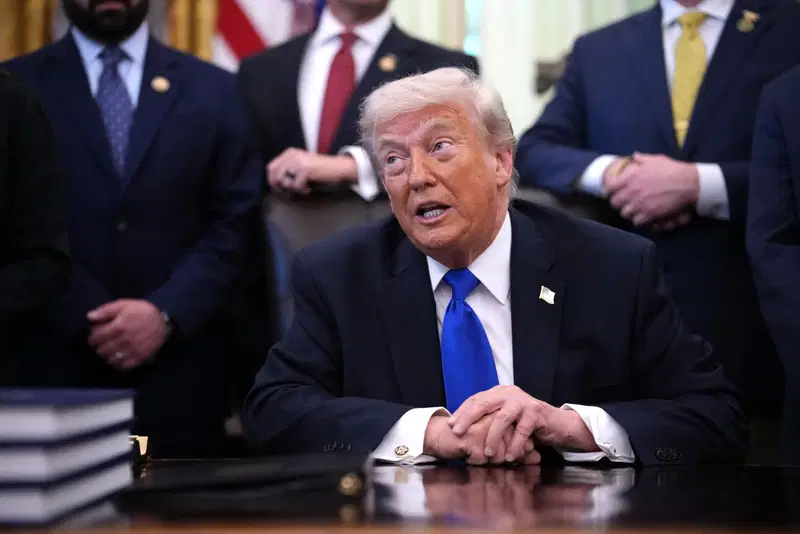
The United States House of Representatives has approved a resolution aimed at preventing President Donald Trump from escalating military operations against Iran without congressional approval.
The measure passed narrowly by a 215-208 margin after four Republicans broke ranks to join Democrats in a rare bipartisan rebuke of the ongoing conflict, which began in February.
The vote marks the fourth effort by lawmakers in the House to limit Trump’s authority to wage war without approval from Congress.
Despite the House victory, the resolution still faces a major hurdle in the Republican-controlled Senate. Even if passed there, it may not completely stop further military operations against Iran.
Trump also retains the power to veto the measure, meaning supporters would need a two-thirds majority in both the House and Senate to override his decision.
A similar resolution cleared a Senate procedural stage in May following seven unsuccessful attempts, although it has yet to be debated on the Senate floor.
Republicans Thomas Massie, Brian Fitzpatrick, Tom Barrett and Warren Davidson joined Democrats in supporting the measure.
Democrat Jared Golden of Maine, who had opposed previous efforts to curb Trump’s war powers, backed the resolution this time.
“Congress alone declares war, that’s something certainly we need to be protective of,” Barrett, a Republican from Michigan, said.
Asked if he was worried about retribution from Trump for his vote, Barrett said, “I vote my conscience for what I think is right and willing to accept that.”
Wednesday’s vote highlighted growing divisions within the Republican Party and came shortly after conservative lawmakers forced the administration to abandon plans for a $1.8bn “anti-weaponization” fund intended for political allies.
Representative Gregory Meeks, the top Democrat on the House Foreign Affairs Committee, called the outcome “a significant bipartisan rebuke of President Trump’s illegal and costly war in Iran and the first step toward ending it once and for all”.
Meeks argued that the military campaign had failed to meet its objectives while worsening fuel costs in the United States and complicating diplomatic efforts over Iran’s nuclear ambitions.
“The passage of this [measure] today signals a significant turning point: more and more Republicans are listening to their constituents who do not want another open-ended war in the Middle East,” Meeks, who co-sponsored the resolution, said.
The conflict intensified after the US and Israel launched coordinated strikes on Iran on 28 February.
Iran retaliated with attacks on Israel and several US-aligned Gulf nations, while also effectively shutting the Strait of Hormuz, one of the world’s most important shipping routes.
In April, Washington announced a blockade targeting vessels travelling to and from Iran’s coastline.
Both countries later agreed to an initial ceasefire on 8 April, but hostilities have continued in recent days.
The US carried out additional strikes on Iranian targets, while Tehran responded with attacks on Kuwait, a key US ally.
Ahead of Wednesday’s vote, Trump insisted that negotiations to end the conflict were progressing positively and could be concluded soon.
“We hit them pretty hard the night before, and actually last night,” Trump told reporters at the White House on Wednesday, referring to strikes in Iran. “Some people would say they were slightly provoked because we took a strong action for a different reason, so they were reciprocating.”
The president added that most members of his administration were eager to bring the conflict to an end through diplomacy.
“Theory they’re pretty close to signing a paper, we’ve actually gotten along with them very well.”
“In theory they’re pretty close to signing a paper, we’ve actually gotten along with them very well.”