

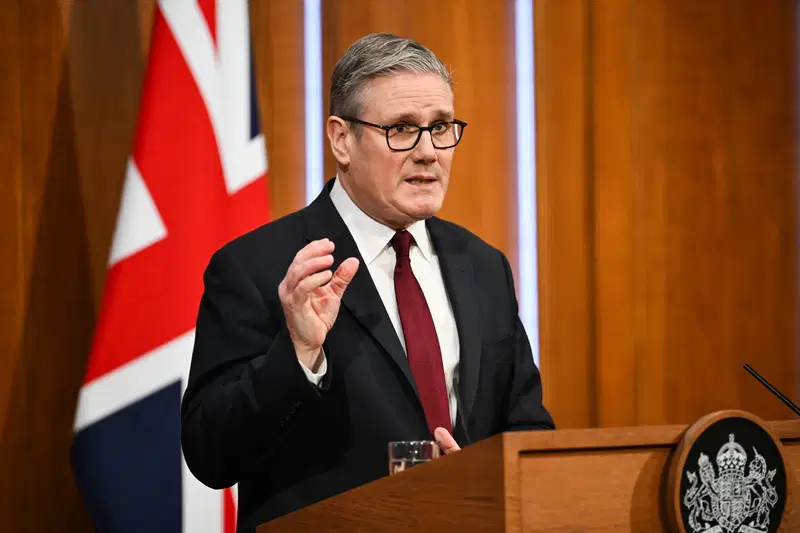
British Prime Minister, Keir Starmer, has announced he will step down after less than two years in office, ending a tenure marked by repeated policy reversals, internal party tensions and declining public approval.
“Every decision I have taken has been about putting the country I love first. That is why I will resign as leader of the Labour Party,” Starmer said as he choked up in an emotional speech outside 10 Downing Street.
He confirmed that the leadership process for the centre-left Labour Party would begin in July, while he would continue serving as prime minister until a successor is selected.
The transition is expected to conclude before parliament reconvenes from its summer recess in September.
Among those positioning for the top job is veteran politician Andy Burnham, who is set to return to the House of Commons on Monday after winning a key special election on Thursday, strengthening expectations that he will enter the leadership contest.
“I will remain in post as prime minister until the contest is complete, and I will do everything I can to ensure an orderly handover of power,” Starmer added.
Until recently, Starmer had insisted he intended to remain in office despite growing pressure, mounting scandals, and a series of high-profile resignations that weakened his authority within government.
His position had been under sustained strain for months, as internal divisions and public dissatisfaction deepened within both the government and the Labour Party.
The UK is now poised to have its seventh prime minister in just a decade, reflecting a period of intense political instability since the Brexit referendum.
Starmer’s resignation comes just ahead of the 10th anniversary of the referendum that led to the country’s exit from the European Union and ushered in years of rapid leadership turnover.
While he is credited with rebuilding Labour into an election-winning force that secured a decisive 2024 victory and ended 14 years of Conservative rule, his leadership has also been overshadowed by policy setbacks and controversy.
His tenure was disrupted by decisions such as cuts to benefits and criticism over defence spending, both of which eroded support.
He also faced a near-ousting in March following controversy surrounding the appointment of Peter Mandelson, a known associate of the late US sex offender Jeffrey Epstein, as ambassador to Washington.
More recently, Labour has struggled to contain the rise of the far-right, anti-immigration Reform UK party, which defeated Labour in local elections in May and further weakened Starmer’s political standing.
“I will also give my successor my full and unequivocal support, knowing that they will inherit a Britain that is far stronger and fairer than the one I inherited two years ago,” Starmer said in his resignation speech.









