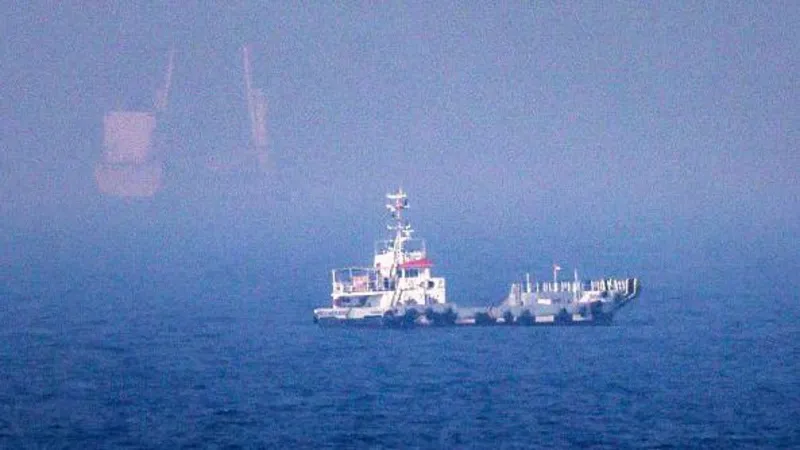
The United Arab Emirates has accused Iran of carrying out what it described as a “brazen” attack on two Emirati tankers in the Strait of Hormuz, killing one crew member and injuring eight others, as US President Donald Trump announced a 20% charge on cargo moving through the strategic waterway under a renewed US naval blockade.
Trump said the United States was striking Iran “very hard” as military operations continued for a third straight night amid intensifying hostilities between the two countries.
Iranian Foreign Minister Abbas Araghchi reacted to the blockade announcement by insisting Tehran would remain the Strait’s “GUARDIAN” — echoing Trump’s own wording.
The latest developments have further complicated efforts to end the conflict, although Trump maintained that a diplomatic agreement remained achievable.
According to the UAE Ministry of Defence, Iranian cruise missiles struck two national oil tankers on Monday night, killing one Indian crew member and leaving eight others injured, including four in critical condition.
The ministry said six of the injured were Indians, while the remaining two were Ukrainians.
“The Ministry of Defense condemns this brazen attack, which constitutes a serious violation and a clear breach of international law, threatening the security and stability of the region,” the ministry said in a statement posted on X.
Iran’s Islamic Revolutionary Guard Corps (IRGC) later confirmed responsibility for the attack in a Telegram statement, claiming the vessels had ignored repeated warnings, switched off their navigation systems and attempted to pass through a mined route.
The IRGC said it disabled both tankers, warning that “co-operation with the aggressor enemy” would only bring regret, destruction and delays in reopening the Strait, as well as the “creation of an energy crisis in the world”.
The escalating conflict continued to affect global energy markets, with Brent crude rising 0.7% to $83.87 per barrel in Asian trading on Tuesday, while US crude gained 0.9% to $79.04 after Brent had already surged more than 9% on Monday.
The Strait of Hormuz remained at the centre of the confrontation after both countries exchanged attacks following overnight strikes on Sunday.
In a post on Truth Social, Trump announced that the US would reinstate a naval blockade of Iranian ports and introduce a 20% charge on all cargo passing through the Strait of Hormuz.
He said the move would prevent “Iran’s ships or customers” from using the vital shipping route, while allowing “all other countries… fair and open use of the Strait”. The blockade is scheduled to take effect at 16:00 Eastern Time (20:00 GMT) on Tuesday.
“The U.S.A. will be, from this point forward, known as “THE GUARDIAN OF THE HORMUZ STRAIT,” but as such, and as a matter of FAIRNESS, will be reimbursed, at the rate of 20% on all cargo shipped, for any and all costs necessary to do the job of providing safety and security to this very volatile section of the World,” Trump wrote.
Speaking later at the White House, the president said the US was “hitting them very hard”.
“We’re knocking out all of their offensive capability. And we’re controlling the Strait,” he added.
Asked whether peace negotiations were still possible, Trump replied: “Yeah, I think a deal is possible, sure, I do.”
US Central Command said the latest wave of strikes began at 16:45 Eastern Time (20:45 GMT) on Monday under orders from the commander-in-chief.
It later confirmed attacks on military targets in Bushehr, Chah Bahar, Jask, Konarak, Abu Musa and Bandar Abbas, saying the operation was intended to “further degrade Iran’s ability to attack commercial shipping”.
Iranian state media reported that Iran’s military responded by targeting US military assets in Kuwait.
The IRGC also said it struck Bahrain, claiming to have destroyed several weapons depots, a satellite communications centre and a building housing US forces.
Early Tuesday, the IRGC further announced it had fired ballistic missiles at an air base in Jordan.
Trump also told Fox News that the US would “probably run” the Strait of Hormuz, accusing Iran of breaking an earlier agreement with Washington.
“We are taking over the strait,” he said.
CENTCOM later confirmed that US forces “will resume blockading maritime traffic entering and exiting Iranian ports” from 14 July.
“The US military continues to support traffic flow through regional waters for all vessels not violating the blockade,” the command said.
Last Friday, Trump informed Congress in a letter, seen by the BBC, that US military operations in Iran had resumed on 7 July.
Under US federal law, congressional approval is required for military operations lasting beyond 60 days, although the White House may extend that period by an additional 30 days on national security grounds.
Responding on X, Iranian Foreign Minister Abbas Araghchi wrote: “POTUS is absolutely right. Whoever provides secure and safe passage of commercial vessels through the Strait of Hormuz should be compensated for this service.”
He added: “Iran has always been the GUARDIAN of the Strait and will remain so FOREVER.”
“20% is of course too much. We will be fair,” Araghchi said.
Meanwhile, the International Maritime Organization, the UN agency responsible for global shipping regulations, rejected the proposal.
“IMO stands firmly against charging fees for passage through straits used for international navigation,” an IMO spokesperson told Reuters.
“There is no legal basis through which to introduce mandatory tolls simply to transit through a strait,” the spokesperson added.
Before Trump’s announcement, Iran’s Khatam al-Anbiya military headquarters had warned the US against interfering in the management of the Strait.
Spokesperson Ebrahim Zolfaghari accused Washington of “repeated adventurism and malicious actions” that had “seriously endangered regional security, international trade and the passage of oil tankers and commercial vessels”.
He warned that any country cooperating with the United States would be regarded as participating in “war” against Iran’s sovereignty, adding that if the conflict widened, “the flames of war will engulf all the countries of the region”.
Despite Trump’s declaration, uncertainty remains over how the proposed blockade and cargo charge would work in practice.
Under international law, coastal states exercise sovereignty over territorial waters extending 12 nautical miles from their shoreline. At its narrowest point, the Strait of Hormuz and its shipping lanes lie within the territorial waters of Iran and Oman.
Iran effectively closed the waterway after US and Israeli strikes on 28 February, prompting missile and drone attacks on Israel and US military bases across the Gulf.
The IRGC also previously fired at commercial vessels attempting to pass through the Strait without its approval and seized two ships, sharply reducing maritime traffic and pushing oil prices higher.
Washington first imposed a naval blockade on Iranian ports in April to increase pressure on Tehran, before lifting it in June under a memorandum of understanding aimed at easing tensions.
The renewed blockade and proposed 20% cargo charge are expected to face resistance from US allies, many of whom are unlikely to support paying Washington for passage through an international shipping route.
The move could also create political challenges for Trump at home, with critics questioning the benefits of the renewed confrontation and expressing concern over rising fuel prices ahead of the US midterm elections.