A court order has led to the removal of President Donald Trump’s name from the John F. Kennedy Center for the Performing Arts in Washington, DC, after a legal dispute over the building’s signage reached a deadline set by a federal judge.
Kennedy Center Executive Director Matt Floca confirmed in court documents on Saturday that Trump’s name had been fully taken off the building, in compliance with the ruling.
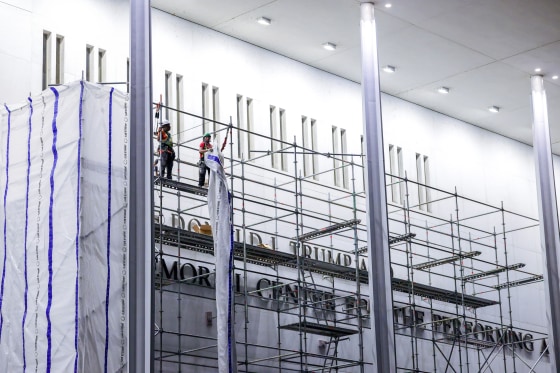
Crews had placed a tarp over the exterior signage on Friday, concealing ongoing work, and it remained in place into Saturday morning even after the removal was reported.
The court had earlier granted a short extension, pushing the deadline from 11:59 p.m. Friday to noon ET Saturday after the center missed the initial cutoff.
The delay was partly attributed to thunderstorms in the Washington area, according to Justice Department attorneys representing the institution.
By early Saturday, workers were seen dismantling the signage, with video footage from CNN showing the removal process underway.
Scaffolding had been erected on Friday, and at points overnight, coverings were draped around the structure, blocking public view as the work continued.
At around 3 a.m., crews were seen taking down the letters from the façade.
A small crowd gathered outside the center as the removal took place, with some taking photos and observing the process.
One attendee, JoAnn Jones, expressed approval of the development, saying, “I just wanted to see (Trump’s) name gone,” JoAnn Jones told CNN. “When a person wants to put their name on a building that you had nothing to do with, you did no work, you just, you don’t deserve it.”
Protesters and onlookers had been present throughout the operation. At one point Friday night, chants of “Shame!” were heard as crews paused work during a storm and legal proceedings continued.
Earlier, some in the crowd had also shouted “Take it down,” while others referred to the workers as “heroes.”
Legal arguments surrounding the case continued in parallel with the physical removal.
An appeals court recently declined to freeze the lower court’s ruling, though it did not provide reasoning. The panel included Judge Gregory Katsas, Patricia Millett, and Robert Wilkins, and requested further written submissions from both sides.
In filings, Justice Department lawyers argued that reversing the name change could cause public confusion and potentially affect funding arrangements tied to donor agreements.
They stated, “All of this money, hundreds of millions of dollars, will have to be immediately returned, or not received by the Center,” the department told the appeals court.
The filings also noted that compliance could affect private donations tied to naming rights provisions, while the legal dispute over the center’s branding continues.
Rep. Joyce Beatty, who has been involved in the legal challenge, visited the site during the operation.
“We know we’re on the right side of justice and the law,” Beatty said to applause from protesters. “No matter what happens, we’re going to continue to fight for the Kennedy family.”
After confirmation that the name had been removed, Beatty later shared a celebratory video on social media with the caption, “POV: When you protect the Kennedy Center”
The signage bearing Trump’s name had been installed in December following a board decision to include it in honor of the president, whose influence on the institution’s leadership and programming has been widely debated.
The move drew criticism from members of the Kennedy family and triggered the current legal challenge.
The center’s board also recently approved a resolution praising Trump’s “profound dedication” to the arts institution and establishing the “Trump Kennedy Center Fund,” intended to support additional private fundraising for the organization.
Outside the building, visitors reflected on the controversy as they watched the removal unfold.
Jon Knepp, who previously worked at the John F. Kennedy Presidential Library in Boston, said the ruling carried symbolic weight against self-naming public institutions.
Another visitor, Susana Quinonez, who has been a long-time patron, said she returned after the tarp was placed over the scaffolding.
“This has nothing to do with security,” Quinonez, who has been a patron of the institution for 22 years, said about the tarp. She added that she thinks the removal is being hidden so that “people don’t enjoy … watching that.”