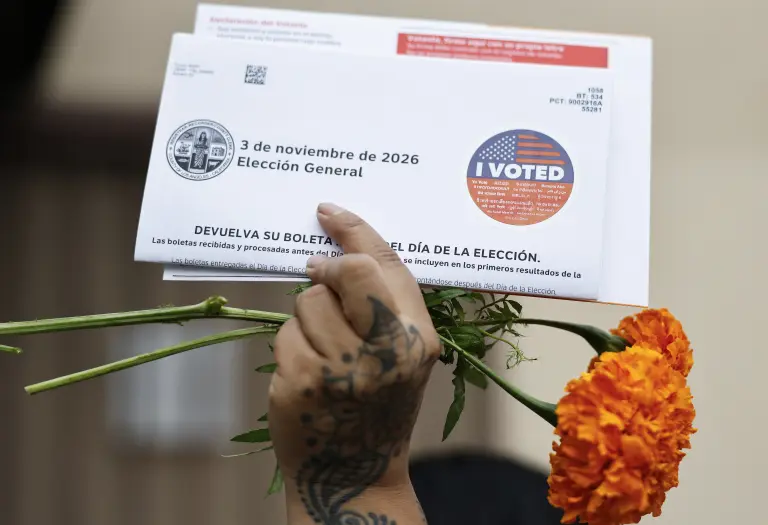
The administration of United States President Donald Trump has asked the Supreme Court to temporarily stop California from counting mail-in ballots cast by more than 20,000 registered voters whose citizenship status has been questioned by federal officials.
The emergency application, filed by the Justice Department on Monday, seeks to prevent the ballots from being counted until the voters’ citizenship is verified.
The move comes a day before the US midterm elections, amid an escalating legal dispute over voting procedures in the state.
The request followed a Friday decision by a federal appeals court rejecting the administration’s bid to block the ballots.
Trump’s fellow Republicans are seeking to retain control of Congress in Tuesday’s elections, while California, the most populous US state, remains a stronghold of the Democratic Party.
In its application to the Supreme Court, the Justice Department argued that the disputed ballots must be kept separate from other votes.
“Once California commingles the challenged ballots with lawful ones, there is no way to get the challenged ballots back,” the Justice Department said in its request.
The administration urged the court to direct California to set aside the ballots pending verification of the voters’ citizenship.
It also asked the justices to issue an interim order while they consider the request.
The dispute centres on a list of 20,000 registered voters compiled by the Department of Homeland Security and forwarded to California and Los Angeles County officials.
The Justice Department filed a lawsuit against California on October 15, alleging that the state was obstructing the enforcement of a 1996 federal law criminalising voting by non-US citizens in federal elections.
California, however, has maintained that its measures against noncitizen voting are effective.
The state argued that the federal government’s scrutiny of voter registration records was unreliable and could wrongly identify eligible citizens as ineligible voters, potentially depriving thousands of their voting rights.
US District Judge David Carter, sitting in Los Angeles, rejected the administration’s request on October 28, raising concerns about the reliability of the federal government’s data.
“Never before in American history has the federal government, on the eve of an election, sought to coerce a state and local government to abandon their own constitutional elections procedures and bend to the will of the executive branch,” Carter wrote.
He also noted that individuals previously identified as noncitizens on voter registers in other states had subsequently been confirmed as naturalised US citizens.
“If the executive can discount votes and threaten an ongoing election due to unproven allegations, then our democracy is in danger,” Carter wrote.
The US Court of Appeals for the Ninth Circuit also declined to halt the ballot count on Friday, citing California’s authority over election procedures and its existing safeguards against voter ineligibility.
The court warned that granting the administration’s request could disenfranchise eligible voters and potentially disrupt the entire election in the affected county.
The Trump administration has intensified its efforts to challenge how states conduct elections, including threatening election officials with criminal prosecution over the presence of noncitizens on voter registers.
The Justice Department has also faced setbacks in several lawsuits seeking access to voter registration records from states across the country.
A Reuters investigation published in July found that only 129 cases of noncitizens being charged with illegally voting had been recorded since a 1996 federal law criminalised the practice.
Many of the cases were linked to voter confusion or administrative mistakes rather than deliberate fraud.
California has 52 seats in the US House of Representatives, the highest number of any state.
Democrats need a net gain of four seats to secure a majority in the chamber.