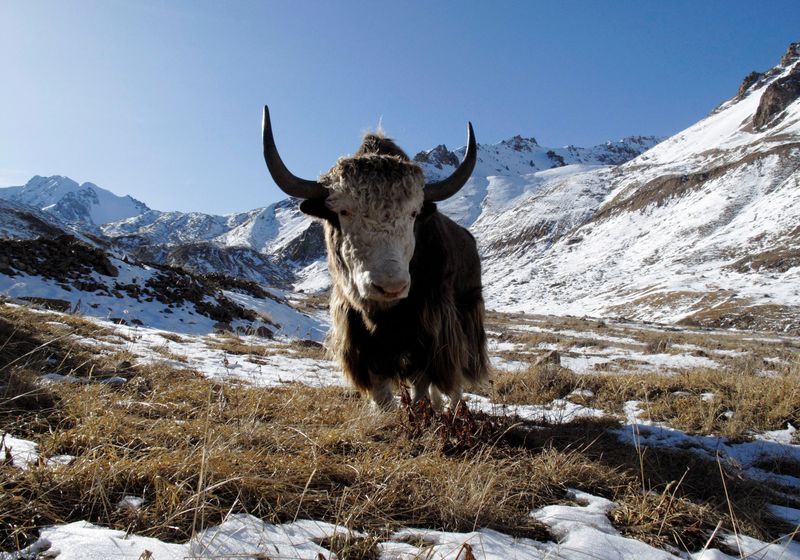
Scientists have discovered evidence of a previously unknown Ice Age mammal closely related to modern yaks in a Siberian cave renowned for its connection to an extinct human species known as the Denisovans.
The discovery was made at Denisova Cave in the Altai Mountains of southern Siberia, Russia, where researchers recovered bone fragments belonging to an unidentified bovine species.
DNA analysis revealed that the animal was genetically distinct from other known living and extinct species.
The findings, published in the journal Current Biology, provide fresh insights into the diversity of large mammals that inhabited Eurasia during the Ice Age.
Researchers examined 20 bone fragments attributed to the animal, with 14 recovered from Denisova Cave and six from other locations in the surrounding region.
The oldest specimens date back approximately 250,000 to 200,000 years ago, while the youngest is about 27,000 years old.
Although the bones were too fragmented to identify the animal through their physical characteristics alone, scientists successfully extracted ancient DNA and reconstructed 20 genomes.
The genetic evidence showed that the animal belonged to a distinct evolutionary lineage that separated from the ancestors of modern yaks approximately 400,000 years ago.
Because genetic evidence alone is insufficient to formally name a new species, researchers have provisionally referred to the animal as “Yak X.”
Evolutionary geneticist Love Dalén of the Centre for Palaeogenetics, a collaboration between Stockholm University and the Swedish Museum of Natural History, described the discovery as unusual.
“It is unusual, especially to recognize a large mammal species from small, unidentifiable fragments,” he said.
Dalén attributed the breakthrough to improvements in ancient DNA research, which have enabled scientists to identify species from remains that would otherwise be difficult to classify.
Alexandre Gilardet, a doctoral student at the Centre for Palaeogenetics and co-lead author of the study, said, “I’d say that this is related to the advances in the field of ancient DNA, as genetics is a powerful new layer of information applied to ancient materials.”
Yak X Lived Alongside Mammoths and Woolly Rhinoceroses
According to the researchers, Yak X inhabited the same Ice Age environment as several other large mammals, including steppe bison and aurochs, the extinct wild ancestors of modern domestic cattle.
The animal also shared its habitat with woolly mammoths, woolly rhinoceroses, horses, cave hyenas and brown bears.
Given its close genetic relationship with modern yaks, scientists believe Yak X probably resembled them more closely than it resembled bison.
Modern yaks are heavily built animals characterised by long fur, horns and a prominent shoulder hump. Wild yaks today are mainly found at high elevations on the Tibetan Plateau.
The discovery adds to scientific knowledge of the wide variety of large mammals that inhabited the mammoth steppe, an extensive grassland ecosystem that covered much of Siberia during the Ice Age.
Researchers also found evidence suggesting that Yak X populations may have declined during a warming period approximately 120,000 years ago.
Jonas Oppenheimer, a postdoctoral researcher at the Centre for Palaeogenetics and co-lead author of the study, said the species became extinct sometime after the youngest known specimen, which dates to around 27,000 years ago.
“Using the long, 200,000-year time span of our sampling, we can see that the species may have undergone a population decline during a period of warming around 120,000 years ago, and went extinct some time after our youngest sample, about 27,000 years ago,” Oppenheimer said.
The researchers noted that the mammoth steppe remained largely free of the massive ice sheets that covered extensive areas of North America and Europe during the Ice Age.
They also observed that the evolutionary separation between Yak X and the ancestors of modern yaks occurred around the same period as the divergence of the lineages that eventually produced today’s brown bears and polar bears.
Possible Connection to Denisovans
Denisova Cave is internationally recognised for its contribution to understanding human evolution.
In 2008, scientists discovered a finger bone there that provided the first evidence of the Denisovans, an extinct human lineage related to Neanderthals and modern humans.
Additional Denisovan remains have since been identified in the cave and at several locations across Asia.
Denisovans were hunter-gatherers who occupied different environments, and genetic evidence indicates that they interbred with Homo sapiens before eventually disappearing.
Some present-day populations, particularly in Melanesia and Papua New Guinea, carry a small proportion of Denisovan DNA.
Scientists believe Yak X may have been among the animals hunted by Denisovans, although direct evidence of this has not yet been established.
Dalén said, “It seems reasonable that Yak X was on the Denisovan menu.”
The discovery highlights how advances in ancient DNA analysis are helping researchers uncover previously unknown species and reconstruct the ecosystems that existed tens of thousands of years ago.