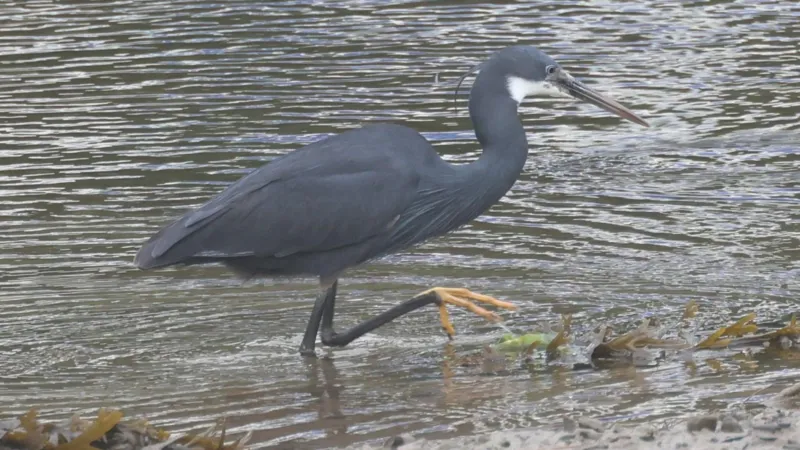
Hundreds of birdwatchers from across the United Kingdom have descended on the north Wales seaside town of Caernarfon after the sighting of a rare western reef heron believed to be a first for Britain.
The unusual grey-blue bird, commonly found in southern Europe, Africa and parts of Asia, was spotted at Y Foryd on Saturday morning by experienced ornithologist Simon Hugheston-Roberts during a routine birdwatching walk.
After identifying the bird as a western reef heron, Hugheston-Roberts alerted fellow birdwatchers through a WhatsApp group, triggering a wave of excitement among ornithologists and twitchers.
By later in the day, hundreds of enthusiasts had travelled to the area hoping to catch sight of the rare species.
Hugheston-Roberts, who regularly conducts bird counts at Y Foryd and has years of experience observing birds in Africa and the Middle East, carefully compared the heron with similar-looking species before confirming its identity.
He ruled out other dark-plumaged birds, including rare variants of little egrets and North American herons with similar features.
The western reef heron has since been spotted feeding in the harbour near Cei Llechi, resting in trees close to Aber Bridge and flying over Morfa Dinlle and Caernarfon Castle, attracting photographers, artists and birdwatchers from various parts of the UK.
Among those searching for the bird near the Anglesey Wall was artist and ornithologist Richard Partis, who spent several hours tracking its movements around the estuary and nearby woodland areas.
Visitors reportedly travelled from as far as Essex, while others planned overnight stays in the town following reports of the sighting.
Naturalist and broadcaster Iolo Williams described the sighting as highly significant, noting that it could become the first confirmed record of a western reef heron in Britain.
Williams suggested the bird may have been blown off course by strong southern winds before eventually reaching Wales.
He added that the Y Foryd and Afon Seiont estuary areas provided a suitable habitat because of the abundance of small fish, similar to the feeding grounds used by little egrets.
The sighting came shortly after Wales recorded unusually high temperatures in May, although Williams did not directly connect the event to climate change.
Hugheston-Roberts is expected to submit a formal report to the British Birds Rarities Committee for official verification. If accepted, the western reef heron will be added to The British List.