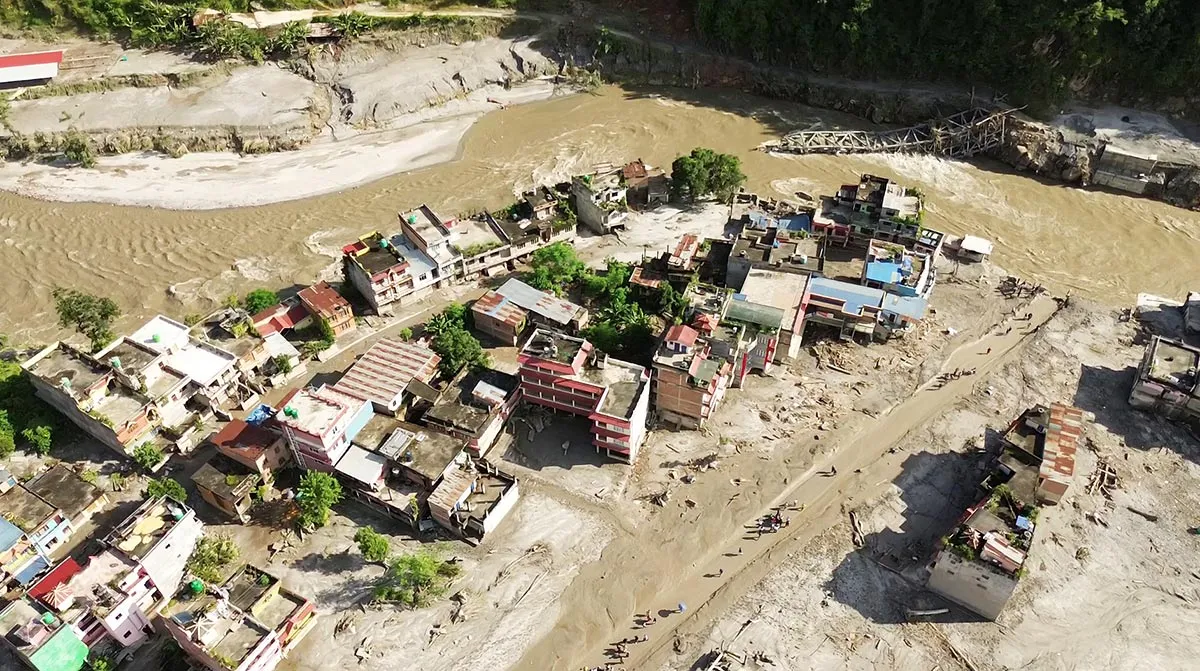
Nepal has declared a national day of mourning for victims of the devastating glacial floods that have killed at least 1,355 people, while rescue teams continue searching for nearly 5,000 others reported missing.
The disaster, which occurred on August 26 following a glacial and mountain collapse near the China-Nepal border, destroyed homes, roads and entire communities.
Flags were flown at half-mast across the country on Monday, while candlelight vigils and religious prayers were planned as part of mourning activities.
Hundreds of hydropower workers are among those still unaccounted for. However, the recent rescue of three workers trapped inside tunnels has raised hopes that more survivors could still be found.
Nepal Army spokesman, Raja Ram Basnet, said rescue operations were continuing with the same intensity to ensure that nobody remained trapped.
Foreign specialists from China, India and South Korea are supporting Nepal’s rescue teams, while Australian tunnel rescue expert Arnold Dix described the operation as an unprecedented challenge involving several possible rescues in different locations.
Families of missing workers have urged authorities to intensify the search, saying they remain hopeful their relatives could still be alive.
Meanwhile, Nepal’s President, Ram Chandra Paudel, visited relief camps in Nuwakot district on Monday to meet people displaced by the floods.
Authorities have been forced to bury hundreds of recovered bodies in mass graves after collecting DNA samples to aid future identification, as mortuaries became overwhelmed.
Amid the devastation, some survivors have been rescued days after they were presumed dead.
A 64-year-old woman, Chandika Shrestha, was pulled alive from her mud-covered home in Bidur on Saturday after her family had already performed a symbolic funeral for her.
The disaster has also renewed concerns about the impact of climate change, with experts warning that rising global temperatures are accelerating glacial melting and increasing the risk of catastrophic flooding in vulnerable mountainous regions.
A preliminary United Nations assessment put the cost of damage to buildings at about $158 million, while the overall economic impact is expected to be significantly higher after accounting for destroyed roads, bridges, farmland and humanitarian needs.
Nepal, a country of about 30 million people with limited resources, is expected to face a huge reconstruction burden following the disaster.
As rescue operations continue, volunteer groups in Kathmandu have also been mobilising relief supplies, including clothing, blankets and household items, for displaced survivors.