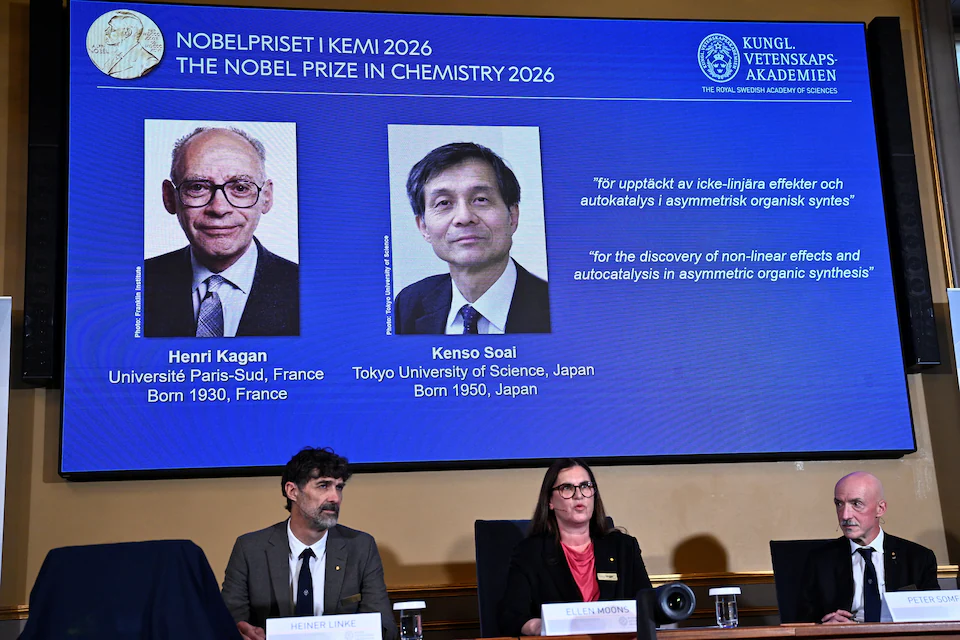
French scientist, Henri Kagan and Japanese researcher, Kenso Soai have won the 2026 Nobel Prize in Chemistry for their work on asymmetric molecules, helping scientists understand and control the formation of molecular “mirror images”.
The Royal Swedish Academy of Sciences announced the award on Wednesday, recognising the scientists’ contribution to solving a longstanding problem in chemistry known as homochirality.
Their research has also provided important tools for producing medicines with the desired molecular structure.
Soai, 76, said he was surprised by the announcement, revealing that he was out shopping when he received the news.
“This is the most exciting day in my life, I am very glad to share this prize with professor Henri Kagan,” he said during a phone call to the Nobel Prize press conference.
Kagan, 95, is French and became the third-oldest person to receive a Nobel Prize.
At the time of the announcement, the Nobel committee was still trying to reach him to inform him of the award.
French President, Emmanuel Macron congratulated the two laureates on X, describing the honour as significant recognition for France.
“A recognition suited to a lifetime of research,” he said.
The scientists’ work builds on research by 19th-century French chemist Louis Pasteur, who discovered that some molecules could exist in two forms that were mirror images of each other.
The two forms can have different properties despite having the same chemical composition.
Such molecular differences are particularly important in medicine because one version of a compound can produce a desired effect while its mirror image can have a different or harmful effect.
Peter Somfai, a member of the Nobel Committee for Chemistry, explained the significance of the discovery.
“The left-handed version of the drug can have one effect, and the right-handed version can have another effect, and then we need methods for selectively preparing them,” he said.
“In developing such methods the findings of this year’s laureates are important. They provided powerful tools for that,” he added.
The importance of controlling molecular forms was highlighted by the thalidomide tragedy of the early 1960s, when thousands of children were born with defects linked to the drug.
Researchers later established that a mirror-image form of the active substance was responsible for the harmful effects.
The chemistry award is the third Nobel Prize announced this week, following the medicine and physics prizes. Kagan and Soai will receive their medals from Sweden’s King Carl XVI Gustaf at a ceremony in Stockholm on December 10.
The laureates will share 12 million Swedish crowns, about $1.2m, in prize money.