

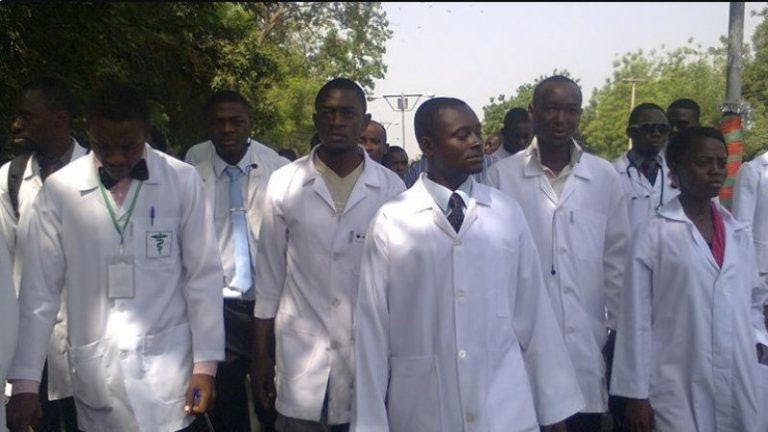
Medical doctors have warned that Nigeria’s healthcare system is under severe strain due to a deepening manpower crisis, with only about 55,000 doctors reportedly available to serve a population exceeding 220 million people.
The concern was raised at the Ordinary General Meeting and Scientific Conference of the Association of Resident Doctors, Association of Resident Doctors, FNPH Yaba, themed “Too Few Doctors, Too Many Patients: The Consequences of Manpower Shortage on the Mental Well-being of Nigerians.”
The doctors, including mental health specialists, said the shortage is now significantly worsening access to psychiatric services, leaving millions of Nigerians with untreated mental health conditions.
They further disclosed that at least 16,000 Nigerian doctors have left the country in the past five years under the wave of migration popularly called “Japa,” intensifying pressure on an already overstretched health system.
Confirming the situation, the President of the Nigerian Medical Association, Prof Omoti Ernest, said data from the Medical and Dental Council of Nigeria showed that although over 130,000 doctors are registered, only about 55,000 are currently practising within Nigeria.
He explained that this translates to roughly one doctor per 3,600 to 4,000 patients in a country of over 220 million people.
“This ratio is far below the World Health Organisation’s recommended threshold of one doctor to about 600 people, highlighting the significant shortage of medical personnel and the strain on healthcare delivery.
“Many Nigerian-trained doctors have emigrated or are no longer engaged in active clinical practice, contributing to the country’s healthcare workforce shortage,” the NMA President said.
He added that the continued migration of healthcare professionals has severely affected hospitals across the country.
He said further, “Thousands of doctors and other healthcare professionals have left the country in recent years, leading to severe staff shortages, increased workload for those who remain with many suffering from burnout, longer waiting times for patients, and declining quality of care in many public hospitals.
“Rural and under-served communities have been particularly affected, as they already struggle with limited access to healthcare services.
‘’The reasons behind this migration include poor remuneration, inadequate working conditions, insecurity, limited opportunities for career advancement, and insufficient investment in healthcare infrastructure, among others.
“Many professionals are attracted by better pay, improved facilities, and more stable environments in countries such as the United Kingdom, Canada, and the United States.”
‘What can be done’
To reverse the trend, he urged government intervention through improved welfare, infrastructure, and career development pathways for health workers.
Omoti said, “Strengthening security, ensuring timely payment of wages, and providing incentives for professionals to work in under-served areas will also help retain talent.
‘’In addition, partnerships with the private sector and diaspora engagement programmes could encourage Nigerian healthcare professionals abroad to contribute their expertise and support development of the country’s healthcare system.”
At the same gathering, a Consultant Psychiatrist at the Federal Neuropsychiatric Hospital, Aro, Dr. Yesir Kareem, painted a grim picture of mental healthcare delivery, noting that Nigeria’s doctor-to-patient ratio has deteriorated sharply to about one doctor for over 10,000 patients.
According to him, the situation is especially critical in mental health, where service gaps are widening rapidly.
“Only about 55,000 doctors remain to serve a population of over 220 million Nigerians. More than 40 million Nigerians suffer from mental health disorders, yet about 85 per cent of them do not have access to mental healthcare services,” Kareem said.
He added that the shortage of psychiatrists and mental health professionals has reached alarming levels, contributing to rising social and economic consequences such as family breakdowns, substance abuse, unemployment and premature deaths.
“The economic consequences are equally devastating, with billions of dollars lost annually due to untreated mental health conditions,” he added.
He also noted that 94,000 doctors and nurses had left Nigeria since the Japa syndrome began.
He listed poor remuneration, delayed salaries, heavy workload, inadequate facilities, insecurity, lack of career advancement, and unstable socio-economic conditions among the key drivers of emigration.
Speaking further, President of the Association of Psychiatrists in Nigeria, Dr. Veronica Nyamali, said the shortage has become so severe that consultants are now forced to take on lower-level duties due to the absence of junior doctors.
“There are gaps everywhere. Work that should be done by four psychiatrists is now being handled by one or two people. Consultants are increasingly forced to work at lower levels because the doctors they are supposed to supervise are no longer there,” she said.
She lamented that many trainees leave before completing specialist training, worsening shortages across all levels of psychiatric care.
“Those we train are leaving. Junior registrars, senior registrars, many complete their examinations and return abroad. The result is that we have shortages at every level of care,” she stated.
Nyamali also warned that Nigeria now has fewer than 150 psychiatrists, making mental healthcare expensive and inaccessible, particularly in rural areas.
“When specialists become scarce, services become more expensive. Access becomes difficult because patients must travel long distances to find care. This is contrary to the principle of universal health coverage, where mental health services should be available, affordable and accessible to everyone,” Nyamali said.
She further noted that reduced pharmaceutical availability is worsening treatment outcomes, as several companies have scaled down or exited Nigeria, limiting access to newer psychiatric medications.
“We now have fewer treatment options. Some of the newer drugs that offer better outcomes are no longer readily available. At the same time, the market is being flooded with fake medicines, making treatment even more challenging,” she warned.
Nyamali also observed that the shortage has increased reliance on traditional and faith-based healing centres, where patients often first seek help.
While acknowledging their role in communities, she said psychiatrists are now engaging such centres to discourage harmful practices and promote referrals.
“We recognise that people go to them first because they are available, accessible and affordable. Rather than confront them, we are engaging them and providing basic mental health education so that harmful practices can be eliminated and patients referred appropriately,” she explained.
She linked the rising burden of mental illness to worsening insecurity, poverty, unemployment, substance abuse and widespread trauma.
“People are being traumatised daily. Poverty, joblessness, violence and insecurity are all social determinants of mental illness. Those already living with mental health conditions are relapsing more frequently, while many others are developing new mental health challenges because of the pressures of daily living,” she said.
She also noted that mental healthcare remains largely out-of-pocket, with limited insurance coverage for psychiatric treatment.
“Mental illness is not properly covered under health insurance. Many of the newer medications are not included in insurance drug lists, leaving families to bear enormous treatment costs. The burden on care-givers is huge,” she added.
The President of ARD, FNPH Yaba, Dr. Okuwoga Temitope, said the manpower shortage is directly undermining quality care delivery in psychiatric services.
“As mental health professionals, we witness first hand the widening treatment gap, the burden on already stretched healthcare workers and the impact these shortages have on access to quality mental healthcare for Nigerians,” he said.
He added that resident doctors are increasingly suffering burnout, anxiety and depression due to excessive workload.
In its communique, the association called on government at all levels to improve remuneration, strengthen welfare systems, expand specialist training, and invest more in mental health infrastructure.
It also recommended integration of mental health services into primary healthcare, wider use of telepsychiatry, and stronger public awareness campaigns to reduce stigma.
The doctors reaffirmed their commitment to improving healthcare delivery and welfare of practitioners, while urging urgent action to stem ongoing brain drain.
They also urged the management of the Federal Neuropsychiatric Hospital, Yaba, to speed up the enrolment of newly recruited resident doctors into the Integrated Payroll and Personnel Information System to avoid salary delays.
The conference also commended the Medical Director of the hospital, Dr. Olugbenga Owoeye, for restoring electricity to the Yaba and Oshodi facilities after prolonged outage, while calling for sustained power supply to support medical services and training.






