

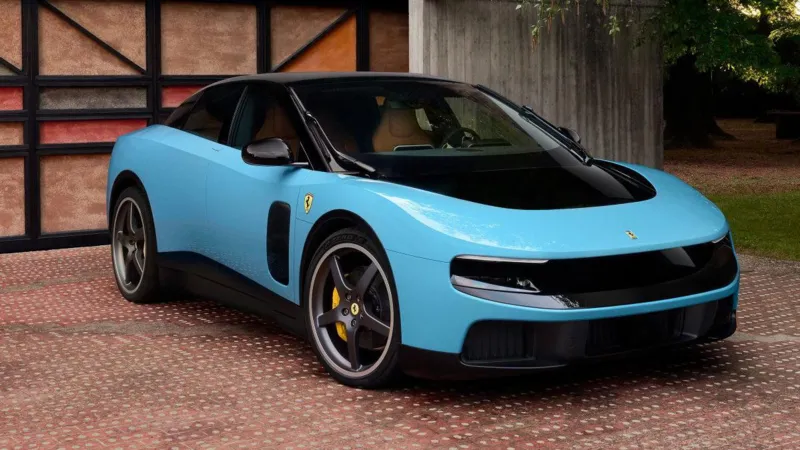
Italian luxury automaker Ferrari has unveiled its first fully electric vehicle, the $640,000 (£474,320) Luce, marking a major shift for the iconic brand.
The Luce, which means “light” in Italian, introduces a dramatic departure from Ferrari’s traditional styling.
Designed as the company’s first-ever five-seater, the model was developed in partnership with LoveFrom, the design agency founded by former Apple design chief Sir Jony Ive.
Reaction to the unveiling on social media has been sharply divided, with some critics describing the car as “straight to the junkyard trash,” while others hailed it as an “absolute masterclass in design.”
The launch comes at a challenging time for the electric vehicle market, with rivals such as Lamborghini and Porsche scaling back their EV ambitions amid sluggish demand and mounting competition from Chinese manufacturers.
Ferrari chief executive Benedetto Vigna said during the unveiling in Rome that the Luce had been in development for five years.
The company had previously resisted producing a fully electric car, focusing instead on hybrid models that combine petrol engines with electric technology.
According to Ferrari, the Luce features a dedicated electric motor on each wheel, enabling the vehicle to accelerate from 0 to 60mph (96km/h) in roughly 2.5 seconds.
The automaker also stressed that every major component is produced internally, allowing Ferrari to maintain and repair the vehicle for decades, a move aimed at protecting the Luce’s long-term resale value.
The wider automotive industry has struggled with the transition to electric vehicles in recent years.
Carmakers including Ford Motor Company and Volkswagen have renewed focus on petrol-powered cars, particularly in the United States, where weaker demand and policy changes under President Donald Trump have reduced incentives for EV buyers.
Ferrari’s new concept has drawn comparisons with Jaguar, whose electric concept car also faced backlash for moving away from its classic design identity.
One X user wrote, “Ferrari just killed their brand just like Jaguar did. This is straight to the junkyard trash.”
Another post questioned: “What is going on with European Luxury car manufacturers? First Jaguar and now Ferrari.”
However, supporters of the design praised the company’s bold direction. One social media user described the Luce as an “Absolute masterclass in design. Ferrari just unveiled the breathtaking LUCE concept, and it is a total game changer.”
Ferrari’s chief design officer Flavio Manzoni, speaking with YouTuber Cleo Abram, said criticism was a natural part of innovation.
He admitted the idea of an electric Ferrari featuring a radically different design would be “polarising,” but expressed confidence that opinions would shift positively over time.
Ferrari also confirmed it will continue producing petrol and hybrid models alongside its first all-electric car.
Meanwhile, some of Ferrari’s closest competitors are retreating from aggressive EV expansion plans.
Lamborghini has abandoned plans for a fully electric lineup in favour of hybrids, citing weak demand for luxury EVs, while Porsche has reduced its EV targets amid poor sales in China and tariff pressures in the US.
Western automakers are additionally facing rising pressure from Chinese brands, which are producing electric vehicles more quickly and at lower costs.
Despite the challenges, Ferrari remains Europe’s most valuable carmaker, supported by its strategy of selling highly exclusive vehicles.
However, the company’s shares have fallen by more than 25% over the past year, reflecting broader weakness across the global luxury goods market as inflation continues to affect consumer spending.









