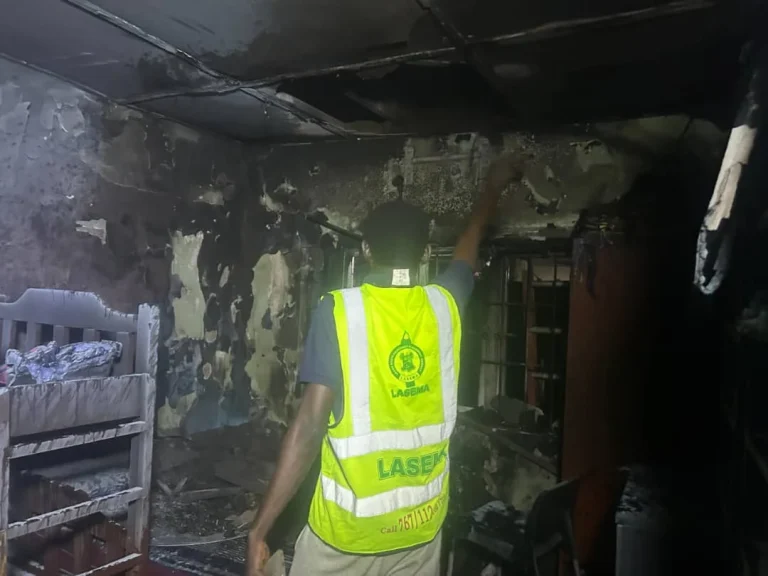
The Lagos State Emergency Management Agency has disclosed that chemical materials stored at an industrial facility were responsible for the massive fire that destroyed Parco Enterprises Nigeria Limited along the Alaba Suru axis of the Badagry Expressway on Saturday.
According to preliminary findings, the fire outbreak occurred at about 7:25 p.m. at a warehouse used for chemical blending and storage within a large industrial complex, rapidly escalating due to the presence of volatile substances.
In a statement issued on Sunday and signed by LASEMA’s Permanent Secretary, Olufemi Oke-Osanyintolu, the agency said the inferno spread quickly across an estimated 15,000 square metres of the facility.
“The affected location is a warehouse and chemical blending and storage site. The fire spread rapidly across an estimated area of 15,000 square metres, involving large quantities of stored chemical materials,” the statement said.
“The intensity of the blaze resulted in intermittent explosions that lasted for several hours.”
LASEMA noted that the explosions caused widespread panic and posed serious risks to nearby industrial facilities and residents within the surrounding community.
The agency explained that the fire was eventually brought under control through a coordinated emergency response involving the LASEMA Response Unit, the Lagos State Fire and Rescue Service, the Federal Fire Service, and private firefighting support from Veepee.
“A multi-agency response was activated, with firefighting operations carried out from both the front and rear access points of the facility,” LASEMA said.
While the Lagos State Fire and Rescue Service led suppression efforts from the main entrance, LASEMA fire teams provided strategic support from the rear of the premises. The agency also acknowledged assistance from Lacasera, which supplied water to sustain firefighting operations.
Following containment, LASEMA said damping-down operations had commenced, with emergency personnel remaining on site to prevent a possible re-ignition and protect adjoining facilities.
Preliminary assessments by responders identified several factors that may have worsened the incident, including the storage of highly volatile chemicals in a confined space, poor ventilation, and limited emergency preparedness.
“Initial observations suggest that the high volume of chemical storage, inadequate ventilation, and insufficient fire-response measures contributed significantly to the scale and intensity of the incident,” the agency stated.
LASEMA added that investigations were ongoing to establish the immediate cause of the fire outbreak and to determine compliance with safety regulations at the facility.