Canada has begun imposing retaliatory tariffs worth about $20 billion on American goods, escalating an already tense trade dispute with the United States.
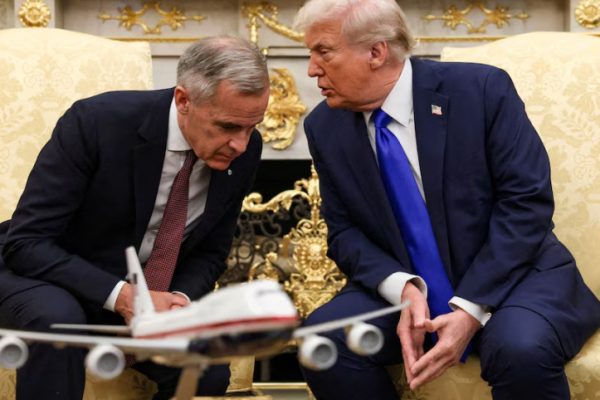
The measures took effect at 12:01 a.m. Eastern Time on Tuesday, hours after US President Donald Trump threatened to block Canadian aircraft manufacturer Bombardier from selling its jets in the United States unless the company builds them domestically.
The latest confrontation marks a further deterioration in relations between the two neighbouring countries, which are major trading partners.
Under the new Canadian measures, tariffs on US steel and aluminium have been doubled to 50%, matching the rate imposed by Washington on Canadian metals. Additional duties have also been placed on products including paper, construction materials, household appliances and agricultural goods.
Trump issued his warning to Bombardier on Monday through Truth Social, arguing that companies seeking access to the US market should manufacture within the country.
“If they want our Market, they must build here, and stop treating America like a ‘piggybank,’” Trump said.
Bombardier, which is headquartered in Montreal, said it already has a significant manufacturing footprint in the United States and has continued to expand its operations there.
“The American aerospace industry is a clear winner on trade and exports. Bombardier is a strong contributor to the sector, creating tens of thousands of jobs across the United States,” the company said in a response to CNN.
The latest tariffs follow the collapse of trade negotiations between Washington and Ottawa last month. The two sides had initially appeared close to an agreement, but failed to resolve outstanding differences before talks broke down.
Canadian Prime Minister Mark Carney has defended his government’s response and indicated that Ottawa would respond to any further trade measures imposed by Trump.
Carney has also accused the US administration of failing to approach the negotiations seriously.
“When the Americans stop doing memes, stop throwing shade, stop trying to be tough and start being serious about having those discussions — we can have those discussions,” Carney said last week.
Canadian Industry Minister Mélanie Joly said Ottawa had deliberately designed its countermeasures to “put political pressure” on the Trump administration and encourage Washington to reconsider its trade policies.
Canada, however, excluded American seafood from the 25% tariffs, protecting industries in states such as Alaska and Maine from additional costs.
The escalating dispute could trigger another round of retaliatory measures. Ontario Premier Doug Ford has already warned that his province could consider restricting electricity exports to US states, including New York and Michigan, which depend on supplies from Ontario.
Why the trade talks collapsed
Canadian officials said the US pushed for changes to rules concerning the prominence of Canadian and French-language content on streaming services, as well as requirements governing bilingual product labels.
Carney has maintained that such measures are essential to protecting Canadian and Quebec culture.
“For the Americans, questions about the French language, Quebec culture, francophone culture and Canadian culture are irritants. Here in Quebec, here in Canada, they are rights, fundamental rights,” Carney said last month.
Trump rejected the suggestion that his administration opposed Canada’s French-language protections.
“I would never interfere with Canadians speaking French!” he said, while accusing Carney of using the dispute to strengthen his political support.
US Trade Representative Jamieson Greer has disputed Canada’s account of the negotiations, saying disagreements over French-language requirements were not responsible for the collapse of the talks.
US Commerce Secretary Howard Lutnick, meanwhile, said Canada made last-minute demands, including seeking tariff relief for trucks.
The United States currently applies a 25% tariff on trucks, with exemptions for portions of vehicles that comply with the trade agreement involving the US, Canada and Mexico. Similar 25% duties apply to cars and auto parts.
As part of a preliminary agreement, Washington had reportedly agreed to reduce auto tariffs to 15%, with the possibility of lowering them further to 7%. The proposed deal also included cutting steel and aluminium tariffs to 25%.
US has greater economic power, but both sides face risks
US Treasury Secretary Scott Bessent has argued that Washington has the stronger position because of the huge difference between the two economies.
“I don’t think you can be in a tit-for-tat with someone who’s 13 times larger than you are,” he said in a CNBC interview on August 31.
While the US economy is considerably larger than Canada’s, analysts warn that Washington would also suffer consequences from a prolonged disruption in trade.
Trump has argued that ending trade with Canada could save the United States money.
“If we don’t do any trading with Canada, we just end all trade with Canada, we’d save ourselves $90 billion.”
However, the close integration of the two economies means that many goods and components cannot easily be replaced by alternative suppliers.
For example, Ford’s plant in Windsor, Ontario, produces specialised engines used in some of the US automaker’s major trucks, making an immediate shift to another supplier difficult.
Economists also expect the impact of the new tariffs to take time to reach consumers because companies often agree on prices and supply contracts before goods arrive at their destinations.
However, consumers in both countries could face noticeably higher prices by next summer if the trade confrontation persists.