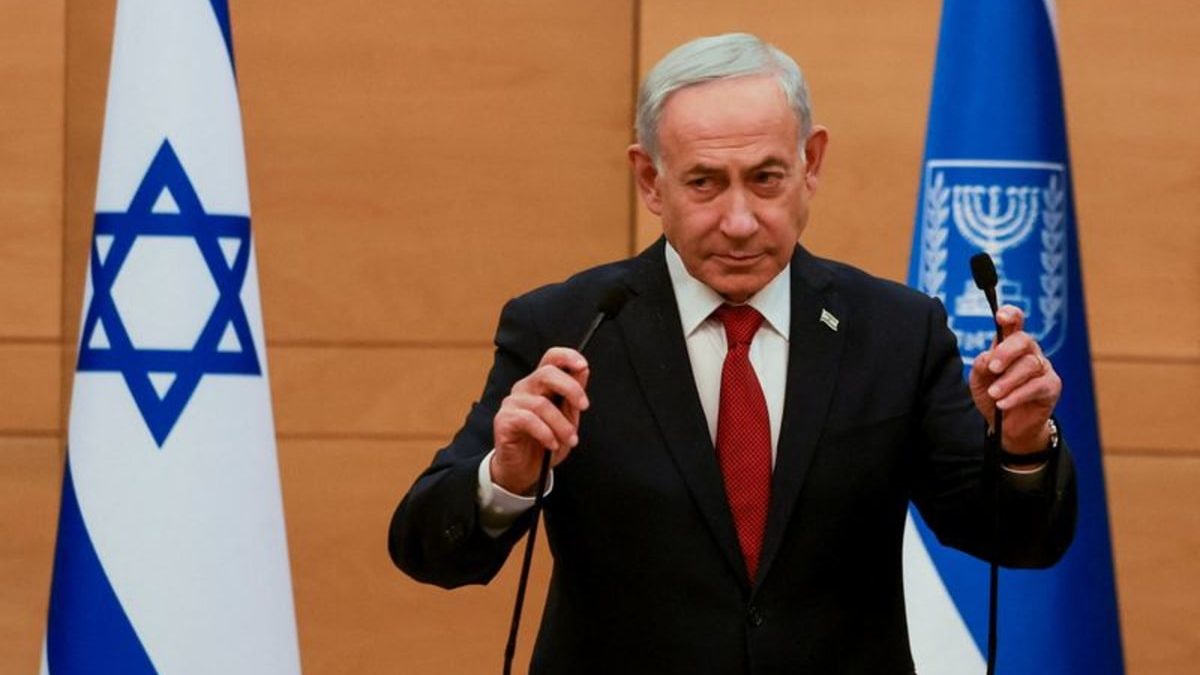
Israeli Prime Minister, Benjamin Netanyahu, has offered to share power with opposition leader Gadi Eisenkot in a proposed unity government, as mounting political pressure threatens his hold on power.
Netanyahu said on Saturday that he was prepared to temporarily step aside and allow Eisenkot to serve as prime minister first under a rotational leadership arrangement, in which both politicians would take turns leading the government.
The offer comes as Eisenkot gathers support from opposition parties following Israel’s inconclusive October 27 election, which left neither politician with a clear path to forming a government.
Israel’s President had tasked Eisenkot with forming a coalition after the election.
He has until December 6 to secure enough support, although he could receive an additional 14 days to complete negotiations.
Eisenkot has made progress in his efforts, signing coalition agreements this week with The Democrats, a left-wing party, and Yisrael Beiteinu, a right-wing political party.
Their backing could bring him closer to securing the parliamentary majority required to form a government.
In a statement explaining his offer, Netanyahu maintained that he believed he should lead the government but said the country’s security situation required him to put political interests aside.
He said he should lead the Israeli government but “given the magnitude of the existential threat and the possibility that a government could be formed that isn’t able to deal with this danger”, his “responsibility as a leader” required he “put everything aside”.
However, Eisenkot suggested that negotiations between their parties had been difficult, accusing Netanyahu’s Likud party of failing to engage meaningfully with his team.
In a statement, he said his Yashar party’s negotiating team had, for weeks, been “trying to conduct a real, sincere, and accelerated negotiation” with Netanyahu’s Likud party but faced “refusal and evasion”.
Eisenkot subsequently invited Netanyahu to participate in what he described as serious discussions “on the core lines and policy issues” with his party’s negotiating team.
The proposed arrangement represents a significant attempt by Netanyahu to remain politically relevant as his rival moves closer to assembling a coalition capable of ending his tenure as Israel’s longest-serving leader.