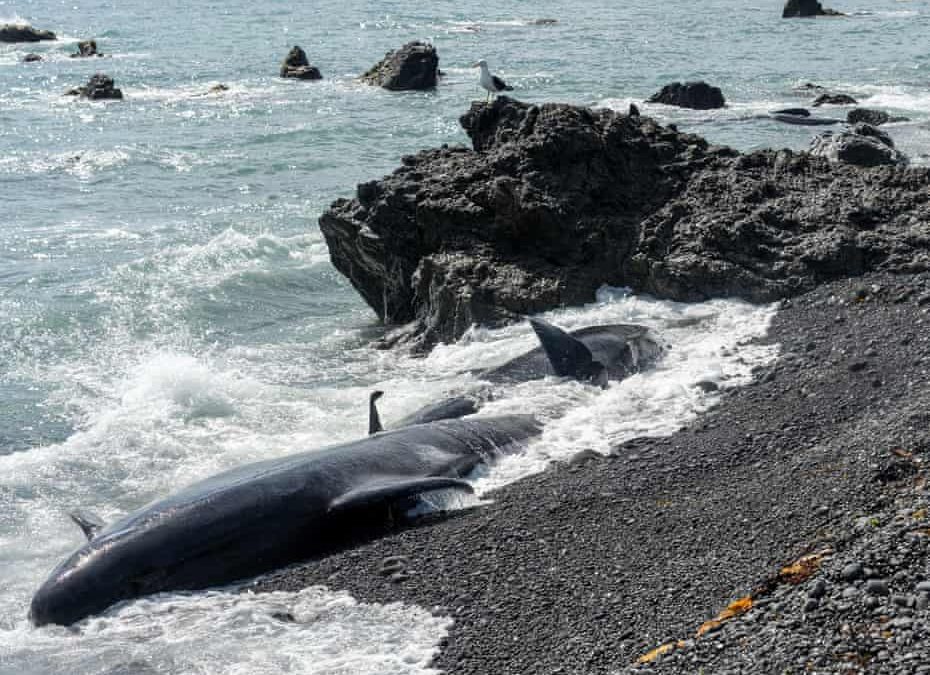
At least 43 pilot whales have died after a mass stranding along the coast of New Zealand, with rescuers describing the incident as “difficult and distressing.”
The whales were discovered stranded along the Ngawi coast, near the village of Cape Palliser on the southern tip of New Zealand’s North Island, shortly after 8am local time on Thursday, according to the country’s Department of Conservation.
Initially, at least 20 whales were reported ashore, with four still alive, the marine conservation organisation, Project Jonah New Zealand, said in an update on Thursday afternoon.
The group was working alongside the Department of Conservation and the local iwi, a community of Māori tribes, to assess the animals and prepare to return the surviving whales to the sea during high tide.
However, in a statement released on Friday afternoon, the Department of Conservation confirmed that 43 whales had been found stranded along the Ngawi to Mangatoetoe coastline, adding that “unfortunately none of these are believed to have survived.”
Project Jonah said several of the whales, which were spread across “several kilometres of coastline,” were already dead when responders arrived, while those found alive “succumbed throughout the day.”
“It was a difficult and distressing event for those who were involved in the response,” the charity said. “We are grateful to the locals who were first on the scene and supported the whales that were found alive, keeping them cool and as comfortable as possible.”
The Department of Conservation said it was working with the local iwi to oversee the burial of the whales, described as “taonga,” meaning highly prized heritage.
Project Jonah noted that the southern coastline of the North Island is exposed to the strong swells of Cook Strait, while its loose gravel beaches and sharp rocks posed additional difficulties for rescuers.
The remote location also complicated the response.
A local fisherman, Andrew Sim, who has spent more than 40 years working along the coast, described the incident as “very sad” in an interview with Radio New Zealand on Thursday.
Sim said he had witnessed whale strandings in the area before but had never seen pilot whales come ashore.
“It’s most strange that they’ve come in here, there’s just no reason for it, to be honest. Just bad luck, I don’t know,” he said.
The Department of Conservation says pilot whales are “prolific stranders,” although the exact reasons behind mass strandings remain largely unclear.
Ian L. Boyd, a professor of biology at the University of St. Andrews in Scotland and former chief scientific adviser at the UK’s Department of Environment, Food and Rural Affairs, said mass strandings frequently involve highly social marine species.
“They happen to species which tend to be highly social and it is likely that all or part of a social group becomes stranded at the same time,” Boyd said in a statement shared with CNN by the Science Media Centre on Friday.
“Mass strandings can tend to happen in particular locations often where there is a shallow shelving coastline,” he added.
“It is possible that a whole social group gets disorientated and caught by a falling tide, but this is almost certainly only part of much more complex set of causes.”
According to the Department of Conservation, pilot whales’ strong social bonds mean that when one animal becomes disoriented, others may follow it to provide assistance.
The agency said the most likely explanation for the strandings is that their echolocation abilities are poorly suited to shallow, sloping waters.
New Zealand is currently experiencing summer, a period when pilot whales move closer to shore in pursuit of common food sources.
The season also records the highest number of mass strandings.
The country’s largest recorded pilot whale stranding occurred at the Chatham Islands in 1918, involving an estimated 1,000 animals, according to the Department of Conservation.
Mass strandings have also been reported in other parts of Oceania in recent years.
In 2022, about 500 pilot whales died after being stranded near shark-infested waters on remote New Zealand islands.
In February 2025, more than 150 whales were stranded off Tasmania, Australia, in the first such incident involving the animals in the region in 50 years. All the whales either died or were euthanised.
In 2024, about 160 pilot whales were stranded off Western Australia, with 28 dying while the majority were successfully returned to the sea.