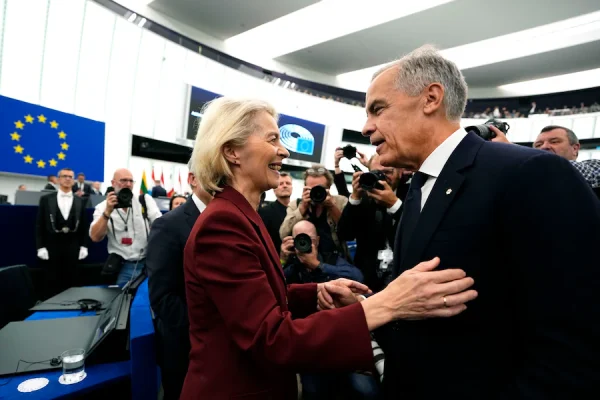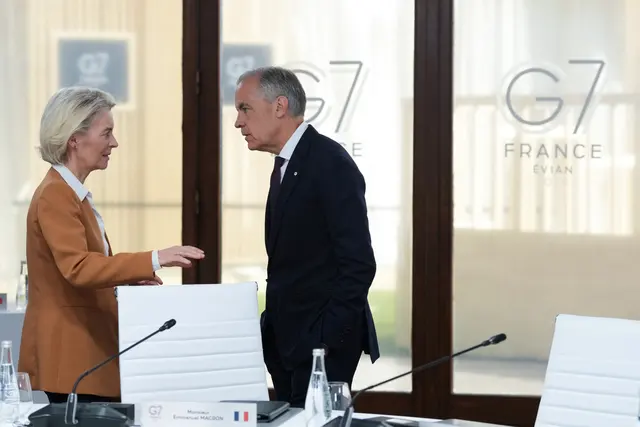
Canada is seeking to establish a closer relationship with the European Union as tensions with the United States continue to deepen, with Prime Minister Mark Carney describing the proposed arrangement as a “unique alliance”.
Carney said Canada was not seeking membership of the 27-nation bloc but wanted to explore a new form of partnership that would strengthen economic, political and strategic ties with Europe.
“We share the same values, we have the same priorities, and we have very complementary strengths,” said Carney, who is expected to address the European Parliament in Strasbourg, France, this week.
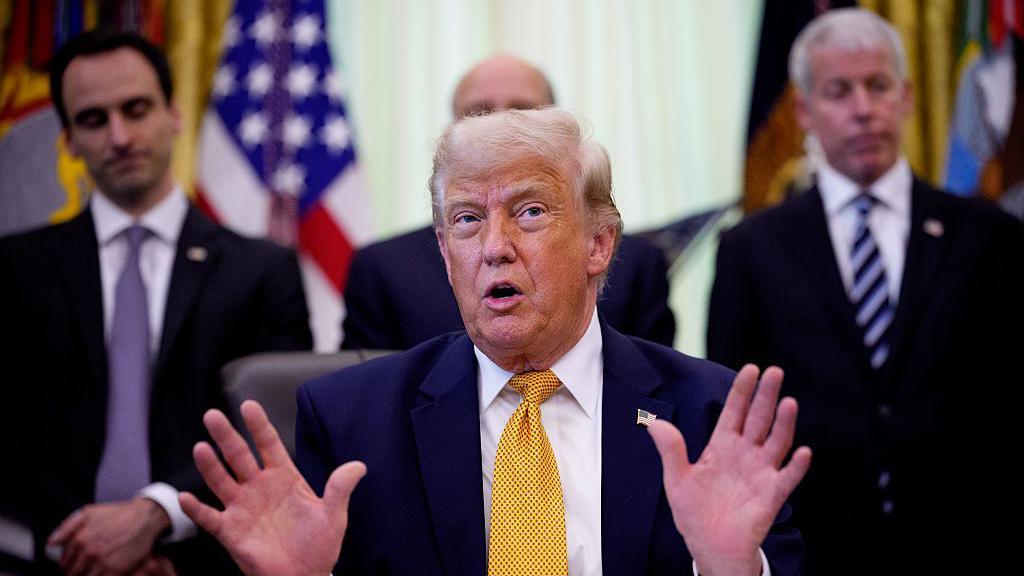
The move comes amid an escalating trade dispute between Canada and the US and growing efforts by Ottawa to reduce its economic dependence on its southern neighbour.
According to a Wall Street Journal report, Carney had directed a special envoy to Europe to explore options for deeper cooperation that would fall short of full EU or common-market membership.
Among the proposals reportedly under discussion are reducing trade barriers, developing underwater cables connecting Canada and Europe, expanding Canadian gas supplies to Europe, investing in artificial intelligence and technology infrastructure, and potentially allowing Canadians to live and work in Europe without visas.
Although Canada is geographically outside Europe and therefore cannot realistically join the EU as a full member under existing rules, some European leaders have openly expressed support for closer relations.
Finland’s President Alexander Stubb has previously suggested that Canada could become part of a larger European bloc, while French officials have also floated the possibility of Canadian EU membership.
Stubb has said he can “envisage a much larger EU, whether Canada is a part of it or not is up to Canada to decide,” while describing the shared values between Canada and Europe as a basis for a close strategic partnership.
He also reportedly asked, “Wouldn’t it be lovely if Canada was the 28th state of the European Union rather than the 51st state of the United States?”
Canada and the EU already maintain significant economic ties through the Comprehensive Economic and Trade Agreement, which has been provisionally applied since 2017.
Trade in goods and services between both sides reached €130.8bn ($151bn) last year, representing an increase of more than 80 per cent over the past decade.
However, the proposal has generated mixed reactions within Canada.
An Abacus Data survey conducted earlier this month found that about 80 per cent of Canadians supported deeper cooperation with the EU on foreign policy, defence and economic priorities, while 49 per cent backed full EU membership.
Opposition Conservative Party leader, Pierre Poilievre, criticised Carney’s approach, describing the effort to deepen ties with the EU as “out of touch”.
“We will NEVER be the 51st U.S. state. And we will NEVER be the 28th EU state.”