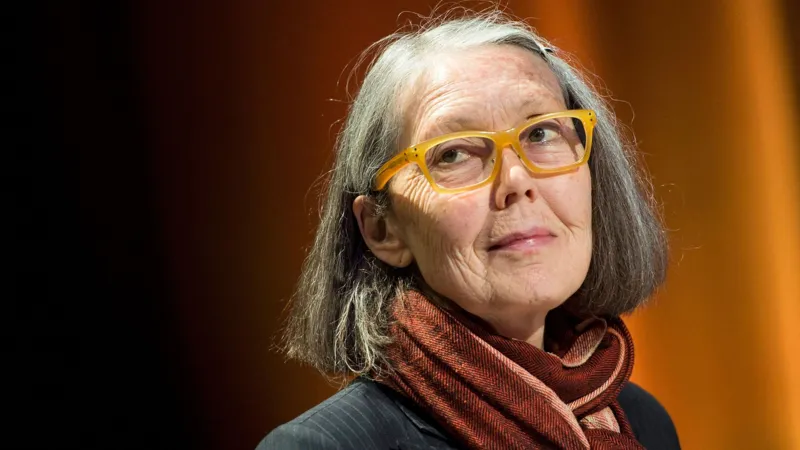
Canadian poet, essayist and translator Anne Carson has won the 2026 Nobel Prize in Literature for a body of work that spans poetry, fiction, scholarship and translation.
The 76-year-old writer was recognised by the Swedish Academy for what it described as her “bold and inventive oeuvre that, in playful dialogue with the classical tradition, has created new forms for contemporary literature”.
The Nobel Prize, regarded as the world’s most prestigious literary award, comes with 12 million Swedish kronor, about £900,000 or $1.2m.
The prize recognises a writer’s lifetime body of work.
Carson, who was born in Toronto in 1950 and lives in Michigan, has been a professor of classics for more than three decades.
Her writing frequently draws on Greek literature, while her translations have sought to give ancient works a contemporary interpretation.
Speaking on Carson’s selection, Anders Olsson, chairman of the Swedish Academy’s Nobel committee for Literature, praised her departure from conventional lyrical poetry.
“Broken away from lyrical poetry bound to the narrative self and inspired new forms of contemporary literature”.
He added that her approach had enabled her to produce works that move across genres and artistic traditions.
“This method of writing leads to playful and ironic works that move not only between classical and modern poetry but also between different genres and artforms,” he said.
Carson’s works include The Glass Essay, Autobiography of Red: A Novel in Verse, Nox, Float and The Beauty of the Husband: A Fictional Essay in 29 Tangos.
Her interest in classical literature has also featured in several collaborations with artists and performers.
In 2019, her performance piece Norma Jeane Baker of Troy drew parallels between Helen of Troy and Marilyn Monroe, while her 2021 work The Trojan Women: A Comic offered a graphic retelling of Euripides’ ancient tragedy.
Her translation of Sophokles’ Elektra was also staged in London last year, starring actress Brie Larson.
Ingrid Carlberg, permanent secretary of the Swedish Academy, said she informed Carson of the award by telephone shortly before the public announcement.
“She had time to tell me was that she is, for the moment, in Iceland, where she is listening to the wind,” Carlberg said.
“She was taken by surprise but very happy. I could hear that in her voice.”
Carson has also held Icelandic citizenship since 2022.
Her work, according to the Nobel committee, has had a significant influence on the international art and literature scene since the 1990s.
Olsson said her collaborations with visual artists, choreographers and directors in opera and theatre reflected the freedom with which she approached established literary conventions.
“Her collaborations with visual artists and choreographers and with opera and theatre directors demonstrate the freedom with which she relates to literary expectations and rule systems,” Olsson said.
“It is this that lies behind the outstanding importance her work since the 1990s has had for the international art and literature scene.”