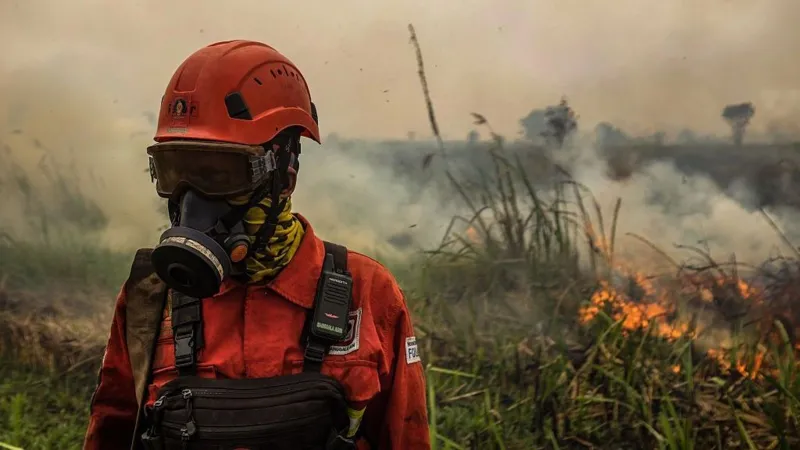
A thick blanket of toxic wildfire smoke is spreading across parts of Southeast Asia as worsening fires in Indonesia continue to choke communities and push air pollution to dangerous levels.
The haze has affected millions of people in Indonesia, Malaysia, Singapore and the Philippines, with pollution in some areas reaching more than 15 times the level recommended by the World Health Organization.
Many of the fires have been burning across Sumatra and Indonesian Borneo since mid-July, with experts linking their rapid spread to severe drought conditions intensified by a so-called Super El Niño.
Indonesia’s Health Ministry recorded more than 50,000 cases of respiratory infections associated with land and forest fires between July and August.
More than 12,000 of those affected were children below the age of five.
Rizma Nur Fatimah, a 19-year-old teaching assistant in Banjarbaru, South Kalimantan, described the worsening conditions at her school.
“Even inside the house, with everything closed, the haze still got in,” she said.
“We’ve been living with this since I was born. It’s the same every year, so we’ve almost become resigned to it. But this year is worse.”
She also said the smoke inside her classroom had become so dense that “you couldn’t even see your own feet”.
In the nearby village of Pengayuan, 23-year-old mother Misbah said her three-year-old daughter had developed “a cough, a sore throat and a runny nose” as the haze intensified.
The impact has also been felt beyond Indonesia.
In Palawan, an island province in the Philippines about 1,300km away, residents reported symptoms including irritation of the eyes, nose and throat.
“We are now experiencing mild headaches,” said Dr Precious Bañas-Melad.
“My cousin who isn’t allergic to anything started developing allergies. My husband is the first one who had itchy eyes and throat.”
Malaysia has likewise reported increasing cases of asthma and conjunctivitis as smoke continues to cross the border and worsen air quality.
Fires linked to land use
Wildfires and haze are a recurring problem in Indonesia, with environmental experts tracing part of the crisis to decades of land-use changes.
Large areas of rainforest and peatland in Kalimantan were opened for logging, plantations and major development projects during the Suharto era.
Today, fires are frequently associated with industrial plantations and other forms of commercial land development. Environmental organisations, researchers and government investigations have repeatedly alleged that some companies use fire as a cheap method of clearing large areas of land.
Experts say the El Niño-driven drought is making the situation worse, but human activity is also a major factor.
Drained peatlands, timber estates and oil palm plantations can become highly vulnerable to fires, which often return to the same locations.
Unlike smaller traditional fires managed by local communities, fires associated with large-scale land development can spread more rapidly and prove much harder to contain, creating serious consequences for both public health and the environment.
The situation in Indonesian Borneo is particularly concerning because many of the fires are burning through extensive tropical peatlands.
These peatlands normally function as major carbon stores because their waterlogged environment slows decomposition and allows carbon to accumulate underground over thousands of years.
However, when they are drained or burned, they can release large quantities of stored carbon into the atmosphere.
Dr Nisa Novita, a peatland researcher at conservation organisation Yayasan Konservasi Alam Nusantara, described them as potential “carbon bombs” under abnormal conditions.
Fears fires could worsen
There are growing concerns that the wildfire crisis could become significantly more severe as the Super El Niño intensifies in the coming months.
Professor Bambang Hero Saharjo, a forest fire forensics expert at Institut Pertanian Bogor University, said Indonesia recorded about 359,000 hectares of forest fires last year despite the absence of El Niño conditions.
Citing research reports, Prof Bambang warned that this year’s El Niño could result in fires affecting as much as 11 million hectares.
Such a scenario would put the current crisis on a scale comparable to Indonesia’s devastating 1997-98 wildfire season.
Indonesia’s forestry minister, Raja Juli Antoni, said earlier this week that efforts to contain the fires had reached a critical stage, with September expected to be particularly challenging.
“Our problems are not over. September is the peak of El Niño,” he said earlier this week. “September is the main fight for us.”