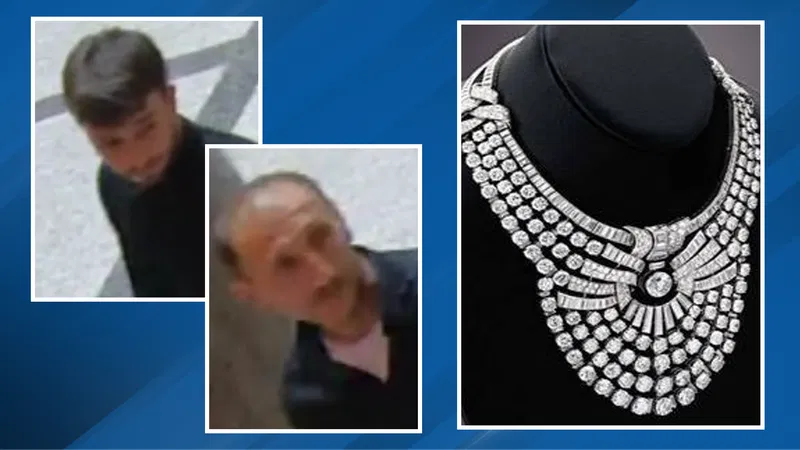
A diamond necklace valued at more than $4 million has been stolen from a museum in Vienna, Austria, after two men reportedly smashed a glass display case with a hammer during a daylight robbery.
The suspects allegedly entered the Museum of Applied Arts as ordinary visitors before targeting the platinum necklace, which was part of a major jewellery exhibition.
Austrian police have launched a manhunt for the pair and released CCTV images showing them before they entered the exhibition.
According to police, the men fled the museum on foot towards a nearby park after taking the necklace.
No injuries were reported, although investigators believe one of the suspects may have been armed.
Police said “extensive search operations” were underway, with dog units also deployed in the hunt for the suspects. Interpol has added the stolen necklace to its database of stolen artworks.
The necklace, designed by French luxury jewellery house Van Cleef & Arpels, was created for Egypt’s Queen Nazli in the 1930s.
It was among more than 300 pieces featured in the MAK exhibition, titled “GLANZSTÜCKE,” which brought together items from the museum’s collection and works by Van Cleef & Arpels.
The exhibition was temporarily closed following the robbery but later reopened.
A blue panel was subsequently placed over the damaged display case.
The stolen piece contains 673 diamonds weighing more than 200 carats in total, including a six-carat central diamond.
The stones are arranged in a sunburst design, surrounded by baguette-cut diamonds and hundreds of smaller gems.
Queen Nazli commissioned the necklace together with a matching tiara for the 1939 wedding of her daughter, Fawzia. Nazli was the wife of Egypt’s King Fuad I.
After losing her royal status decades later, Queen Nazli eventually moved to the United States.
Facing financial difficulties, she sold the necklace and tiara in the 1970s.
The necklace resurfaced at a Sotheby’s auction in 2015, where it fetched nearly $4.3 million.
Queen Nazli’s great-granddaughter, Fawzia Farouk, expressed her “profound sorrow” over the theft in a Facebook post, describing the necklace as an “irreplaceable part of our family’s history and of Egypt’s cultural heritage.”
She added, “It is a precious testament to an era of elegance, artistry, and vision, whose significance extends far beyond personal interests.”
MAK director general Lilli Hollein also acknowledged the seriousness of the incident, saying the theft had “hit us hard.”
She added, “Especially considering the incidents at major museums in recent years, we took this as an opportunity to thoroughly review our own security measures at the museum in general.”
Local reports said additional security measures, including metal detectors, have since been introduced at the exhibition, which is scheduled to run until September 27.
The Vienna robbery comes amid growing concerns over increasingly aggressive museum thefts across Europe.
Europol reported last week that criminals are increasingly using violent and forceful methods to steal valuable cultural objects, particularly items containing precious metals and gemstones.
The agency also warned that museum robberies are attracting “new criminal actors” and “opportunists from other criminal sectors,” who view them as “low-risk, high-profit” crimes.