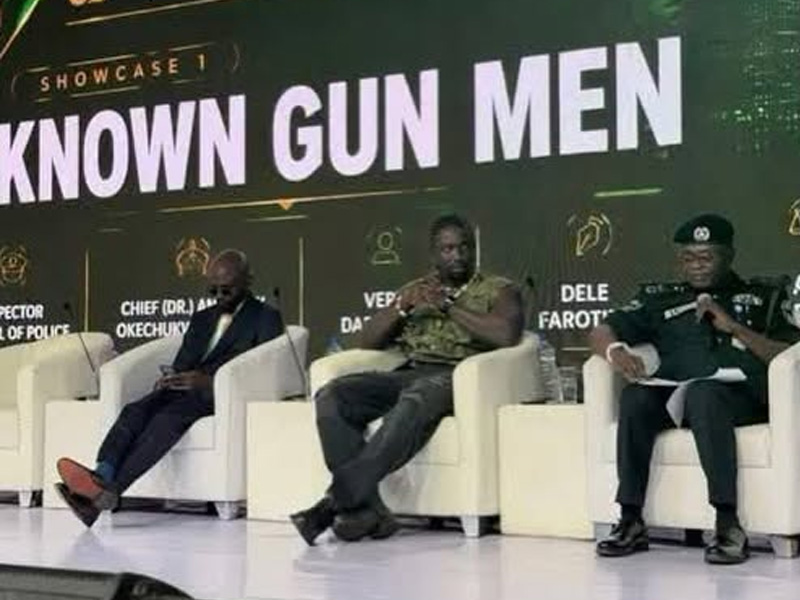
Social media activist, Martins Otse, popularly known as VeryDarkMan, has alleged that Nigeria’s security agencies know the identities and locations of those behind kidnappings and other violent attacks but have failed to stop them.
Otse made the allegation on Tuesday while speaking at the 2026 Annual General Conference of the Nigerian Bar Association (NBA) in Port Harcourt, Rivers State.
He was a panellist at a session titled “Known Gun Men”, which also featured the Inspector-General of Police and other security chiefs.
Challenging the continued use of the term “unknown gunmen”, VDM said security agencies had enough information to identify the perpetrators of violent crimes.
“You people know where these people are. You people know these ‘unknown gunmen’. But nothing is happening,” he said.
He also made allegations against personnel of several security agencies, including the military, Nigeria Immigration Service and Nigeria Customs Service.
“There are no unknown gunmen anywhere. The military men are the unknown gunmen, the Immigration, the Customs they are the unknown gunmen. Nobody else,” he alleged.
However, Otse did not provide evidence at the conference to substantiate his allegations against the security agencies.
The activist also questioned the effectiveness of security checkpoints on major highways, particularly amid the continued spate of kidnappings across the country.
Using the Lagos-Abuja highway as an example, he alleged that security personnel at checkpoints could determine the financial status of motorists based on their vehicles and potentially pass such information to kidnappers.
“When you pass with a car, you will meet a checkpoint, the policeman tells you to wind down the car glass, open your boot you open it. Believe me, everybody knows who is rich, who is poor, and everybody knows the people that belong to the middle class,” he said.
According to him, information gathered at checkpoints could potentially help criminals identify motorists who may be able to pay large ransoms.
VDM also warned lawyers at the conference that insecurity was no longer an issue affecting only ordinary Nigerians, noting that members of the judiciary had also become victims.
He referred to the reported abduction of a judge travelling from Sokoto who was kidnapped in Kebbi State on July 26 and freed after spending about a week in captivity.
“This is not the topic of ‘if I may, my Lord’, because a lot of your lords are being kidnapped,” Otse told the participants.
He said his assessment of Nigeria’s security crisis was partly shaped by his visits to scenes of violent attacks.
“I have seen blood and seen people burnt alive,” he said.
Otse recalled visiting Yelwata and other locations affected by attacks, saying such experiences exposed him to the devastating impact of insecurity on communities.
He also spoke about the aftermath of a Sallah Day bombing in Borno State and incidents associated with the University of Maiduguri Teaching Hospital.
On the Yelwata killings, he described the violence as retaliation for the killing of a Fulani man, alleging that the subsequent attack was carried out in response.
The activist further criticised the Nigerian media, accusing news organisations of failing to give adequate coverage to violent attacks and their impact on victims.
Explaining his decision to attend the NBA conference, Otse said he was not there to teach lawyers about the law but to share his personal experiences with insecurity.
“I am not here to teach you the law. I am here to share an experience,” he said.
He maintained that insecurity had implications for lawyers, judges and the wider administration of justice and should therefore be a major concern for the legal profession.
Meanwhile, the Niger Delta Development Commission, at another session of the NBA conference, called for increased investment in agriculture and other sustainable sectors to reduce the Niger Delta’s dependence on oil.
NDDC Managing Director, Dr Samuel Ogbuku, acknowledged the importance of petroleum resources to Nigeria’s development but said the region could not rely on oil indefinitely.
He stressed the need for accurate data on the volume of resources produced in the Niger Delta, noting that such information was essential in determining what should accrue to the region.
“Without accurate information on what the Niger Delta produces, it would be difficult to determine what it is entitled to receive,” he said.
Ogbuku identified agriculture as a key sector for investment, citing its potential to improve food security, create jobs and provide sustainable livelihoods, particularly for women and young people.
The commission also highlighted its institutional reforms, digitalisation programme, training of young people in artificial intelligence and other digital skills, as well as its adoption of Environmental, Social and Governance principles.
The NDDC said its shift from “transaction to transformation” was aimed at improving governance, accountability and the sustainability of development projects across the Niger Delta.
NDDC Board Chairman, Chiedu Ebie, and Ogbuku were also honoured with awards for their contributions to the development of the region.