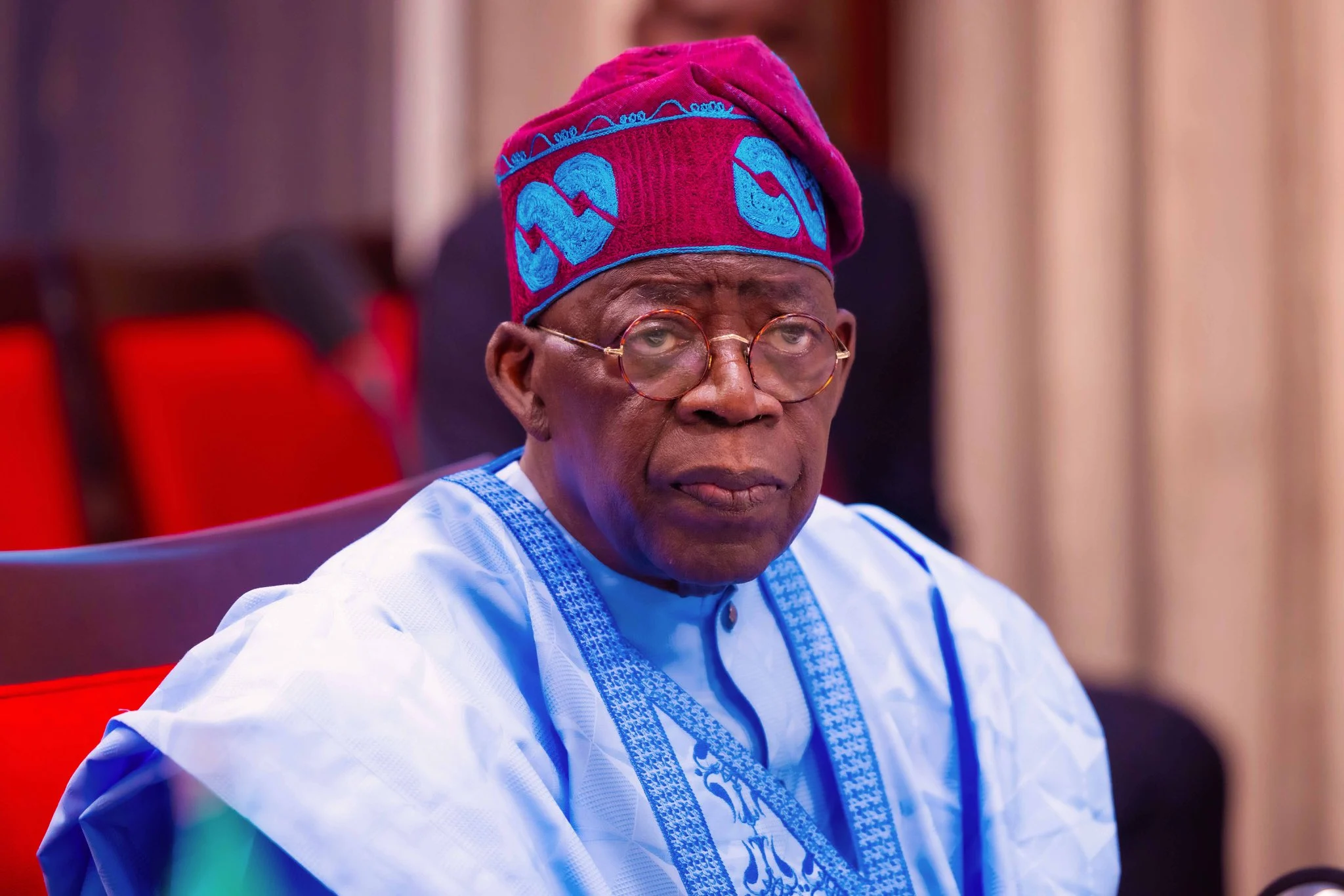
The publication of President Bola Tinubu’s nomination documents for the 2027 presidential election by the Independent National Electoral Commission has revived public scrutiny over his academic credentials after his personal particulars did not include entries for primary and secondary school certificates.
The Punch reported that the omission has sparked fresh political controversy, with opposition figures demanding explanations from both the President and INEC, while others argue that the matter has already been resolved by the courts and should no longer dominate national discourse.
The debate followed INEC’s release on Saturday of the nomination forms and supporting documents of presidential and vice-presidential candidates in line with preparations for the 2027 general election.
An examination of Tinubu’s EC9 nomination form showed that he listed only a Bachelor of Science degree in Business Administration obtained from Chicago State University as his educational qualification.
The sections designated for primary and secondary school certificates were left blank.
However, copies of his university degree certificate and National Youth Service Corps certificate accompanied the nomination papers.
According to the form, Tinubu was born on March 29, 1952, in Lagos and identified his occupation as “Politician.”
His employment history stated that he worked with Mobil Nigeria Limited from 1983 to 1992 before serving as Governor of Lagos State between 1999 and 2007.
The President also indicated that he has been employed by the Federal Government since 2023 and declared that he had never been dismissed from public service.
Reacting to the development, the National Publicity Secretary of the National Democratic Coalition, Osa Director, said questions surrounding the omission should be directed at the President and his aides.
He said, “It is so disappointing that this is what we are talking about. Again, I believe that we are just raising this question for academic purposes. We don’t know the answer to our question. That is, those certificates are not there. So, it is what it is.
“But I think this question should be directed to the appropriate quarters, that is to the President and his aides, not to us in the opposition.
“Let them tell us why the President’s secondary school and primary school certificates are not there. We all know that you cannot graduate from university without attending basic school.
“They should be able to tell us what happened to them. Because when you fill out forms online and to submit, it will reject your submission, saying you have not completed filling in all the necessary information.
“So, I am surprised that this form went through INEC, knowing it was not filled.
“INEC also has a question to answer by accepting that form when the information was incomplete, though we also have to commend them for having the guts to publish it for all Nigerians to see the gaps. So, over to the President.”
Similarly, the spokesman for the Kwankwasiyya Movement, Habibu Muhammed, maintained that the concerns being raised were valid and deserved clear answers.
“I think the constitution is very clear as to the minimum qualification one should possess before becoming the president.
“Sometimes you wonder what exactly that means because when they say something is minimal, it means it is the basic requirements. When such is not available, I think one should begin to ask what happened.
“So, Nigerians are legitimately demanding answers, actually. And I think they have every reason to do so.
“It doesn’t matter whether somebody got away with it the first time (2023). Let it be scrutinised and proven.
“If that means a violation of the law or shortcomings, I think there is really nothing more important than making sure that the right thing is done at whatever point it was discovered.
“So, I think it is a legitimate question that Nigerians are asking and a solid explanation should be given – be it through the decision of the courts or any kind of pronouncement by the Supreme Court – for us to be clear.
“You don’t expect people to build a house without a foundation at all. And the foundation for any academic qualification lies in the primary and secondary schools.
“We need to have a definite position of the law on the subject matter so that people will stop speculating or doing guesswork. That will continue to guide our politicians and their inter-political life.”
Offering a different perspective, Labour Party National Publicity Secretary Ken Asogwa argued that the issue should be assessed strictly within the framework of the law.
He said, “But the law allows him to tender that B.Sc without the other documents that are assumed he would have got before getting the B.Sc. So if the law permits that, I don’t see the hue and cries over it.
“Unfortunately, this matter has been litigated up to the Supreme Court, which threw the case out in the last election.
“However, I agree with you that for anyone to say he earned a B.Sc, it is assumed that you should have had your First School Leaving Certificate and WAEC that enabled you to proceed for B.Sc.
“But, as I said, it is a matter of law. For me, it bothers more on the moral aspect, which has nothing to do with his eligibility at this point.
“So I think we should concentrate efforts on the credibility of this coming election and what should be done to appeal to voters and win the confidence of Nigerian electorates, other than his qualification.
“Otherwise, it will be a total waste of time for the opposition to be dwelling on that.”
Also commenting, the National Chairman of the New Nigeria Peoples Party, Major Agbo, advised anyone dissatisfied with the President’s declaration to seek judicial interpretation rather than rely on public opinion.
“The truth is that the position of the law states that the minimum qualification is secondary school, that is either GCE, SSCE or whatever they call it. The implication is that a candidate can declare any certificate beginning from First School Leaving Certificate to WAEC.
“But in this country, we like putting the cart before the horse. If what INEC has published now is his certificate from Chicago University and people want to know whether he went through primary and secondary school, the right thing to do in a democracy is to ask the courts to help find out.
“For how long shall we continue to put our public officers through the court of public opinion? Again, how has that helped us in the past?
“Every Nigerian has the right to sue anybody who is a leader or aspires to be a leader. If he declares that he has a certificate from Chicago University, the law still covers him.
“The law states that you should declare anything that is not less than SSCE. And that is exactly what INEC has done. So if what was published is just a degree certificate, the right thing for anybody who wants to contest it to do is to approach the courts. Let’s stop dragging our leaders in the court of public opinion. It will not help us.”
The National Coordinator of the Obidient Movement Worldwide, Yunusa Tanko, however, insisted that the controversy had not been settled.
“There is no need for us to continue debating this. Every Nigerian knows this man is not qualified academically. This is a big issue.
“Until it is proven that he is qualified, the controversy will continue. It is disgusting and embarrassing for INEC to even post it the way it did.
“It is a condemnable act because we know he is not qualified. It is a terrible thing, and we need to challenge it,” he said.
The issue gathered further momentum on Sunday after African Democratic Congress chieftain Dino Melaye alleged that Tinubu failed to submit his primary and secondary school certificates to INEC.
Melaye questioned how the President secured admission into a foreign university without first obtaining basic educational qualifications.
In a post on his X account, he wrote, “See what Tinubu submitted to INEC, no primary, no secondary school, no Nigerian classmate…”
Tinubu, the All Progressives Congress candidate, is seeking a second term in office in the 2027 presidential election.
The renewed attention to his educational records comes more than three years after similar questions formed part of the legal challenges arising from the 2023 presidential election.
While those disputes eventually reached the Supreme Court, INEC’s latest publication of the President’s nomination documents has once again reopened public debate, with political stakeholders divided over whether the matter presents a legal issue or simply a moral and political one.