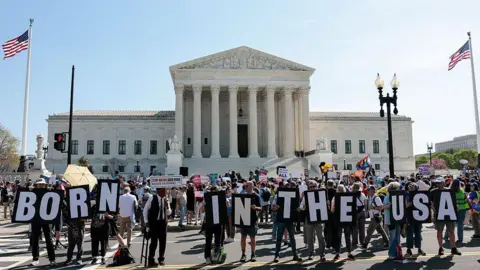
President Donald Trump suffered a major legal setback on Tuesday after the U.S. Supreme Court blocked his bid to restrict birthright citizenship, ruling that the policy violated long-standing constitutional protections.
In a 6-3 decision, the court struck down an executive order Trump signed on January 20, 2025 — the opening day of his second term — which sought to limit automatic citizenship for children born on American soil.
Five justices concluded that the measure conflicted with the 14th Amendment of the U.S. Constitution, which has traditionally been interpreted to grant citizenship to nearly everyone born in the country.
Conservative Justice Brett Kavanaugh agreed that the order could not stand, although he argued that it breached federal law rather than the Constitution itself.
The ruling marks Trump’s third major defeat at the Supreme Court in recent months. In February, the court invalidated his broad tariff measures, while on Monday it ruled that he could not immediately remove Federal Reserve governor Lisa Cook from office.
Despite the court’s conservative 6-3 makeup, including three justices appointed by Trump, the president failed to secure support from a majority of the bench on the citizenship issue.
Chief Justice John Roberts, writing for the majority, said there was little basis for the administration’s attempt to reinterpret a constitutional principle that has been accepted for generations.
“Citizenship then and now, was the right to have rights — to freely participate in our political community,” he wrote.
Roberts noted that the 14th Amendment was adopted after the Civil War to guarantee citizenship rights to all people, including formerly enslaved individuals.
“We keep that promise today,” Roberts said.
Justices Clarence Thomas, Samuel Alito and Neil Gorsuch dissented, arguing that the Constitution could permit Trump’s proposal.
The 14th Amendment provides that: “All persons born or naturalized in the United States, and subject to the jurisdiction thereof, are citizens of the United States.”
Trump’s executive order would have restricted citizenship at birth to children with at least one parent who is either a U.S. citizen or a lawful permanent resident.
Children born to temporary visitors or undocumented immigrants would not automatically receive citizenship.
In his dissent, Thomas argued that the amendment’s original purpose was tied to the status of formerly enslaved Black Americans.
“Blacks were entitled to citizenship because they were Americans. They had no other homeland, owed no allegiance to any foreign power, and were subject to no other authority,” he wrote. “The same could not be said for the children of foreign temporary visitors.”
Alito, in a separate dissenting opinion, criticized the ruling, saying it “preserves a powerful incentive to enter or remain in this country illegally,” and argued that it imposes a “medieval rule” of citizenship that even the United Kingdom, where the concept originated, has abandoned.
The executive order never took effect after lower courts swiftly blocked it following its signing.
Responding to the judgment, Cecillia Wang, National Legal Director of the American Civil Liberties Union, welcomed the outcome.
“The court’s decision reaffirms a fundamental American promise — if you are born here, you are a citizen. A president cannot change the Constitution by executive fiat,” Wang said in a statement.
For more than 100 years, birthright citizenship has generally been understood to apply to anyone born in the United States, except in limited circumstances such as children of foreign diplomats.
Federal immigration legislation enacted later adopted similar wording, including the phrase “subject to the jurisdiction thereof.”
The majority also relied on the landmark 1898 Supreme Court case United States v. Wong Kim Ark, which confirmed that a man born in San Francisco to Chinese parents was entitled to U.S. citizenship.
Roberts said the legal arguments advanced by the Trump administration mirrored those rejected by the court in that historic case.
“But this view commanded only a dissent in 1898, and neither time nor circumstance has changed the fact it is not the law,” he wrote.
The executive order faced multiple legal challenges from Democratic-led states and civil rights organisations. Courts at every level that reviewed the policy ruled against the administration.
The Supreme Court agreed in December to hear a case originating from New Hampshire, where the ACLU represented several plaintiffs, including children who would have been directly affected by the order.