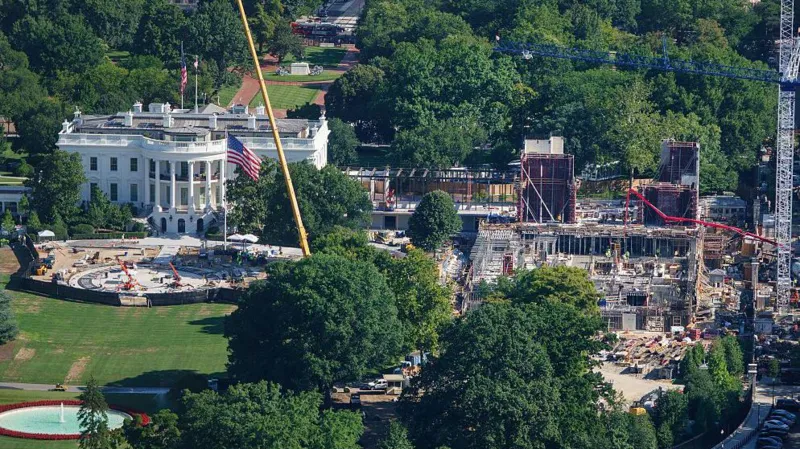
The United States Supreme Court has temporarily allowed President Donald Trump’s administration to continue construction of a proposed ballroom at the White House, putting on hold a lower court order that would have halted the work.
The order issued Friday by Chief Justice John Roberts does not determine whether the project is lawful. Instead, it temporarily suspends the lower court ruling while the justices consider the administration’s request to keep construction going indefinitely.
The Supreme Court did not set a new deadline for the stay, meaning work on the project can continue until the justices issue another order.
Because Roberts issued the administrative stay alone, the order contained no explanation, vote count or dissent.
He is expected to refer the case to the full nine-member court.
Construction has advanced rapidly in recent weeks.
According to a filing by the Trump administration, about 250 workers have been operating 20 hours a day, seven days a week, and the entire ballroom complex is now about 65% complete.
Trump welcomed the Supreme Court’s intervention, saying on social media, “We are grateful for the Decision of the United States Supreme Court,” Trump said.
“The Military/Ballroom Complex being built on the hallowed grounds of the White House, which is so vital for National Security, will be THE GREATEST OF ITS KIND! It is something that Presidents have wanted for 150 years, and that the Military has been seeking for the last 100 years.
Their wish will soon be fulfilled! Construction is under budget and ahead of schedule.”
The legal dispute began after the National Trust for Historic Preservation sued the administration over the project in December.
A federal judge in Washington, Richard Leon, subsequently ordered the administration to stop work on the ballroom until Congress authorised the project.
Leon, however, allowed construction of a sophisticated underground bunker to continue after the Trump administration argued that the bunker was separate from the ballroom.
As the project progressed, Trump and senior administration officials increasingly linked the entire development to national security, pointing to previous attempts on the president’s life.
The US Court of Appeals for the DC Circuit later upheld Leon’s decision in a 2-1 ruling, ordering construction of the ballroom to stop from August 21.
“Whether or not a massive ballroom should be constructed is for Congress to decide and is not a matter for Executive self-help,” the appeals court said.
“The National Trust has shown, compellingly, that Congress has not ceded unfettered authority to the Executive Branch to dramatically redesign, reshape, and reconstruct the White House, the People’s House – to fit a particular President’s desires,” the court added.
The Trump administration then appealed to the Supreme Court. Solicitor General D.
John Sauer argued that the ballroom was necessary for national security and presidential protection, while also defending the president’s authority to alter the White House grounds.
“The President of the United States of America is not a tenant, but rather the sole, elected head of the Executive Branch, and Congress has authorized him to renovate, secure, and protect the White House and its grounds, as other Presidents have been allowed to do, without exception,” Sauer wrote.
The administration also challenged the National Trust’s legal standing to bring the case.
Lower courts have ruled that the organisation has standing because one of its members, architectural historian Alison Hoagland, claims the project has affected her ability to enjoy and study the White House as a historic structure.
Trump has dismissed that argument, saying, “The woman has absolutely no standing.”
The National Trust has warned that the administration’s rapid pace of construction could make the project increasingly difficult to reverse if the courts ultimately rule against it.
The group said after Friday’s Supreme Court order, “We are aware of the administrative stay. To be clear, this is not a final decision on the merits of the government’s stay application, and we await further action.”
The cost of the project has also become a major point of controversy.
The administration initially estimated the ballroom at $200 million, while Trump later said the cost would be around $300 million. More recently, he said nearly $400 million had already been spent.
Internal contracts and documents obtained by The Washington Post reportedly put the combined cost of Trump’s various changes to the White House complex, including the ballroom, Rose Garden, helipad and other projects, at about $900 million.
For now, construction will continue as the Supreme Court considers the broader legal battle over whether Trump has the authority to undertake the massive redevelopment without prior congressional approval.