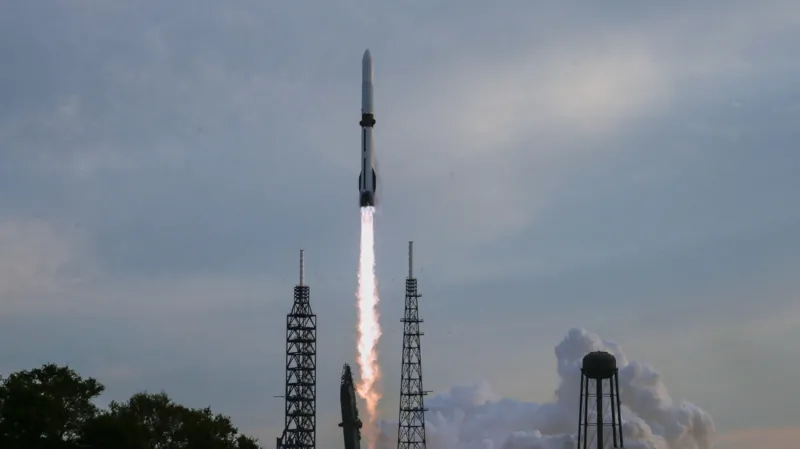
A fireball that illuminated the sky over Florida’s Kennedy Space Center on Thursday night has raised fresh doubts about Jeff Bezos’ Jeff Bezos and his space company Blue Origin, as questions mount over its ability to meet a series of critical commitments to NASA, including missions tied to a future Moon base.
The incident occurred when Blue Origin’s New Glenn rocket exploded around 21:00 local time during a routine engine test.
The 98-metre (322-foot) vehicle had been preparing for a mission to deploy 48 satellites for Amazon’s low-Earth orbit broadband project, ahead of a planned launch window as early as 4 June.
The failure represents a significant blow to the Leo constellation, formerly known as Project Kuiper, which is intended to compete with SpaceX’s Starlink network. However, analysts say the impact extends far beyond commercial internet competition.
No injuries were reported. “All personnel are accounted for and safe,” Bezos wrote on X. “Very rough day, but we’ll rebuild whatever needs rebuilding and get back to flying. It’s worth it.”
Despite that reassurance, the explosion caused major damage at Space Launch Complex 36 (LC-36). Video footage shows a lightning protection tower collapsing in the aftermath.
The site is currently the only facility equipped to launch New Glenn, meaning Blue Origin is now without an operational pad for its largest rocket. Industry observers expect repairs and recertification could take months.
The timing is particularly sensitive, coming just days after NASA administrator Jared Isaacman announced the first set of missions under the agency’s lunar base programme, which he described as the beginning of a “permanent presence” at the Moon’s south pole.
A key element of that plan, Moon Base 1—is scheduled to fly on Blue Origin’s robotic Blue Moon Mark 1 “Endurance” lander, targeted for launch no earlier than autumn 2026.
The mission is designed to deliver two NASA science payloads to the Shackleton Connecting Ridge and test precision landing systems needed for future crewed missions.
However, the lander was expected to launch aboard the New Glenn rocket family, the same system now affected by the LC-36 destruction, raising immediate concerns about whether that timeline remains achievable.
Earlier this week, NASA also awarded Blue Origin a contract worth up to $468 million to deliver two commercial lunar terrain vehicles, built by Astrolab and Lunar Outpost, to the Moon’s south pole by 2028.
These rovers are intended to arrive ahead of astronauts, with NASA currently targeting a crewed lunar landing in 2028, although that schedule was already under scrutiny.
The failed rocket had also been scheduled to carry 48 satellites for Amazon’s Leo broadband constellation.
Only around 300 satellites are currently in orbit, all launched by competitors including SpaceX, United Launch Alliance, and Arianespace, rather than Blue Origin itself.
The gap between Amazon’s system and Starlink, now exceeding 10,000 satellites in orbit, has become a major commercial challenge for Bezos’ space ventures.
Under its Federal Communications Commission licence, Amazon is required to deploy half of its 3,236-satellite network by 30 July 2026.
As of late May, it was more than 1,300 satellites short, with delays partly attributed to “launch vehicle availability” across Blue Origin and other providers.
With New Glenn now grounded indefinitely pending repairs, Amazon may be forced to rely even more heavily on rival launch providers, including SpaceX, and is increasingly likely to seek an extension from regulators.
Reacting to footage of the explosion, SpaceX CEO Elon Musk posted on X: “Most unfortunate. Rockets are hard.”
NASA’s upcoming Artemis III mission, currently scheduled for next year, is intended as a key step in returning humans to the Moon and will involve commercial lunar landers developed by both Blue Origin and SpaceX.
Until recently, Blue Origin was viewed as slightly ahead in readiness, with its Mark 1 demonstrator nearing final assembly in Florida, while SpaceX’s Starship system has yet to demonstrate full in-space propellant transfer.
The setback now places additional pressure on NASA’s broader lunar ambitions, including its goal of establishing sustained operations on the Moon by 2028.
Many elements of that plan depend on New Glenn-class heavy lift capability and associated lunar delivery systems.
NASA administrator Jared Isaacman responded to the incident on X, saying, “Spaceflight is unforgiving, and developing new heavy-lift launch capability is extraordinarily difficult.”
But with key launch infrastructure damaged and multiple lunar missions tied to the affected rocket system, the latest failure is likely to intensify concerns about whether NASA’s accelerated Moon programme can stay on schedule.