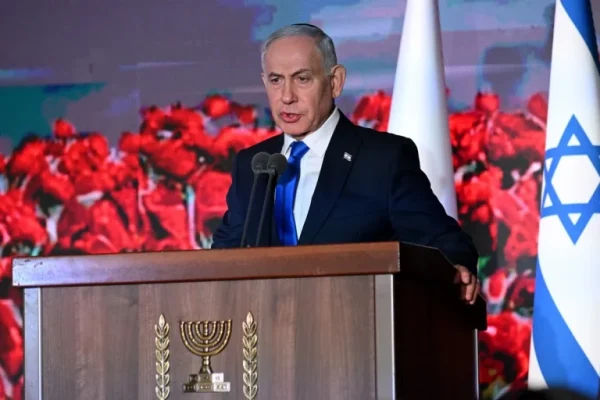
Israeli Prime Minister, Benjamin Netanyahu, said early Monday that he had directed “relevant authorities” to permit Cardinal Pierbattista Pizzaballa, the Latin Patriarch, access to Jerusalem’s Church of the Holy Sepulchre on Palm Sunday so he could “hold services as he wishes.”
The announcement followed strong criticism after church leaders were blocked from entering the holy site on Sunday.
According to the Latin Patriarchate in Jerusalem, Israeli police prevented senior church officials from accessing the church to celebrate Palm Sunday Mass, marking what it described as an unprecedented action.
“For the first time in centuries, the Heads of the Church were prevented from celebrating the Palm Sunday Mass at the Church of the Holy Sepulchre,” the Patriarchate said in a statement on Sunday. “This incident is a grave precedent and disregards the sensibilities of billions of people around the world who, during this week, look to Jerusalem.”
Palm Sunday signals the beginning of Holy Week, one of the most important periods in Christianity, commemorating Jesus Christ’s entry into Jerusalem.
The Church of the Holy Sepulchre is traditionally regarded as the place of Jesus’ crucifixion, burial and resurrection.
The restrictions come as Israeli authorities tighten access to major religious sites in East Jerusalem during the ongoing conflict with Iran. Sites including Al Aqsa Mosque and the Western Wall have faced limitations due to security concerns.
Although Israel has fought several wars since taking East Jerusalem from Jordan in 1967, broad restrictions on access to holy sites during important religious observances have remained uncommon.
In a post on X, Netanyahu argued that “Iran has repeatedly targeted the holy sites of all three monotheistic religions in Jerusalem with ballistic missiles” in recent days. He added that one missile landed just “meters from the Church of the Holy Sepulchre.”
Israeli police later said a limited prayer arrangement had been approved for the Church of the Holy Sepulchre in coordination with a representative of the Latin Patriarch.
The arrangement followed a security review led by Jerusalem District Commander Deputy Commissioner Avshalom Peled and senior officers.
Police also confirmed that other religious sites, including the Western Wall Plaza and the Temple Mount compound, remain closed to worshippers because of public safety concerns.
Italy reacted strongly to the restrictions, criticizing the decision to block church leaders from the site and announcing plans to summon the Israeli ambassador in Rome.
The Patriarchate had already cancelled Jerusalem’s traditional Palm Sunday procession because of the conflict, which has seen Iran launch thousands of projectiles toward Israel.
The Patriarchate said the two senior church officials, including Cardinal Pierbattista Pizzaballa, “were stopped en route, while proceeding privately and without any characteristics of a procession or ceremonial act, and were compelled to turn back.”
Preventing them from entering the church “constitutes a manifestly unreasonable and grossly disproportionate measure,” it added.
The Patriarchate further accused Israeli authorities of making a “hasty and fundamentally flawed decision, tainted by improper considerations.”
Netanyahu’s office insisted there was “no malicious intent whatsoever” behind the restrictions, saying they were motivated only by concern for the safety of worshippers.
“However, given the holiness of the week leading up to Easter for the world’s Christians, Israel’s security arms are putting together a plan to enable church leaders to worship at the holy site in the coming days,” Netanyahu’s office added.
Israeli police maintained that all holy sites in Jerusalem’s Old City had been “closed to worshippers, particularly locations that do not have standard protected spaces, in order to safeguard public safety and security.”
“The Old City and the holy sites constitute a complex area that does not allow access for large emergency and rescue vehicles,” the police said in a statement.
Authorities have also sharply restricted access to other holy places. Jewish worshippers at the Western Wall have been limited to 50 people per day, while Muslims have been entirely barred from Al Aqsa Mosque since the conflict began in late February, including throughout Ramadan.
US Ambassador to Israel Mike Huckabee also criticized the decision, describing it as “an unfortunate overreach already having major repercussions around the world.”
He noted that churches, synagogues and mosques across Jerusalem “have met with the restrictions of 50 or less” because of security concerns.
“For the Patriarch to be barred from entry to the Church on Palm Sunday for a private ceremony is difficult to understand or justify,” he said.
Italian Prime Minister Giorgia Meloni voiced support for Cardinal Pizzaballa and other Christian leaders.
“The Holy Sepulchre in Jerusalem is a sacred place of Christianity, and as such must be preserved and protected,” Meloni added. Preventing church leaders from entering the church “constitutes an insult not only to believers, but to every community that recognizes religious freedom,” Meloni said.
Italian Foreign Minister Antonio Tajani also condemned the decision on X, describing it as unacceptable. He said he had instructed Italy’s ambassador in Israel to formally protest and planned to summon the Israeli ambassador in Rome on Monday.
During Palm Sunday Mass at the Vatican, Pope Leo said God rejects the prayers of leaders who wage war and have “hands full of blood.”
He added that his prayers are “more than ever with the Christians of the Middle East, who are suffering the consequences of a brutal conflict and, in many cases, are unable to observe fully the liturgies of these holy days.”
Speaking before tens of thousands gathered in St. Peter’s Square, the pope described the conflict as “atrocious” and insisted Jesus must not be used to justify war.
Earlier this month, Saudi Arabia, Jordan, the United Arab Emirates, Qatar, Indonesia, Pakistan, Egypt and Turkey also criticized Israel’s continued closure of the Al Aqsa Mosque compound to Muslim worshippers.
The eight Muslim-majority countries said the discriminatory and arbitrary restrictions on access to religious sites amounted to a “flagrant violation” of international law.